



Tailored services take fans out to the ballpark
L.A. Metro is offering its Dodgers Stadium Express bus service for free to ticket holders, while Minneapolis’ Metro Transit brought fans to Target Field for the third year.
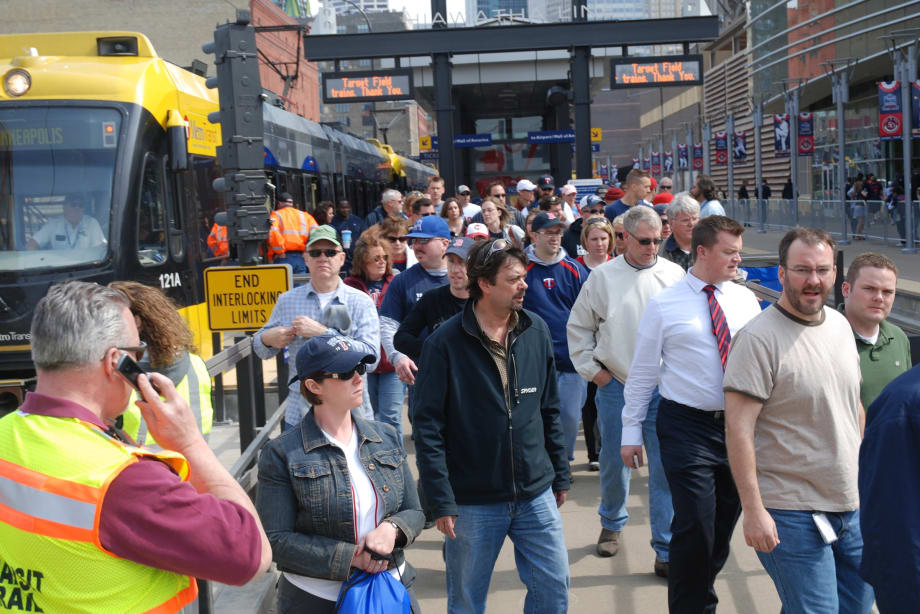
Metro Transit began moving fans for the third season to the recently opened Target Field, which was built with access to public transportation in mind.
Metro Transit began moving fans for the third season to the recently opened Target Field, which was built with access to public transportation in mind.
With the Major League Baseball season underway, transit agencies around the nation are tailoring services to help move fans to and from ballparks. One such service is even being funded by a state grant, while another partners with the local teams to promote the service.
In Los Angeles, the Los Angeles County Metropolitan Transportation Authority (L.A. Metro) offered its Dodger Stadium Express bus service from its downtown Union Station for the fourth year in a row. Opening day ridership for the service, which is free for fans with a valid game day ticket, grew from 4,326 riders last year to 5,787 in 2013.
A two-year grant worth more than $1.1 million ($1,169,000) awarded to L.A. Metro by the Mobile Source Air Pollution Reduction Review Committee (MSRC), a branch of the local Air Quality Management District, will fund the operation for the next two seasons. The funding is made in support of clean fuel transit service to link Union Station to Dodger Stadium.
Last year under a similar grant from the MSRC, the Dodger Stadium Express bus service transported more than 136,000 fans.
A 2012 Metro riders’ survey showed more than 84% of customers used public transportation from their place of origin to Union Station to connect with the Dodger Stadium Express, taking advantage of the regional rail and bus network to get from their home or work to the games. An estimated 79% of transit riders to the games used L.A. Metro’s rail or bus service. The survey also revealed 53% of the Dodger Stadium Express passengers are repeat customers.
Because of those survey numbers, the agency is expecting further ridership growth as the season continues.
“We always project growth, especially this year with the new Dodgers ownership team and the excitement surrounding that,” explained L.A. Metro spokesperson Rick Jager. “We definitely expect games to be sellouts and more people to take advantage of the service.”
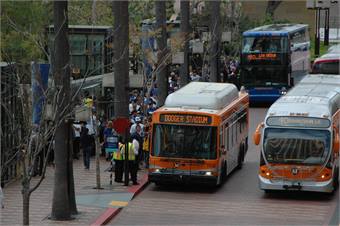
A two-year grant worth more than $1.1 million grant will fund Dodger Stadium Express operations for the next two seasons.
New for this year through an agreement with the Los Angeles Department of Transportation, the Dodger Stadium Express bus service will use a dedicated bus lane on Sunset Boulevard where traffic congestion is expected to be heaviest along the route to help expedite trips to and from the games.
Meanwhile in Minneapolis, Metro Transit began moving fans for the third season to the recently opened Target Field, which was built with access to public transportation in mind.
“Our Hiawatha light rail line comes in feet away from a gate at bridge level [of the stadium], and then at ground level, is our Northstar commuter rail line,” said John Siqveland, public relations manager for Metro. “We also have a lot of regular route and express bus service that serves the downtown area or the stadium directly, as well as an express route, branded the Twins Express, which goes from a large park-and-ride in the west metro area and comes into the stadium on an HOT lane.”
Additionally, the Interchange, a con-struction project led by Hennepin County, is currently taking place adjacent to the ballpark and will extend the platform area for transit to accommodate fans using Hiawatha service, which will be rebranded the Blue Line, or the Green Line from St. Paul, beginning next season.
Siqveland added that last season Metro transported about 12%, or somewhere between one in five to one in 10 baseball fans to any given Twins game, depending on the opponent. Growth is expected for 2013; however, ridership ultimately depends on how well the team is playing.
“We always expect growth. The first year the stadium opened, there was a lot of excitement about the stadium and the Twins had a great season, so we were seeing a higher share of rides because there were a higher number of people traveling to games,” said Siqveland. “The performance last year wasn’t what it was in the inaugural year, so we did see some ridership declines as a result of that. This year, everybody is just hoping for a good season.”
Both transit agencies work with their local baseball teams to market each other both inside and outside the ballparks and transit vehicles, including wrap buses, announcements and marketing signs during the games, and take ones and on pocket schedules.
New for this year in Minneapolis, Metro has a social media contest that encourages fans to take pictures of themselves using transit, with a monthly winner scoring four tickets and a $50 Metro smart card. The agency has also begun selling advance tickets to use its Northstar commuter line as well as a discounted family rate for both Northstar and the Twins Express.
More Bus

New York MTA Plans Largest Bus Fleet Upgrade in More Than a Decade
The agency is seeking manufacturers for 650 new CNG buses to replace aging vehicles, improve reliability, and advance its broader fleet modernization strategy.
Read More →
Building a Flexible Path to Transit Electrification
John Hroncich discusses BAE Systems’ modular and scalable approach, lessons learned from decades of real-world operations, and how agencies can identify electrification strategies that fit their fleets.
Read More →
Bus Tech Talk: Keeping Transit Technicians Ahead of the Technology Curve
LA Metro’s Obed Mejia discusses technician training, evolving maintenance technology, fleet replacement, and strategies for getting the most out of today’s transit fleets.
Read More →
Biz Briefs: RIPTA Unveils New Frontrunners, Clevland RTA Adds New Siemens, and More
In METRO's latest installment, we take a look at recent news from Siemens, Prevost, Dodge, and more partnerships making headlines across the transportation sector.
Read More →
People Movement: Holly Arnold Joins Transdev and More
In this edition, we also cover recent appointments and announcements at Pace, CamTran, MCI, and more, showcasing the individuals helping to shape the future of transportation.
Read More →
The High Cost of Transit Buses: Industry Leaders Look to Procurement Reform
Transit leaders and policymakers examine how standardized bus designs, streamlined procurement, and predictable funding could help agencies stretch budgets and deliver better service.
Read More →
The Business Voice Behind Public Transportation
As chair of APTA’s Business Members Board of Governors, Ray Melleady explains how more than 850 business members are partnering with transit agencies to advance funding, innovation, and industry-wide collaboration.
Read More →
From Surviving to Thriving: Building Stronger Transportation Organizations
Bus Business Consultants founder Brian Dickson shares lessons on leadership, organizational health, and creating options for long-term success in a changing transportation industry.
Read More →
Finding the ‘Happy Medium’: Optimizing Maintenance Without Sacrificing Reliability
The key to maintenance optimization isn’t doing less work—it’s doing the right work at the right time on the right assets.
Read More →
LA Metro, City of West Hollywood, and Partners Advance Smarter Bus Lane Enforcement
The award-winning partnership combines AI-powered detection with human oversight to improve bus reliability, accessibility, and enforcement efficiency.
Read More →