



Transit systems work to preserve trees along rail lines
Transit systems planning rail lines, such as Honolulu Authority for Rapid Transportation and California’s Sonoma-Marin Area Rail Transit, are working with their communities to preserve trees in the paths of proposed routes.


SMART is reviewing options to save a rare green and white Chimera Coast Redwood tree located within a planned railroad right-of-way.
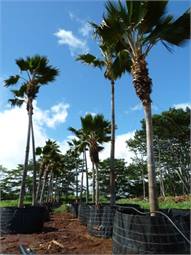
HART has transplanted 250 trees along its planned rail line with a 90% success rate.
Transit systems planning rail lines, such as Honolulu Authority for Rapid Transportation (HART) and California’s Sonoma-Marin Area Rail Transit (SMART), are working with their communities to preserve trees in the paths of proposed routes.
HART received high marks from The Outdoor Circle, a nonprofit environmental group, for measures it is taking to preserve up to 900 trees that will need to be removed to make way for a 20-mile rail line.
Marti Townsend, The Outdoor Circle’s executive director, told KITV4 that HART has done “an excellent job” ensuring that the trees they transplant survive.
In the first phase of the project, 300 trees have been removed and 250 of those have been transplanted elsewhere with a 90% survival rate, according to a report filed last month with the Honolulu City Council.
Additionally, some trees determined to be too valuable to lose have resulted in HART moving rail columns by a few feet to accommodate them.
“Some of the trees initially slated for removal or relocation were able to remain in place by making slight changes to the rail design and tree pruning,” Jeanne Mariani-Belding HART’s director, communications, said.
HART’s planning team meets regularly with The Outdoor Circle’s local chapter to go over the proper and safe relocation of trees. The working relationship includes group discussions and on-site visits, Mariani-Belding added.
HART’s Environmental Impact Statement identified which trees would be affected by the rail alignment. From there, the transit system’s project arborist evaluated the health, size and species of each tree to determine the best course, including which trees could be successfully transplanted, Mariani-Belding explained. The arborist also prepared a regularly updated plan that provides the status of each tree.
“The environment is a special part of Hawaii’s beauty, and we take special care to do all that we can to protect it,” she added.
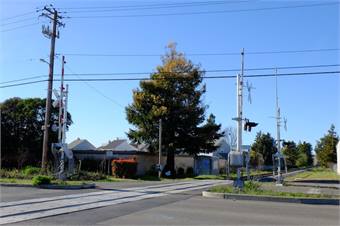
SMART is reviewing options to save a rare green and white Chimera Coast Redwood tree located within a planned railroad right-of-way.
Meanwhile, in March, SMART suspended the removal of a rare, green and white Chimera Coast Redwood tree located within a planned railroad right-of-way as it explores other options.
The community’s interest in the tree prompted the move, Matt Stevens, community and media relations, SMART, said.
An arborist hired by SMART conducted a study and identified the tree as a Chimera Redwood Tree, which has some chromosomes without chlorophyll, making it partially albino, Stevens explained.
The study also determined the tree is not naturally-occurring; it was raised in a nursery. The redwood was planted in the right-of-way of the historic 1850’s-era Northwestern Pacific Railroad approximately 45 years ago by a private individual, likely as a landscape ornamental, according to SMART.
Reviewing an option to meet the safety clearances through extensive pruning, the study concluded that in addition to requiring removal of all branches and foliage on the east side of the tree, the tree’s health would be undermined by the track construction and it could not survive in its present location. It would also become prone to wind throw, within falling distance of both the track and adjacent private property, creating a public safety hazard.
SMART will consult with additional independent experts to verify the report’s conclusions and continue to look at options to save the tree.
One of the options is to move the tree to another location. The City of Cotati has volunteered to accept the tree if moving it is the most viable option, Stevens said.
SMART is still making good progress on the project, he added.
“Our contractors are working in other areas while we evaluate our options. While it has slowed down construction in that area, it has not slowed down project construction in general,” said Stevens.
More Rail

New York MTA Advances Final Contract for Second Avenue Subway Expansion
Contract Four is the largest in the Second Avenue Subway Phase 2 project and includes construction of station infrastructure, tracks, and signals for the subway expansion, MTA officials said. Work on Contract Four will begin in 2027.
Read More →
San Diego MTS Breaks Monthly Trolley Ridership Record
Agency officials said July’s ridership indicates MTS’s continued recovery from the pandemic.
Read More →
Report Examines NJ TRANSIT Reliability, Funding Challenges
The Garden State Initiative analysis examines the roles of Amtrak infrastructure, fleet management, and agency operations while recommending a more performance-based approach to improving reliability.
Read More →
Stadler, CapMetro Sign Long-Term Rail Fleet Support Agreement
Beginning in 2027, Stadler will provide on-site technical expertise, spare parts support, training, and obsolescence management to help extend the reliability and longevity of CapMetro’s GTW fleet.
Read More →
Biz Briefs: Alstom Lands Canadian Contract, LYT to Supply California TSP, and More
In METRO's latest installment, we take a look at recent news from Complete Coach Works, Beep, FlixBus, and more partnerships making headlines across the transportation sector.
Read More →
CATS Gold Line Marks 5 Years of Service, 2.8M Passenger Trips
With a six-mile expansion planned, the Charlotte streetcar is positioned to connect more neighborhoods and major transit hubs across the region.
Read More →
Why Simulating Pedestrian Movement Has Become Essential for Modern Rail Stations
Pedestrian microsimulation is helping rail planners identify bottlenecks, test station designs, and prepare complex transit hubs for growing passenger volumes.
Read More →
Amtrak Begins Major Construction at New York’s Sunnyside Yard
The new maintenance facility will support Amtrak’s Airo trainsets while improving maintenance efficiency and turnaround times in New York.
Read More →
Chicago Leaders Unveil Plans for O’Hare Airport Express Train
The privately developed project would offer a 15-minute trip between downtown and O’Hare’s Terminal 2, with trains operating every 15 minutes on a dedicated track. The service would use battery-electric trains and three existing freight rail rights-of-way.
Read More →
OCTA Maps Out 30-Year Strategy to Protect Coastal Rail Corridor
The draft feasibility report identifies strategies to protect the coastal rail line for decades as the agency continues near-term stabilization and sand placement efforts.
Read More →