



Upgrading a Bus Facility for CNG: What You Need to Know
An often overlooked or misunderstood aspect of a compressed natural gas project is the garage upgrade. Upgrades are necessary to ensure safe operation with CNG vehicles in existing maintenance or vehicle storage facilities.
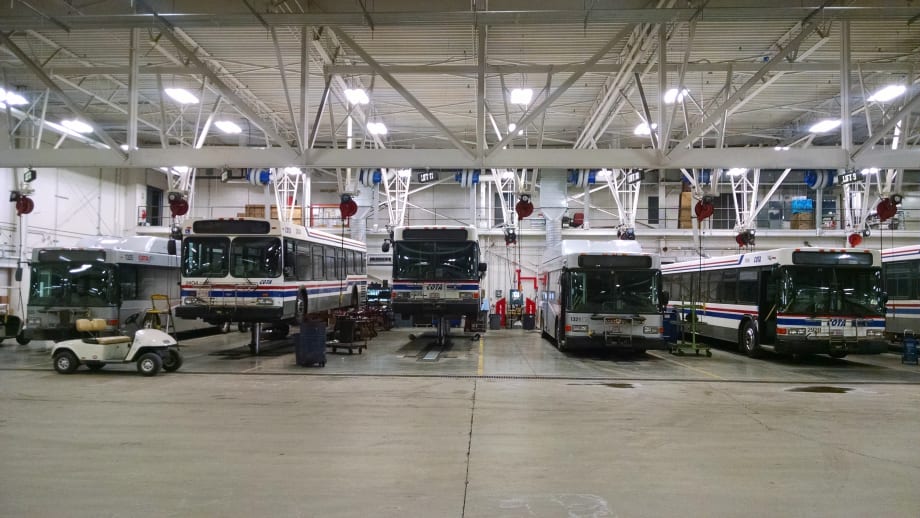
Compressed natural gas (CNG) has proven itself to be a very safe fuel in vehicle use around the world; however, like any fuel, there are risks that must be addressed. Existing maintenance facilities are generally constructed to safely house or facilitate maintenance of liquid-fueled vehicles, where the combustion risk is mostly at floor level. CNG is a lighter-than-air fuel, so the risk resides primarily near the ceiling, and to a lesser extent, in the zone between the vehicle and the ceiling. It is this area that is addressed in garage upgrades, primarily through heating and ventilating equipment changes.
While CNG upgrades are required to safely domicile CNG vehicles, the buildings must also meet all requirements of other fuels that might be present in the garage.
Follow Codes, Best Practices
Several U.S. codes provide guidance on required upgrades, but there is also ambiguity and conflict. For example, one code requires four air changes per hour (ACH) where another requires five ACH. A list of potentially applicable codes follows for facilities where CNG is not dispensed inside:
• International (or State) Building Code.
• International (or State) Fire Code.
• International (or State) Mechanical Code.
• National Fire Protection Association (NFPA) 30A Motor Fuel Dispensing Facilities and Repair Garages.
• NFPA 88A Standard for Parking Structures.
• NFPA 70 National Electrical Code.
The NFPA 52 Vehicular Gaseous Fuel Systems Code will also apply to facilities where CNG is dispensed indoors
Facility designers cannot pick and choose which code they wish to follow; they must meet the requirements of all applicable codes. Rather than providing a detailed review of each code, this article will instead consolidate and summarize the dominant code requirements. Because codes represent the minimum allowable requirements, gaps in codes must be filled using best industry practices, which are also summarized.
There are basically three types of buildings or rooms that require CNG upgrade. Codes require differing levels of upgrade depending on the use of the area:
1. Major repair facilities: Areas where vehicle body work, hot work or heavy repairs, such as engine overhauls, may be performed or where fueling system work may take place (this definition varies by code).
2. Minor repair facilities: Areas where no hot work or fuel system work takes place, such as an area for tire, brake and lubrication work.
3. Vehicle storage areas: Enclosed spaces used to park vehicles but not used for service repair. Indoor fueling facilities will not be addressed in this article — they require much more upgrade and cost than other parts of the facility and are a relative rarity in the CNG market.
While there are a number of risk scenarios to consider, a small or slow leak of gas into a large well-ventilated room poses a relatively low risk. The primary concern is the potential for a fast release and complete depressurization of one or all CNG tanks on the vehicle — in many vehicles, venting from one tank will empty all tanks. In the late 1990s, the CNG industry had a number of unprovoked releases from CNG vehicles in buildings through the failure of the vehicle’s pressure relief device (PRD), a device intended to release gas pressure in the event of a fire. These unprovoked PRD releases have effectively disappeared through design improvements, but the industry continues to design building upgrades to protect against such an event.
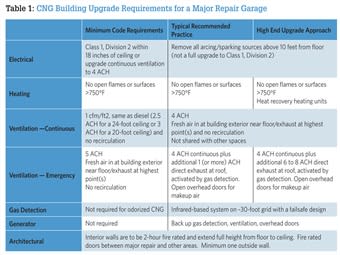
Table 1 shows upgrade requirements for a major garage repair. The most common and costly upgrades are the heating and ventilation systems. There are a number of heating and ventilation systems, including hydronic floor or unit heaters; warm air (direct or indirect fired) with unit outside of garage and 100% outside air; low temperature (<750°F) radiant tube heaters with ducted combustion air and sealed combustion; and rated catalytic task heaters.
The code requirements for storage areas are very low (see Table 22), but there have been releases in those spaces, so I recommend a more robust upgrade approach in those areas.
Defueling is Not a Viable Alternative
Defueling is the act of safely removing gas from cylinders and venting directly to the atmosphere or with recapture — the requirements of these systems are addressed in International Fire Code 2208.8 Discharge of CNG from Motor Vehicle Fuel Storage Containers.
It is not unusual for newcomers to the CNG industry to propose defueling any vehicle requiring indoor maintenance to reduce or eliminate garage upgrades. While this sounds appealing initially, defueling is time-consuming and wasteful, and creates other safety risks. Wide-scale defueling is not a practical alternative to building upgrades, and in fact, it should only be used when work involves repair or removal of a vehicle tank. Most well-managed fleets defuel very infrequently.
Use Common Sense & Safe Operating Procedures
Building upgrades are intended to allow the fleet to safely perform all required maintenance, repair, and storage of vehicles; however common sense and safe operating procedures must also be utilized. A partial list of recommendations follows:
1. Develop standard operating procedures (SOPs) and train and drill staff on their use.
2. If maintenance is required, try to avoid fueling the vehicle before bringing it into the shop. If a vehicle is inadvertently fueled, defueling is only recommended if high-pressure fuel system work is required where pressure isolation is not possible.
3. Do not bring a leaking vehicle into a building.
4. Use a handheld gas detector to check the vehicle for leaks prior to maintenance.
5. Isolate the tank valves on any vehicle in a maintenance shop overnight.
6. Maintain and test all building upgrade equipment including fans, gas detection, generators, etc.
Most facilities can be readily and cost-effectively upgraded for safe use with CNG vehicles. This article is intended to provide an overview of the issues involved in upgrading garages, but many design details have been omitted for brevity or may apply to unique site conditions. Given the gaps and ambiguities of current codes, fleets should consult with a design professional experienced with CNG upgrades to discuss code-compliant and cost-effective upgrades.
Rob Adams is the founder and principal of Marathon Corp. He can be reached at
radams@marathontech.ca.
More Technology

From Hardware to Digital Partner: Luminator Charts Its Next Chapter
CEO Magnus Friberg discusses Luminator’s shift toward becoming a digital partner, the growing importance of software and interoperability, and how AI can help agencies improve operations and passenger experience.
Read More →
Beyond the Checklist: A Structured Approach to Transit Maintenance
Reliability-Centered Maintenance helps transit agencies move beyond routine checklists to focus limited resources on the assets and failures that have the greatest impact on safety, reliability, and service.
Read More →
NJ TRANSIT Advances Bus Technology Upgrades Across Statewide Fleet
More than 1,500 buses now feature upgraded technology designed to improve arrival predictions and provide free Wi-Fi, with deployment expected to reach nearly 2,000 buses by the end of 2026.
Read More →

Building a Flexible Path to Transit Electrification
John Hroncich discusses BAE Systems’ modular and scalable approach, lessons learned from decades of real-world operations, and how agencies can identify electrification strategies that fit their fleets.
Read More →
Biz Briefs: Alstom Lands Canadian Contract, LYT to Supply California TSP, and More
In METRO's latest installment, we take a look at recent news from Complete Coach Works, Beep, FlixBus, and more partnerships making headlines across the transportation sector.
Read More →
From Legacy Silos to Conversational Intelligence
What if transit leaders could ask any operational question and get a trusted answer in seconds? Conversational AI is transforming how agencies use their data.
Read More →
USDOT Announces Rail Vehicle Replacement Grants, Chattanooga AV Shuttle Funding
More than $191 million in federal funding will help three transit agencies replace aging rail vehicles and support a new autonomous shuttle service in Chattanooga.
Read More →
Bus Tech Talk: Keeping Transit Technicians Ahead of the Technology Curve
LA Metro’s Obed Mejia discusses technician training, evolving maintenance technology, fleet replacement, and strategies for getting the most out of today’s transit fleets.
Read More →
Biz Briefs: RIPTA Unveils New Frontrunners, Clevland RTA Adds New Siemens, and More
In METRO's latest installment, we take a look at recent news from Siemens, Prevost, Dodge, and more partnerships making headlines across the transportation sector.
Read More →
Why Simulating Pedestrian Movement Has Become Essential for Modern Rail Stations
Pedestrian microsimulation is helping rail planners identify bottlenecks, test station designs, and prepare complex transit hubs for growing passenger volumes.
Read More →