



Vehicle Wash Systems: Keeping Fleets Clean & Green
Applications range from simple, single-brush models to fixed drive-through options. In an effort to go 'green,' some company's systems reduce the amount of water or chemicals used and feature high-efficiency motors to reduce energy usage.
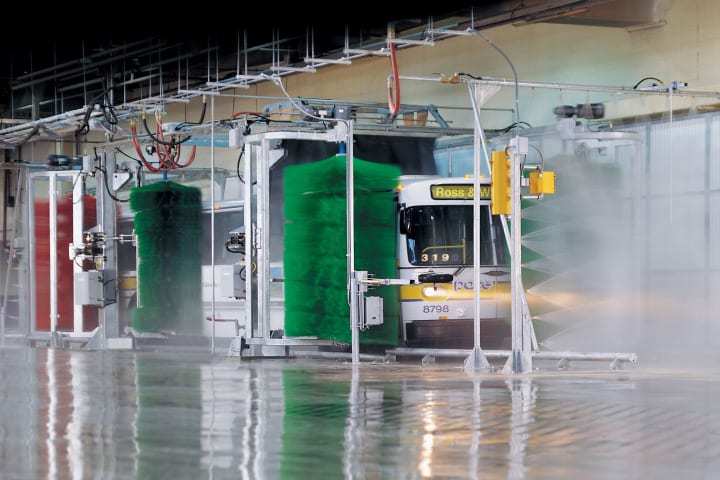
Ross & White’s most popular system is its hybrid system that uses both brushes and high pressure water.
Photo: Ross & White
One important facet of a transportation operation’s public profile is the state of its vehicles. An unclean fleet could tarnish its public image, which could have a negative impact on ridership, or for the private sector, on business.
Choosing the right vehicle wash system is a complicated decision. Consider the operation’s fleet size and goals when shopping for a wash system. Are there a dozen vehicles to wash each night or hundreds? Will the size of the facility be sufficient to install a full system or will it need to be expanded? Is initial cost more important than operating or long-term cost? How often will the vehicles be washed? It’s best to know the basics of such a critical investment, especially with new materials and systems that could save resources, time and money.
While keeping vehicles clean may seem to be inconsequential in the business scheme of things, it is a necessity. “Cleaning is at the bottom of your list because you have a lot of financial things — equipment buying, customers — [to think about],” says Martin Van Tol, president of Beamsville, Ontario-based ACC International. But when it comes down to what’s important, “a clean fleet means a clean image.”
Single Brush Keeps It Simple
For smaller fleets with limited budgets and insufficient space to install a full wash system, ACC’s single-brush system offers a solution. Its system consists of a large brush that spins as it is walked around the vehicle, propelling movement, brushing and rinsing in unison. As it does not require floor-mounted tracks, and the space can be used for other purposes when the brush is not in use, it is ideal for companies with limited space.
“We often fit in perfectly for smaller- and medium-sized fleets that wash by hand,” says Van Tol, citing the system’s lower cost as one of the main factors. However, according to Van Tol, ACC’s clients have fleets ranging from one vehicle to those numbering in the hundreds, so the company custom-makes its brushes for rail, buses, vans and other vehicles of various sizes.
Bitimec, with its U.S. headquarters in Greenwich, Conn., offers a similar single-brush system in six variations for different forms of transport. Its simplest design hooks up to overhead cables for water and power, but all other systems are fully autonomous and self-propelled. The Bitimec 626 runs on rechargeable battery power and can literally be taken to where the vehicle is parked.
“You fill up the tank with water, you fill the soap dispenser with soap, turn it on, charge the battery and you’re good to go,” says Tim Guldin, vice president of sales parts and marketing for ABC Parts Source, which is Bitimec’s distributor for the transit market in North America. The 626 model holds 112 gallons of water, good for four washes before a refill is necessary, while each battery charge is good for 40 washes, according to Guldin.
The Bitimec SEP 900, which runs on diesel power, was designed for the rail industry and contains a small cab driven by the operator. It comes with a single- or double-brush, with the top smaller brush at a slant to clean the curvature on the tops of rails.
The Production Factor
Although the convenience of bringing the wash to the vehicle is appealing, fixed wash bays are another option, as they not only require less manpower, but often run considerably faster for each vehicle wash. Jeff Ross, president of Cary, Ill.-based Ross & White, says his company’s fixed systems typically take between one and two minutes to complete a wash.
“Companies want production,” Ross says. “Most transits want to do their entire fleet [in one day], especially in the winter, so they want to do a nightly service in eight hours.”
Ross & White’s most popular system is its hybrid system that uses both brushes and high pressure water. Meeting the demand for a system with multiple functions, it is equipped with high pressure pumps for wheel, bike rack and undercarriage washing, which are areas that brushes normally cannot clean. The system also features water recycling.
A Compact Design
Smaller fixed-system options are available for vehicle operators that may not have the luxury of space. Headquartered in Detroit, Westmatic offers its Compact wash system that is both a full and fixed bus wash system, however, it utilizes less space. Ed Evans, director of sales and marketing, estimates its six-brush Compact, the most popular of the Compact options for operations, that include two- and four-brush, to occupy an area of 30 x 20 feet.
The Compact is a drive-through system that uses lights to signal the driver when to stop the car for the necessary procedure and when to start again to continue to the next step.
Alternative Materials
Plastic has been a popular material for brush construction, and although it does a thorough job of cleaning, it was considered damaging to vehicle paints and finishes. This led to the development of the touchless wash system — where high water pressure is used to loosen dirt. The touchless system is still in use, but its disadvantages lie in its excessive use of water and chemicals.
New brush materials claim to be less harmful for vehicle finish than plastic. NS Wash Systems, based in Inglewood, Calif., started using what it calls “lammscloth,” a synthetic lamb’s wool that is a softer fiber to prevent damage to the vehicle. Others use a combination of materials to get the best result; ACC uses polyethylene and foam in its brushes, the ratio of each depending on the type of vehicle to be washed, and Bitimec uses a brill brush that is a combination of bristles and foam.
Ross, however, stresses that brush material isn’t the only factor in keeping a clean exterior. “It does have some effect on it, but it’s more a function of applying detergent and water to the interface of the brush,” he says. “It’s also a function of the speed of the brush and the amount of air pressure that may be applied to a brush.” The right factors will result in no damage to vehicle finish, despite brush material, he says.
Biodegradable chemicals are now standard to the industry. Ross & White carries enzyme-based wash agents instead of the usual alkaline-based agent.
Reduce and Reuse
With the pressure of being green becoming more intense in recent years, vehicle wash manufacturers are coming up with better technology, with the goal of using fewer resources.
When wash systems were first developed, the idea was to pump a lot of water and soap on the car, says NS Wash Systems CEO Thomas Ennis. This resulted in waste of both chemicals and water, as only a percentage of what is blasted on adheres to the vehicle. Ennis’ company has developed the 5M series systems, which reduce the amount of resources used.
Many systems require a pump to increase the amount of water pressure for the wash. The 5M series uses just city water pressure and 20 gallons of water per minute, an estimated 75 percent decrease from what is used in normal wash systems. “By applying just enough to coat the vehicle, we get very little run-off,” Ennis says. Less water use results in a proportionate decrease in chemical use, and, Ennis adds, “We’re not even using a pump, so we’re cutting down on electricity as well as another maintenance issue.”
ACC’s brush is estimated to use only 3 to 5 gallons of water per minute, and because the brush does the scrubbing, fewer chemicals need to be used. Bitimec’s 626 uses 25 gallons per wash and Westmatic’s Compact wash system uses 80 gallons.
Reducing energy is another factor. NS Wash Systems has developed more energy efficient systems that use two- horsepower motors instead of five. Ennis estimates at least a 50 percent savings.
Westmatic’s green efforts, according to Evans, include high efficiency motors that use less electricity. In addition, using a HydroMinder to pre-mix chemical and water results in less waste, and an overlapping brush design for the front and rear of the vehicle, which tend to be the dirtiest, reduces water and chemical use.
Most systems are sold with water reclamation systems or are available as a separate option. The end result is an 80 to 90 percent water savings, which is reused in the first stages of the wash cycle. Installed systems with water reclamation range from more than one-half to nearly all, according to manufacturer estimates.
New green projects are also under way. “We’re starting to see some projects come through with rainwater capture for rinsing the buses as either pre-rinse or even final rinse,” Ross & White’s Ross says. The final rinse usually only utilizes clean, un-reclaimed water.
Things to Consider
Although unseen, the undercarriage could be trapping a considerable amount of dirt. Bike racks or wheels may also require special attention. Manufacturers often sell undercarriage and wheel cleaners in addition to their wash systems. Westmatic’s six-brush system is specifically designed for bike racks. “Brush numbers 3 and 4 are split-brush designs, so it’s able to wash the bike rack and thoroughly wash the front of the vehicle,” says Evans.
In addition to production speed and fleet size, budget is an important consideration in buying a system. ACC’s single-brush system costs range from $13,000 to $19,000. Bitimec’s autonomous 626 system ranges from $25,000 to $28,500. NS Wash’s 5M Bus Wash System costs between $55,000 and $155,000, depending on how the system is built. Ross & White’s hybrid, its top-of-the-line system, costs between $150,000 and $200,000, delivered and installed. The Westmatic Compact’s price ranges from $100,000 to $350,000. Its Twin Line system for rails starts at $350,000.
The life cycle of the system is another consideration, although most are built for extended use. Estimates range from 10 years to 30 years, however, actual life cycle depends on the system’s usage.
Before deciding on a system, many manufacturers recommend that companies speak with previous clients. “Salespeople always give you the best possible story, that’s what they’re hired for,” says ACC’s Van Tol. “Customers don’t care. They tell you what they like or what they don’t like.” He also recommends asking about after-sale service in case customers have questions or problems with their system down the line.
NS Wash Systems’ Ennis agrees, saying “I think word-of-mouth is the best thing going right now.” Customers can ask for a list of previous clients as well as contact numbers to get feedback on the company and products.
More Bus

New York MTA Plans Largest Bus Fleet Upgrade in More Than a Decade
The agency is seeking manufacturers for 650 new CNG buses to replace aging vehicles, improve reliability, and advance its broader fleet modernization strategy.
Read More →
Building a Flexible Path to Transit Electrification
John Hroncich discusses BAE Systems’ modular and scalable approach, lessons learned from decades of real-world operations, and how agencies can identify electrification strategies that fit their fleets.
Read More →
Bus Tech Talk: Keeping Transit Technicians Ahead of the Technology Curve
LA Metro’s Obed Mejia discusses technician training, evolving maintenance technology, fleet replacement, and strategies for getting the most out of today’s transit fleets.
Read More →
Biz Briefs: RIPTA Unveils New Frontrunners, Clevland RTA Adds New Siemens, and More
In METRO's latest installment, we take a look at recent news from Siemens, Prevost, Dodge, and more partnerships making headlines across the transportation sector.
Read More →
People Movement: Holly Arnold Joins Transdev and More
In this edition, we also cover recent appointments and announcements at Pace, CamTran, MCI, and more, showcasing the individuals helping to shape the future of transportation.
Read More →
The High Cost of Transit Buses: Industry Leaders Look to Procurement Reform
Transit leaders and policymakers examine how standardized bus designs, streamlined procurement, and predictable funding could help agencies stretch budgets and deliver better service.
Read More →
The Business Voice Behind Public Transportation
As chair of APTA’s Business Members Board of Governors, Ray Melleady explains how more than 850 business members are partnering with transit agencies to advance funding, innovation, and industry-wide collaboration.
Read More →
From Surviving to Thriving: Building Stronger Transportation Organizations
Bus Business Consultants founder Brian Dickson shares lessons on leadership, organizational health, and creating options for long-term success in a changing transportation industry.
Read More →
Finding the ‘Happy Medium’: Optimizing Maintenance Without Sacrificing Reliability
The key to maintenance optimization isn’t doing less work—it’s doing the right work at the right time on the right assets.
Read More →
LA Metro, City of West Hollywood, and Partners Advance Smarter Bus Lane Enforcement
The award-winning partnership combines AI-powered detection with human oversight to improve bus reliability, accessibility, and enforcement efficiency.
Read More →