



What Are The Real Costs, Value of High-Speed Rail?
With impacts including a shrinking number of vehicles and less road congestion currently being ignored when the financial feasibility of projects is being studied, a new economic value added model must be used to illustrate the total realizable benefits that can be obtained.
Long-term transportation challenges have impelled a number of governments around the world to embark on investment in high-speed rail (HSR) networks. In the U.S., HSR has been debated for a number of years, but the high costs involved have dominated the debate. This, coupled with a lack of understanding of the true value proposition and the related long-term issues surrounding domestic transportation is slowing much of the investment needed for projects to proceed.
To create a better understanding of the wider impact of HSR, including funding concerns, a new financing formula is needed. Looking at the situation through the same lenses as we have used in the past fails to take into account the wider economic impact HSR can have. We need a new view, a financial calculus, which embraces a broader economic footprint than the historical “Farebox Model” that tries, unsuccessfully, to cover the cost of these large-scale systems from farebox revenue. Crucially, this new formula could attract private capital to HSR by clearly presenting the total realizable benefits that can be obtained.
Investment needed
Congress has set out its two-year transportation spending plan for the U.S. Passed June 29 this year and signed into law by President Obama on July 6, the Moving Ahead for Progress in the 21st Century (MAP-21) surface transportation program has been hailed as a successful conclusion to over three years of political debate and is part of the economic regeneration and job creation program.
The bill consolidates nearly 100 programs, providing states with more spending flexibility. MAP-21 authorizes $101 billion of funding from the Highway Trust Fund over the next two fiscal years (FY2013 and 2014). The U.S. Department of Transportation (U.S. DOT) will make $17 billion available immediately.1 To help mobilize qualified, large-scale projects, $1.7 billion will go to the Transportation Infrastructure Finance and Innovation Act (TIFIA) Loan program through 2014.
But, the future of the industry still needs to be addressed because there is no clear sustainable revenue stream to fund the aging and increasingly congested transportation system. This is at the heart of discussions over HSR. In 2009, the launch of a High-Speed Intercity Passenger Railway (HSPIR) program was launched. Dubbed the most ambitious transportation program since President Eisenhower’s Interstate Highway System in the 1950s, the HSPIR plan made some early progress, with approximately $10 billion in federal grant money distributed to date.3
But, the huge cost involved in financing HSR has proved to be a stumbling block, particularly in light of renewed calls for reduced government spending. Outside the U.S., a number of countries, including France, Germany, Spain, China and Taiwan, have launched HSR investment programs to help solve some of their longer-term transportation challenges. Many argue that their economic growth and competitiveness depend, to a large degree, on the effectiveness of their transport networks and are subsequently investing in HSR. But, as much of the investment is still ongoing, the economics of these projects are still being scrutinized.
Much of this investment is predicated on a number of arguments: that compared to road travel, HSR wins out for speed, efficiency, comfort and safety; it represents a viable “green alternative,” with a significantly lower carbon footprint than alternative transport methods; and, crucially, it provides a longer-term solution to fluctuations in oil prices. We should consider updating calculations used to judge the financial impact of HSR, with economic values attributed to all of these points. [PAGEBREAK]
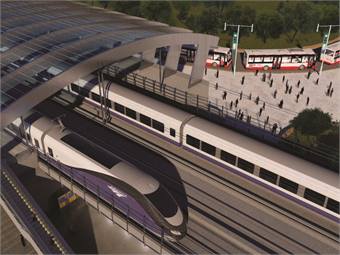
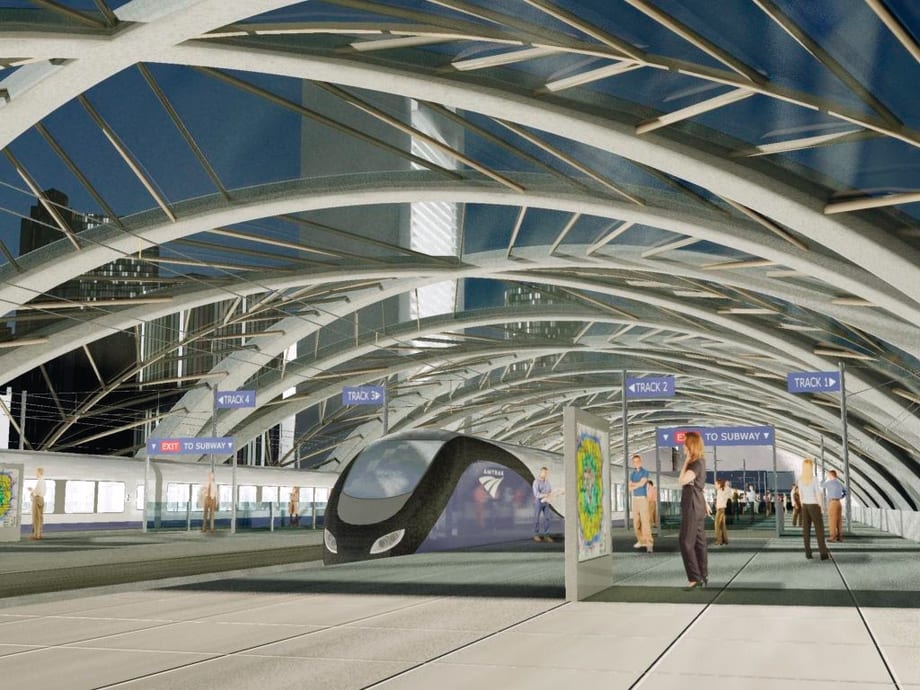
Amtrak outlined plans for a partly brand new and partly re-engineered, 426-mile, Northeast Corridor running from Boston to Washington, D.C. (rendering shown.)
A new math
There is no doubt that the development of HSR requires massive investment. Take as one example Amtrak’s September 2010 publication, “A Vision for High-Speed Rail in the Northeast Corridor.” Amtrak outlined plans for a partly brand new and partly re-engineered, 426-mile, Northeast Corridor running from Boston to Washington, D.C., introducing true high-speed rail in the Northeast Corridor.
The document has projected construction costs estimated by Amtrak at $117 billion in 2010 dollars.4 Like many other routes being proposed, calculating the financial impact using a standard “farebox” model will lead to the inevitable conclusion that it is not financially viable. There is, however, a financial calculus that is generally overlooked. This includes the pressure that HSR can take away from existing infrastructures. For example, where urban road systems are concerned, there are a number of key factors that can be heavily influenced by a robust HSR network. Modal shifting from automobiles to HSR reduces congestion on capacity-constrained road networks. This results in reduced transit times from home to work, which improves productivity by freeing people who might otherwise spend up to two hours a day commuting.
Shrinking the number of automobiles on the road network also cuts carbon emissions and saves fuel. All of these attributes have a definable, measurable economic value to society and they need to be factored into the business case for HSR. As things stand, current models give only a limited understanding of the value proposition for HSR, with an emphasis placed on the upfront costs of these projects — and less on the wider impact they may have.
Because a traditional economic model is still being applied, relying predominantly on fare-box revenues to cover both operating and capital costs, many of these projects risk being doomed from the start. An “out of the farebox” approach needs to be applied.
There is a view that, for HSR to get traction, private capital must be attracted. We need a new approach that will enable private capital to make economic sense out of the HSR proposition. And, that game-changer is putting an EVA (Economic Value Added) model to work to illustrate the total realizable benefits that can be obtained from HSR, and not just those derived from the farebox. The basic elements of this model are set out in the graphic on page 80. (source: Accenture)
The new model
A “New Calculus” needs to be created to recast the economic value proposition more holistically. The numbers in this example are illustrative only. But, one can see from the basic numbers in this example that EVA contribution goes from a net loss of $42 per passenger trip to a positive contribution of $173, when these wider issues are factored into the economic decision. This calculation puts a dollar value on all of the factors when considering the cost of taking a traveler from the car and putting them on the train, not just the sale of the ticket.
We need to consider this EVA model approach to help politicians, the public, and, crucially, private sector investors to get a complete view of HSR. Only then can decision-makers see the final economic impact of HSR. They can then decide if it should be incorporated into plans for a coordinated and linked intermodal strategy that leverages limited funds to maximum effect.
The key is getting people to look at HSR through a different lens. It can help us better understand if HSR projects can help our economy remain competitive, protect our environment and ease pressure on overloaded, and increasingly outdated, transportation infrastructures. This means going beyond the restrictive thinking of the past and toward the wider impact of an HSR investment.
Many are aware of the transportation challenges in the U.S. and elsewhere. From infrastructure deterioration to investment requirements, from congestion to rising fuel costs and from growing carbon emissions to lost productivity, the scale of these challenges should not be underestimated.
More Rail
New York MTA Launches Historic $1.9B Signal, Track Modernization Project
Funded in part by congestion pricing revenue, the project will replace nearly century-old signals along the A and C lines in Brooklyn and Queens.
Read More →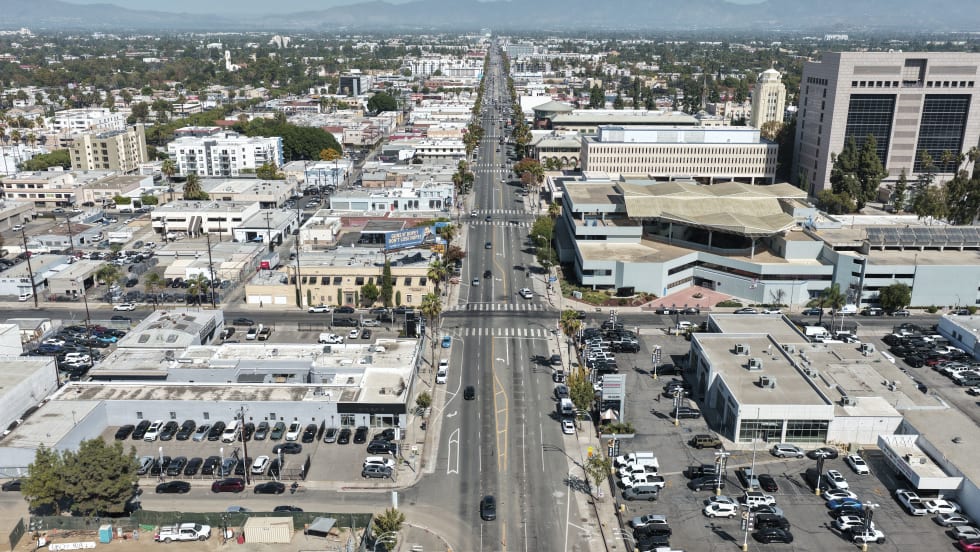
LA Metro Breaks Ground on East San Fernando Valley Light Rail Project
The 6.7-mile line will add 11 stations along Van Nuys Boulevard, expand access to jobs and regional transit connections, and support Metro’s broader efforts to improve mobility as rail ridership grows.
Read More →
CSA Group Releases Climate Resilience Standard for Transit, Passenger Rail
Developed with support from the Standards Council of Canada, CSA D700 guides assessing climate-related risks and planning adaptation measures for transit and passenger rail systems.
Read More →
LA Metro September Ridership Climbs 3.9%, Led by Rail Growth
The agency recorded more than 27.2 million boardings, with rail ridership increasing 12.4% year over year and the D Line posting the largest gains.
Read More →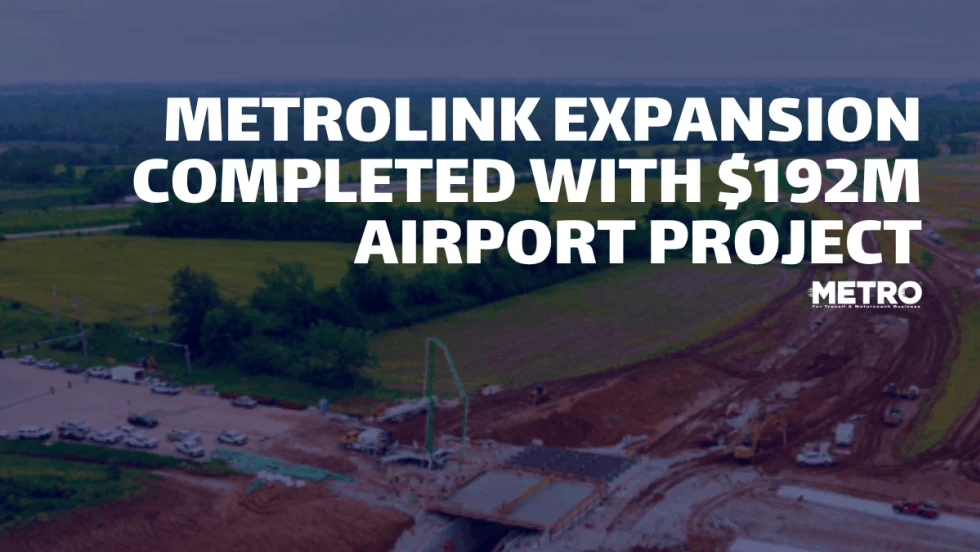
First Full MetroLink Rail Expansion Completed in 20 Years with $192M Airport Project
The project links two St. Louis-area airports by light rail while adding roadway and bike trail connections to improve regional access and mobility.
Read More →
Utilimarc Launches SmartReplace to Optimize Fleet Replacement Decisions
AI-powered SmartReplace helps fleets prioritize vehicle replacements, model budget scenarios, and build more defensible long-term strategies.
Read More →
Scenes from APTA TRANSform & EXPO 2026
Transit leaders, manufacturers, and industry professionals gathered in Chicago to explore new technologies, share ideas, and discuss the future of public transportation.
Read More →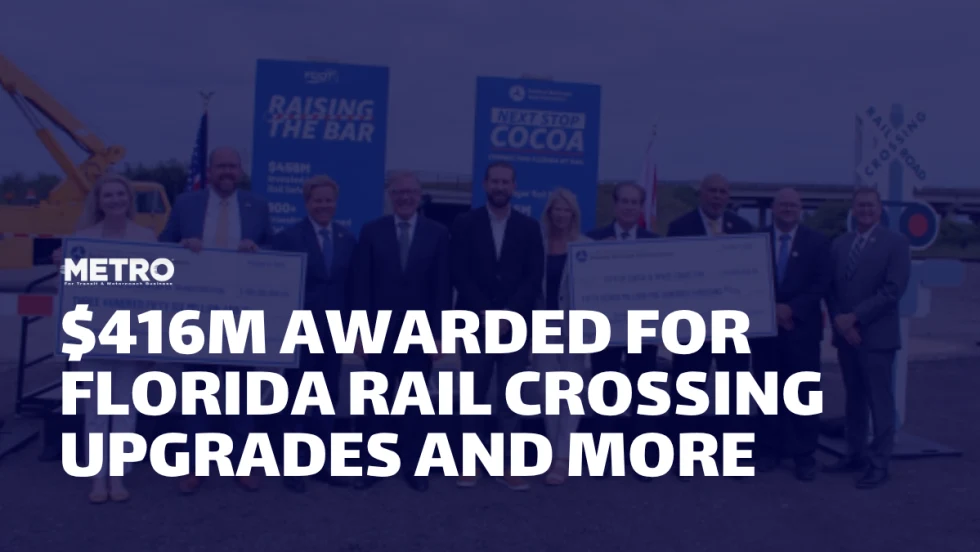
USDOT Awards $416 Million for Florida Rail Crossing Safety Upgrades, New Brightline Station
The projects aim to reduce risks for motorists and pedestrians at rail crossings while expanding passenger rail access along Florida’s Space Coast.
Read More →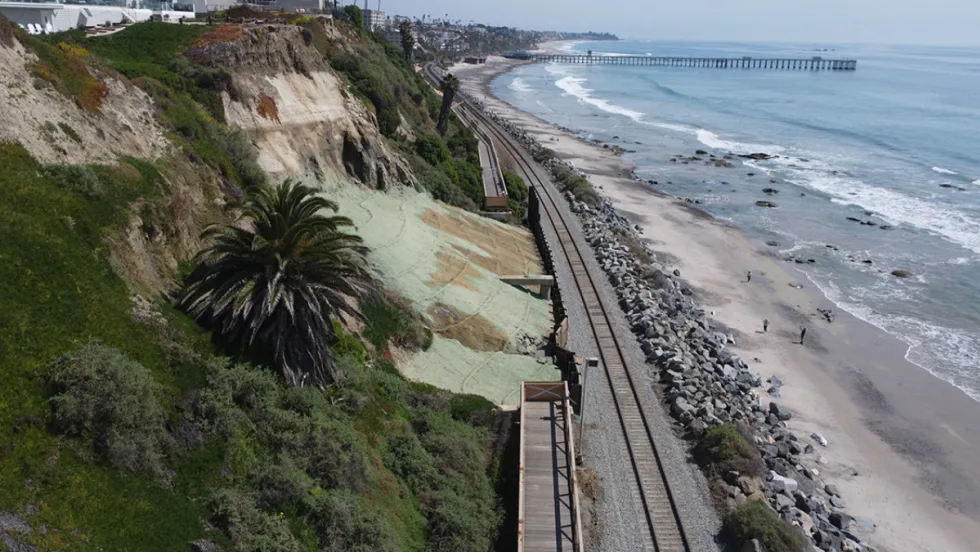
OCTA Declares Emergency to Protect Rail Corridor From Coastal Erosion
The California agency is accelerating shoreline protection and plans to place approximately 690,000 cubic yards of sand along the San Clemente coast to protect a key passenger and freight rail link.
Read More →
More Than a Summer Job: Building the Next Generation of Transit Talent
The Delaware River Port Authority and PATCO have transformed their internship program into a hands-on professional development experience that introduces students to the breadth of transportation careers — and creates a pipeline for future employees.
Read More →