



World’s longest guided busway opens in UK
Since August 2011, passengers have been riding comfortable, well-appointed buses that can attain speeds of 60 miles per hour on the Cambridgeshire Guided Busway.
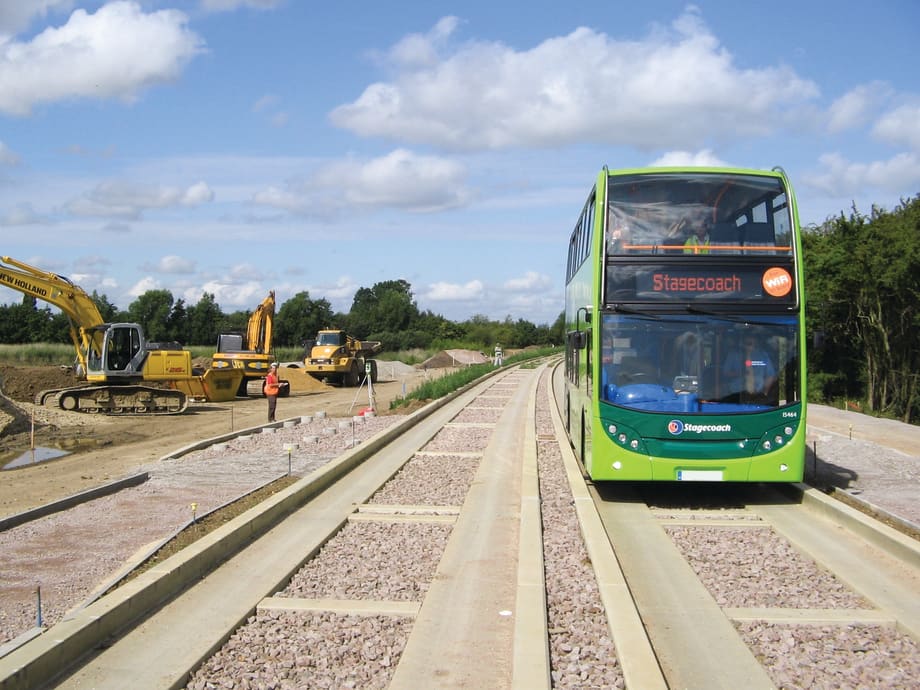
If they haven't already, the new royal couple, the Duke and Duchess of Cambridge, should soon be visiting the Shire from which they take their title. The reason: the world's longest guided busway just opened there, connecting the famous English university town of Cambridge with Huntingdon, a growing community that's home to many commuters who currently drive into London on an increasingly clogged A14 highway. The 16-mile Cambridgeshire Guided Busway (CGB) provides a high-quality, sustainable public transport alternative for Cambridge and surrounding areas.
The Cambridgeshire County Council's choice of guided busway over high-speed rail was prompted by the desire to provide local riders with a travel experience equal in quality to rail, yet at less than half the construction and operational costs. Since August 2011, passengers have been riding comfortable, well-appointed buses that can attain speeds of 60 miles per hour on the guideway. Passengers wait for service on platformed stops with CCTV surveillance and updated travel information and purchase tickets in advance at dedicated vending machines.
Why Guided Busway?
Passenger comfort was not the only reason the council chose a guided busway rather than a light rail or tram system. Due to space constraints, the designated route had to make use of an abandoned railway track that runs through a highly sensitive floodplain. A traditional road for a designated bus lane would have required widening the original Victorian-era railway embankment, which in turn would have negatively affected floodplain storage volume. The narrow guided busway corridor, on the other hand, fits safely within the existing envelope.
Vehicles on the guided busway have two small extra guide wheels in front that can connect with the curbed precast concrete track. Once the buses come to the end of the guided roadway, they are able to operate normally on streets and highways. That means the new infrastructure does not have to penetrate further than the city outskirts — a primary reason why guided busways are more economical than light rail.
Creative Construction
The busway was designed by Parsons Brinckerhoff in joint venture with Arup, on behalf of BAM Nuttall, which had a design-build contract with the Cambridgeshire County Council to deliver the facility.
To achieve maximum cost efficiency, a decision was made to pre-cast all guideway components on site. The assembled guideway was then laid onto a pre-prepared foundation, requiring a purpose-made gantry, and fed with pre-assembled sections by special delivery vehicles running along the completed guideway. To keep expensive moulds to a minimum, only four radii were adopted throughout the alignment. Most of the project utilized "pad foundations," which spread the weight of each guideway track over a nine-foot, nine-inch to six-foot, six-inch area. They were seated on either concrete blinding or a compacted material made of graded aggregate and sand.
A 2.5-mile stretch through the River Great Ouse floodplain required more creative engineering. As it turned out, thickness, depth and location of the gravel on the site were very unpredictable - making it not only impossible to use pad foundations, but also to probe ahead and determine the required length of piles that would secure the superstructure. Luckily, subcontractor Aarsleff found a creative solution to the problem: It ordered piles with half joints at the top that could be adjusted in size by adding a half-jointed overpile with simple single-pinned connections. As a result, any pile that could not be founded in the gravel could be retrofitted on the spot and driven securely into the clay. Altogether, 2,150 precast concrete piles were used to support the busway over the 2.5-mile stretch between St. Ives and Swavesey.
Preserving, Enhancing Landscape
Working within a floodplain adjacent to a river that regularly breaks its banks — as the "Great Ouse" is known to do - is never an easy task. For starters, pre-construction procedures had to be put in place to ensure that the construction plant could be evacuated quickly if required. Water levels also affected the construction schedule, since the new seven-span, 722-foot-long viaduct, which replaced the original 150-year-old structure, had to be built during the months of the year when flood risk was at its lowest. Originally, the old 19-span Victorian-era bridge was to be reconstructed, but ultimately, it was decided the structure should be replaced.
An important side-effect of this infrastructure project was the creation of 14 landscape and ecological mitigation areas, providing about 25 acres of additional habitat for rare flora and fauna, such as grizzled skipper butterflies, wild liquorice and twiggy mullein. The wildlife corridor created by the abandoned railroad was further enhanced through the installation of bat and bird boxes and improved ditches for water voles and invertebrates as well as ponds for the great crested newt. Reptiles and other crawling species received their own designated dead wood piles.
Those features and the fact that existing materials, including railway ballast, were used as substrate for the natural colonization of plants and animals, won the consortium the 2011 Green Apple Award for setting a precedent for balancing construction with long-term ecological goals. Another award was achieved for the use of around 1.8 million shredded tires as drainage material.
Since its opening, approximately 11,500 journeys per day are being taken by commuters and others, a number that will undoubtedly grow as the busway continues to perform, as planned, and gains greater public recognition. And, maybe Will and Kate will even choose to ride it back to Buckingham Palace, rather than risk seeing their motorcade get stuck in the London commuter traffic.
More Bus

New York MTA Plans Largest Bus Fleet Upgrade in More Than a Decade
The agency is seeking manufacturers for 650 new CNG buses to replace aging vehicles, improve reliability, and advance its broader fleet modernization strategy.
Read More →
Building a Flexible Path to Transit Electrification
John Hroncich discusses BAE Systems’ modular and scalable approach, lessons learned from decades of real-world operations, and how agencies can identify electrification strategies that fit their fleets.
Read More →
Bus Tech Talk: Keeping Transit Technicians Ahead of the Technology Curve
LA Metro’s Obed Mejia discusses technician training, evolving maintenance technology, fleet replacement, and strategies for getting the most out of today’s transit fleets.
Read More →
Biz Briefs: RIPTA Unveils New Frontrunners, Clevland RTA Adds New Siemens, and More
In METRO's latest installment, we take a look at recent news from Siemens, Prevost, Dodge, and more partnerships making headlines across the transportation sector.
Read More →
People Movement: Holly Arnold Joins Transdev and More
In this edition, we also cover recent appointments and announcements at Pace, CamTran, MCI, and more, showcasing the individuals helping to shape the future of transportation.
Read More →
The High Cost of Transit Buses: Industry Leaders Look to Procurement Reform
Transit leaders and policymakers examine how standardized bus designs, streamlined procurement, and predictable funding could help agencies stretch budgets and deliver better service.
Read More →
The Business Voice Behind Public Transportation
As chair of APTA’s Business Members Board of Governors, Ray Melleady explains how more than 850 business members are partnering with transit agencies to advance funding, innovation, and industry-wide collaboration.
Read More →
From Surviving to Thriving: Building Stronger Transportation Organizations
Bus Business Consultants founder Brian Dickson shares lessons on leadership, organizational health, and creating options for long-term success in a changing transportation industry.
Read More →
Finding the ‘Happy Medium’: Optimizing Maintenance Without Sacrificing Reliability
The key to maintenance optimization isn’t doing less work—it’s doing the right work at the right time on the right assets.
Read More →
LA Metro, City of West Hollywood, and Partners Advance Smarter Bus Lane Enforcement
The award-winning partnership combines AI-powered detection with human oversight to improve bus reliability, accessibility, and enforcement efficiency.
Read More →