



AC Transit to re-launch Salesforce Transit Center service
The move comes after a thorugh inspection from the agency, the TJPA, and the MTC.

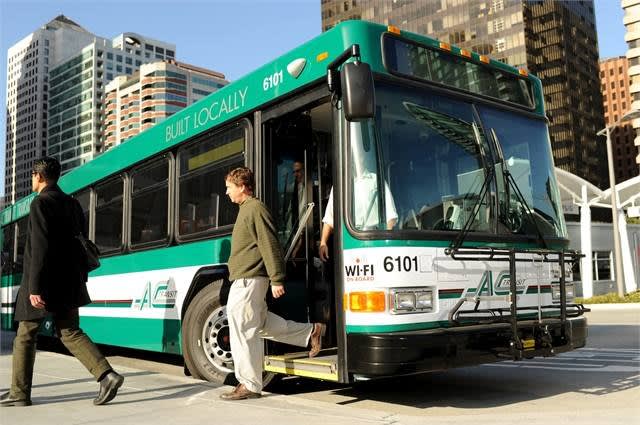
Transbay lines will once again bypass congested San Francisco surface streets by traveling the dedicated bus ramp.
AC Transit
Transbay lines will once again bypass congested San Francisco surface streets by traveling the dedicated bus ramp.
AC Transit
The Alameda-Contra Costa Transit District (AC Transit), following month’s long appraisals and review, announced the restoration of Transbay Bus Line service to the Salesforce Transit Center beginning August 11.
Bus Operator training pacing ahead of forecasted schedules, and the Transbay Joint Powers Authority (TJPA) construction crews making advancements in the reinstallation of bus deck interior finishes — columns, posts, floors, walls, and ceiling treatments — has accelerated AC Transit’s return date, according to the agency.
“Following last year’s discovery of fissures in the steel beams supporting the bus deck, the AC Transit Board of Directors demanded assurances that repairs of the beams would be unequivocally safe and sound,” said AC Transit Board President, Joe Wallace. “The findings presented to our Board provided robust certainties that support restoring service to our 13,000 daily Transbay riders.”
In addition to the nationally recognized five-member Peer Review Committee, empaneled by the Metropolitan Transportation Commission (MTC), AC Transit performed its internal review of the steel beam remediation.
“Our engineering staff members observed installation, monitored physical inspections, reviewed girder fabrication, design stresses, and inspection reports of the girders at Fremont and First Streets,” said Michael Hursh, General Manager. “This comprehensive analysis was the foundation I needed to assure that our Bus Operators, Service Employees, Mechanics, and Road Supervisors are indeed safely working in a world-class transit center.”
Transbay lines will once again bypass congested San Francisco surface streets by traveling the dedicated bus ramp.
Twenty-seven bus bays, dedicated exclusively to AC Transit, allows the agency to better accommodate the popularity of Transbay Bus Lines and double-deck coaches. Recommissioning the transit center also restores the first of its kind Bus Storage Facility (BSF). The BSF is located adjacent to the Salesforce Transit Center and helps the agency to reduce fuel consumption, maintenance costs, and greenhouse gases.
More Bus

New York MTA Plans Largest Bus Fleet Upgrade in More Than a Decade
The agency is seeking manufacturers for 650 new CNG buses to replace aging vehicles, improve reliability, and advance its broader fleet modernization strategy.
Read More →
Building a Flexible Path to Transit Electrification
John Hroncich discusses BAE Systems’ modular and scalable approach, lessons learned from decades of real-world operations, and how agencies can identify electrification strategies that fit their fleets.
Read More →
Bus Tech Talk: Keeping Transit Technicians Ahead of the Technology Curve
LA Metro’s Obed Mejia discusses technician training, evolving maintenance technology, fleet replacement, and strategies for getting the most out of today’s transit fleets.
Read More →
Biz Briefs: RIPTA Unveils New Frontrunners, Clevland RTA Adds New Siemens, and More
In METRO's latest installment, we take a look at recent news from Siemens, Prevost, Dodge, and more partnerships making headlines across the transportation sector.
Read More →
People Movement: Holly Arnold Joins Transdev and More
In this edition, we also cover recent appointments and announcements at Pace, CamTran, MCI, and more, showcasing the individuals helping to shape the future of transportation.
Read More →
The High Cost of Transit Buses: Industry Leaders Look to Procurement Reform
Transit leaders and policymakers examine how standardized bus designs, streamlined procurement, and predictable funding could help agencies stretch budgets and deliver better service.
Read More →
The Business Voice Behind Public Transportation
As chair of APTA’s Business Members Board of Governors, Ray Melleady explains how more than 850 business members are partnering with transit agencies to advance funding, innovation, and industry-wide collaboration.
Read More →
From Surviving to Thriving: Building Stronger Transportation Organizations
Bus Business Consultants founder Brian Dickson shares lessons on leadership, organizational health, and creating options for long-term success in a changing transportation industry.
Read More →
Finding the ‘Happy Medium’: Optimizing Maintenance Without Sacrificing Reliability
The key to maintenance optimization isn’t doing less work—it’s doing the right work at the right time on the right assets.
Read More →
LA Metro, City of West Hollywood, and Partners Advance Smarter Bus Lane Enforcement
The award-winning partnership combines AI-powered detection with human oversight to improve bus reliability, accessibility, and enforcement efficiency.
Read More →