



RELATED: How Reverse Commutes Can Help Reshape Rail Ridership
Algorithms may lead to more efficient public transit
Researchers will spend the next two years poring over the data and leading studies to help the MBTA better understand its ridership.
by By Greg St. Martin
February 11, 2019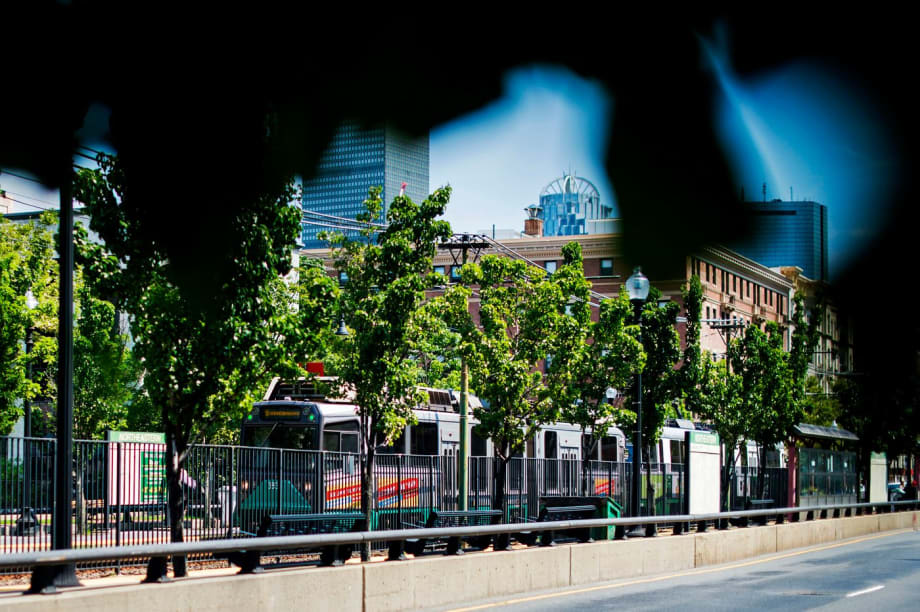
MBTA Green Line stops at Northeastern University. Photo: Adam Glanzman-Northeastern University
4 min to read

MBTA Green Line stops at Northeastern University. Photo: Adam Glanzman-Northeastern University
Riders of the Massachussettss Bay Area Transit (MBTA) system use the Transit app to plan trips, get real-time information on service, and set alerts for departure times. These interactions provide data about how riders use the app and navigate the transit system.
But little has been done with this treasure trove of information in the two years since the MBTA formed a partnership with Transit in 2016 — until now.
Daniel T. O’Brien, an associate professor at Northeastern, is leading a team of researchers that will spend the next two years poring over the data, organizing it into a much more accessible database, and leading studies intended to help the MBTA better understand its ridership.
“Every interaction a user has with the app gives us a snapshot in time of how someone is choosing to navigate that public transit system,” O’Brien said.
“This project will offer brand new insight into how people navigate the public transit system. The insights we produce, which themselves are novel, can be repeated and implemented consistently and incorporated into the MBTA system.”
The researchers will work to shed greater light on how riders navigate the MBTA system, how satisfied they are with its service, how their travel plans change when routes close or snowstorms strike, and how well-equipped the MBTA is to respond to these disruptions.
The researchers will use data from the Transit app to build algorithms and provide analyses that the MBTA can implement to improve service and refine its policies. O’Brien said that his team may also explore whether customer satisfaction surveys from MBTA riders and data records from CharlieCards, which riders use to board trains and buses, could be used to help develop the systems it builds for the MBTA to track and forecast service.
Their findings will have implications beyond Boston’s transportation system. The Transit app is used in more than 175 cities worldwide, and analyses resulting from this work can help inform how the app is being used more broadly, O’Brien said.
The Massachusetts Department of Transportation funded the project by awarding a two-year, $300,000 grant to the Boston Area Research Initiative, which is based at Northeastern’s School of Public Policy and Urban Affairs.
“We’re excited to partner with the Boston Area Research Initiative in analyzing the wealth of data available via the Transit app,” said MBTA Deputy GM Jeff Gonneville. “We’re always looking for ways to better understand how our customers use the system. We’ve endorsed the Transit app as the best way for customers to plan their trips, and the opportunity to better understand how our customers get to their homes and jobs and loved ones through analyzing Transit’s data will give us a unique perspective when we consider service issues and future projects.”
O’Brien, who co-directs the Boston Area Research Initiative, said the data could reveal much more than is currently known about the habits of MBTA riders. While records from CharlieCards reveal only where riders enter the MBTA system, riders can use the Transit app to plot their full trips, with a starting point and a destination.
O’Brien said that the research team could, for example, analyze the data to see how riders reacted each time Red Line service on the MBTA was suspended over the past two years. Did they all flock to a certain bus line, or look up how long it would take for an Uber to arrive to pick them up? O’Brien said the research team could build algorithms that the MBTA could run in real time to proactively respond to, and possibly even anticipate, such disruptions.
In order to learn more about customer satisfaction, the Northeastern research team and the MBTA have discussed the idea of surveying riders who use the Transit app and comparing their attitudes toward the MBTA with how transit service performed on those riders’ routes.
“This project will offer brand new insight into how people navigate the public transit system, and it’s more than just a one-time academic study,” O’Brien said. “The insights we produce, which themselves are novel, can be repeated and implemented consistently and incorporated into the MBTA system.”
This article was originally posted on News@Northeastern
Topics:Technology
More Technology

From Hardware to Digital Partner: Luminator Charts Its Next Chapter
CEO Magnus Friberg discusses Luminator’s shift toward becoming a digital partner, the growing importance of software and interoperability, and how AI can help agencies improve operations and passenger experience.
Read More →
Beyond the Checklist: A Structured Approach to Transit Maintenance
Reliability-Centered Maintenance helps transit agencies move beyond routine checklists to focus limited resources on the assets and failures that have the greatest impact on safety, reliability, and service.
Read More →
NJ TRANSIT Advances Bus Technology Upgrades Across Statewide Fleet
More than 1,500 buses now feature upgraded technology designed to improve arrival predictions and provide free Wi-Fi, with deployment expected to reach nearly 2,000 buses by the end of 2026.
Read More →

Building a Flexible Path to Transit Electrification
John Hroncich discusses BAE Systems’ modular and scalable approach, lessons learned from decades of real-world operations, and how agencies can identify electrification strategies that fit their fleets.
Read More →
Biz Briefs: Alstom Lands Canadian Contract, LYT to Supply California TSP, and More
In METRO's latest installment, we take a look at recent news from Complete Coach Works, Beep, FlixBus, and more partnerships making headlines across the transportation sector.
Read More →
Sponsored•September 8, 2026
From Legacy Silos to Conversational Intelligence
What if transit leaders could ask any operational question and get a trusted answer in seconds? Conversational AI is transforming how agencies use their data.
Read More →
USDOT Announces Rail Vehicle Replacement Grants, Chattanooga AV Shuttle Funding
More than $191 million in federal funding will help three transit agencies replace aging rail vehicles and support a new autonomous shuttle service in Chattanooga.
Read More →
Bus Tech Talk: Keeping Transit Technicians Ahead of the Technology Curve
LA Metro’s Obed Mejia discusses technician training, evolving maintenance technology, fleet replacement, and strategies for getting the most out of today’s transit fleets.
Read More →
Biz Briefs: RIPTA Unveils New Frontrunners, Clevland RTA Adds New Siemens, and More
In METRO's latest installment, we take a look at recent news from Siemens, Prevost, Dodge, and more partnerships making headlines across the transportation sector.
Read More →
Why Simulating Pedestrian Movement Has Become Essential for Modern Rail Stations
Pedestrian microsimulation is helping rail planners identify bottlenecks, test station designs, and prepare complex transit hubs for growing passenger volumes.
Read More →