




Alstom, Engie Partner to Supply Fuel Cell System with Renewable Hydrogen
Alstom’s Autonomous Driving Pilot Project Enters Next Phase
With the German Aerospace Center and the TU Berlin, Alstom is developing technical solutions to gradually digitize rail passenger transport in Germany.
June 10, 2022
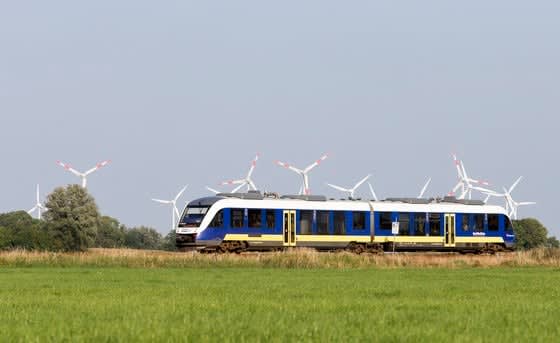
A look at the Coradia Lint regional train for LNVG in commercial service.
Photo: Alstom/Bernd Rosenthal
2 min to read
Alstom's research project “Automated regional trains in Lower Saxony, Germany” is entering the next phase, according to the company's news release.
With the German Aerospace Center (DLR) and the TU Berlin, Alstom is developing technical solutions to gradually digitize rail passenger transport in Germany.
The project will explore the possibilities of automation in regional transport via the European Train Control System (ETCS). The Landesnahverkehrsgesellschaft Niedersachsen (LNVG) supports the project and is providing two regional trains for the tests. Automated driving is being tested on routes in Northern Germany.
While the Federal Ministry of Economics and Climate Protection (BMWK) is supporting the automation research project, Lower Saxony's Ministry of Economics is funding the equipment for the two test vehicles with 5.5 million euro ($5.7 million USD).
For the trials, new systems for driverless operation are being developed in a first phase. This includes signal recognition, which will provide the ability to recognize and interpret the railway traffic signals set up along the track. In addition, the train must be able to recognize obstacles. In the event of a malfunction, the train is controlled remotely or guided by the train attendant. Alstom has already demonstrated with test trains in other countries that automated driving and remote control of trains can be technically implemented.
The project will determine whether the existing regulatory framework for Automatic Train Operation (ATO) could be adapted. It will then examine which tests and results are needed to sufficiently prove safety standards for automated driving in passenger operation.
In a second phase, automated driving must take place as a “living lab” under real conditions. The new systems will be installed in the two LNVG multiple units pre-equipped with ETCS and tested in operation. The findings from development and operation will help to prepare for the later approval of fully automated trains and to further automate regional transport.
“Automated driving is the prerequisite for sustainable and efficient rail transport in the future. With our joint pilot project, we are creating the basis for the use of this technology in German regional transport and are significantly driving forward the implementation of corresponding technical solutions," said Müslüm Yakisan, president of the DACH region at Alstom. "In addition to our partnership with LNVG, we are also actively involved in several other ongoing automation projects for German regional transport. For example, we will be converting S-Bahn and regional trains in the greater Stuttgart area to ETCS technology as part of the Stuttgart 21 and 'Digital Node Stuttgart' lighthouse projects.”
More New Mobility

From Hardware to Digital Partner: Luminator Charts Its Next Chapter
CEO Magnus Friberg discusses Luminator’s shift toward becoming a digital partner, the growing importance of software and interoperability, and how AI can help agencies improve operations and passenger experience.
Read More →
Biz Briefs: Alstom Lands Canadian Contract, LYT to Supply California TSP, and More
In METRO's latest installment, we take a look at recent news from Complete Coach Works, Beep, FlixBus, and more partnerships making headlines across the transportation sector.
Read More →
CharterUP’s Armir Harris on Technology, AI, and the Future of Group Mobility
In a recent episode of METROspectives, CharterUP Founder/CEO Armir Harris discussed the company’s evolution from an online charter bus marketplace into a technology platform supporting public- and private-sector mobility and much more.
Read More →
Jacksonville’s NAVI Project Charts a New Course for Autonomous Public Transportation
Through its NAVI program, JTA is showing how autonomous vehicles, intelligent infrastructure, and coordinated operations can work together to deliver everyday public transportation.
Read More →
Biz Briefs: Luminator Marks Milestone and More
From manufacturers and suppliers to transit agencies and motorcoach operators, these updates offer a snapshot of the projects, partnerships and business moves driving the industry forward.
Read More →
New Tricks for Old Bureaucracies: Joshua Schank on Making Transit Innovation Stick
Former LA Metro Chief Innovation Officer Joshua Schank discusses why good ideas aren't enough, how transit agencies can overcome resistance to change, and why today's challenges demand more innovation.
Read More →
How DART's GoPass Is Redefining Regional Mobility
Serving 14 transit agencies, GoPass simplifies multimodal travel by allowing riders to plan, pay for, and manage an entire trip through one app.
Read More →
Biz Briefs: OCTA Taps Clean Energy for Hydrogen Station, Stadler to Supply Via Rail Vehicles, and More
From manufacturers and suppliers to transit agencies and motorcoach operators, these updates offer a snapshot of the projects, partnerships and business moves driving the industry forward.
Read More →CharterUP Expands Into New Mobility and Autonomous Transportation
Vice President of New Mobility Stephen Joos discusses how CharterUP is leveraging its nationwide transportation network, technology platform, and autonomous vehicle partnerships to expand into workforce mobility, campus shuttles, and transit solutions.
Read More →
METRO Magazine Announces 2026 Innovative Solutions Awards Winners
Projects Recognized for Advancing Mobility Through Technology, Accessibility, Workforce Innovation, and Operational Excellence
Read More →