



Calif. could lose $100B in transportation revenue if bill repealed
As an example, in 2040, the mean projection is that the state will collect $8.6 billion with SB1 and $3.4 billion without, a $5.2 billion difference.


The report also reviews the history of raising transportation revenue in California and documents public opinion about different transportation revenue options based on evidence from voting outcomes and public opinion research.
The report also reviews the history of raising transportation revenue in California and documents public opinion about different transportation revenue options based on evidence from voting outcomes and public opinion research.
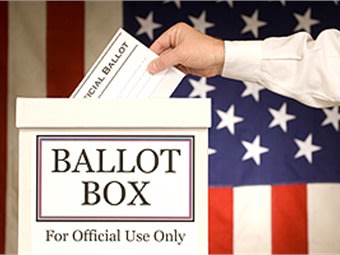
A new report by the Mineta Transportation Institute (MTI) at San José State University explores the consequences if California’s Proposition 6 is passed in November. The proposition would repeal California’s landmark Senate Bill 1 (SB1) — the Road Repair and Accountability Act of 2017.
The study projects that, between now and 2040, California will lose approximately $100 billion in transportation revenue if voters repeal SB1 (see Figure). As an example, in 2040, the mean projection is that the state will collect $8.6 billion with SB1 and $3.4 billion without, a $5.2 billion difference. This has significant consequences for the state’s ability to maintain roads, bridges, and address other transportation improvements.
“California’s ability to plan and deliver an excellent transportation system depends upon the state having a stable, predictable, and adequate revenue stream,” says Martin Wachs, lead author for the report. “Californians have an important decision to make on November 6. A decades-long transportation funding crisis left California’s roads badly in need of costly repair and replacement. Without SB1, where will those funds come from?”
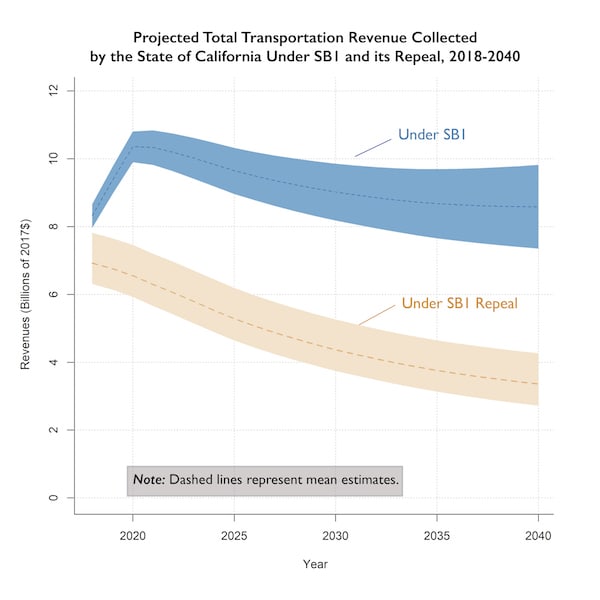
The report’s authors — Wachs, Hannah King, and Asha Weinstein Agrawal — project the amount of transportation revenue that the state’s own taxes will raise through 2040 to support transportation services and infrastructure under two scenarios:
Projected revenue streams under current state laws, including provisions adopted in SB1.
Projected revenue streams should SB1 be repealed by voters in the November 2018 referendum, Proposition 6, on the state ballot.
In addition to projecting total revenues that California will collect under both scenarios, the authors project the cost to Californians who drive by estimating revenue paid per registered vehicle. With SB1 in place, the average revenue collected per vehicle will increase from $265 in 2018 to a maximum of $310 in 2020, and then fall to $190 per vehicle by 2040. Should SB1 be repealed, mean projected revenue per vehicle will drop every year, falling to about $74 in 2040.
The report also reviews the history of raising transportation revenue in California and documents public opinion about different transportation revenue options based on evidence from voting outcomes and public opinion research.
“Whether SB1 is repealed or retained by voters in November 2018, transportation revenue will decrease over time due to inflation and, most importantly, because of dramatic increases in fuel efficiency and the widespread adoption of zero emission vehicles,” notes King. “Of clear importance to the public is assurance that the revenue is being spent efficiently and on things that they care about such as maintenance, safety improvement, and programs that benefit the environment.”
The full report, including data files for the projections, can be downloaded here.
More Management

ENC Lands MATA Contract and More in Biz Briefs
In this edition of Biz Briefs, we spotlight the latest developments shaping the future of mobility.
Read More →
From Surviving to Thriving: Building Stronger Transportation Organizations
Bus Business Consultants founder Brian Dickson shares lessons on leadership, organizational health, and creating options for long-term success in a changing transportation industry.
Read More →
Everett Transit, Community Transit Outline Consolidation Agreement
The proposed agreement calls for a 50% increase in bus service in Everett, a new microtransit zone, continued paratransit service, and the transfer of Everett Transit operations to Community Transit.
Read More →

Strada360’s Steve Lassey on Turning Transit Data Into Better Decisions
From breaking down data silos to preparing for AI, Strada360 CEO Steve Lassey discusses how transit agencies can use technology to improve operations, customer information, and long-term decision-making.
Read More →
People Movement: Phil Washington Joins HNTB, Denver RTD Launches CEO Search, and More
In this edition, we also spotlight recent personnel moves at STV, the Eno Center for Transportation, and more, highlighting the people taking on new roles across the transportation industry.
Read More →
SEPTA Details Accelerate Vision for Transit System
The plan outlines investments in trolley modernization, new Metro and Regional Rail vehicles, accessible stations, and more frequent bus and rail service.
Read More →
FTA Ends Direct Oversight of MBTA Safety Actions
The federal agency closed its remaining special directive to the Massachusetts Department of Public Utilities following a safety review that began in 2022.
Read More →
Report: Transit Bus Manufacturing Supports 34,100 Jobs, $5.1B in GDP
The “Buses Mean Business” report examines the transit bus manufacturing industry’s economic footprint, supply chain, and rising demand for vehicle replacements.
Read More →
LIT Marks 10-Year Milestone at Annual Summit
Hosted by the COTA from September 10 to 13, the Summit carried the theme “Celebrating 10 Years of Excellence, Leadership, and Impact,” with every part of the program honoring the people, agencies, and partners who built LIT over its first decade.
Read More →
People Movement: Dan Dipert Coaches Adds Third-Generation Leader, Keolis Names New Valley Metro VP/GM, and More
In this edition, we also cover recent appointments and announcements at the Wabtec, SilverRide, HNTB, and more, showcasing the individuals helping to shape the future of transportation.
Read More →