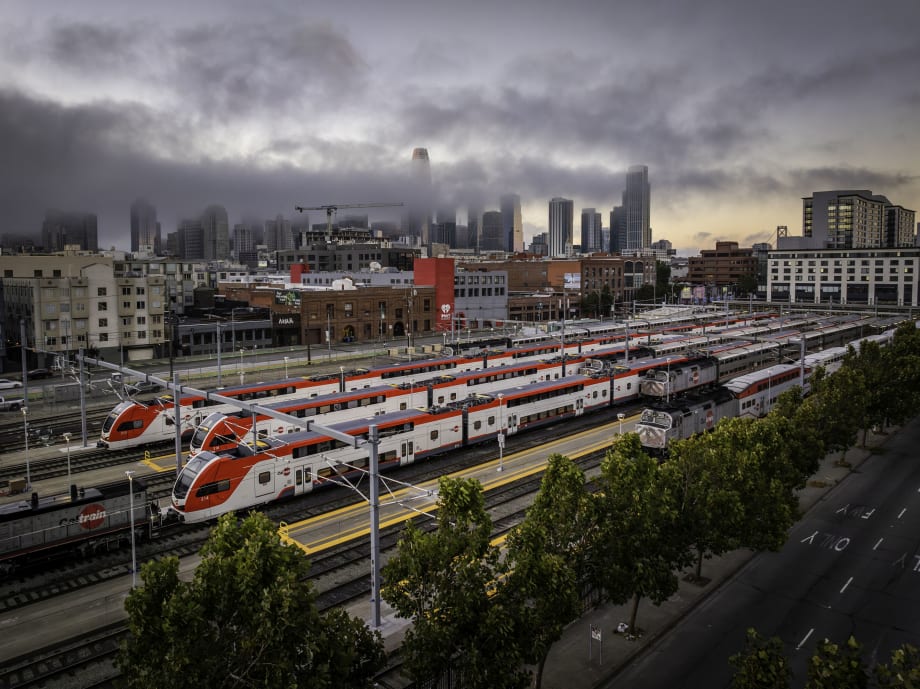
Caltrain's electrification will help meet ambitious regional and state climate action goals by lowering greenhouse gas emissions, improving air quality, and relieving traffic congestion.
Photo: Caltrain
3 min to read
Caltrain launched its new electrified schedule, bringing the 160-year-old San Francisco-San Jose rail corridor from diesel power to electric.
Caltrain is currently running 100% renewable, zero-emission service from San Francisco to San Jose for the first time.
Ad Loading...
Caltrain’s Launch
The new high-performance, state-of-the-art electric trains offer a better experience for Caltrain riders.
Caltrain service is now faster and more frequent, with 16 stations receiving trains every 20 to 15 minutes during peak hours, weekend trains arriving twice hourly and express service from San Francisco to San Jose in under an hour.
Additionally, the new vehicles offer enhanced amenities, including free Wi-Fi, onboard digital displays, power outlets at each forward-facing seat, energy-efficient lighting, baby-changing tables in the bathroom, security cameras, an improved climate control system, and expanded storage under the cantilevered seats.
The electric trains also generate less noise than their diesel equivalent, making the trip more enjoyable both for riders and residents that live near Caltrain tracks.
Making Electrification a Reality
The Electrification Project is fully funded due to the efforts of federal, state, and local partners that helped secure funding.
Ad Loading...
Caltrain’s historic Electrification Project is the first diesel-to-electric transition in North America in a generation, heralding a new day in the legacy of American rail.
“The electrification of Caltrain is a milestone that we have been working towards for decades, and now everyone we serve can enjoy world class rail travel. I am grateful for the thousands of men and women who have worked hard to make this day a reality,” said Caltrain Executive Director Michelle Bouchard. “The future of Caltrain has arrived, and I invite everyone to get on board the premier mode of transportation from San Francisco to San Jose.”
Electrification will help meet ambitious regional and state climate action goals by lowering greenhouse gas emissions, improving air quality, and relieving traffic congestion.
Additionally, electrified service will advance equity along the corridor by reducing noise and air pollution while increasing access for equity priority communities. It will also set the framework for California’s future High Speed Rail network.
The new Caltrain vehicles accelerate and decelerate faster than the diesel fleet, allowing more frequent stops in the same amount of time.
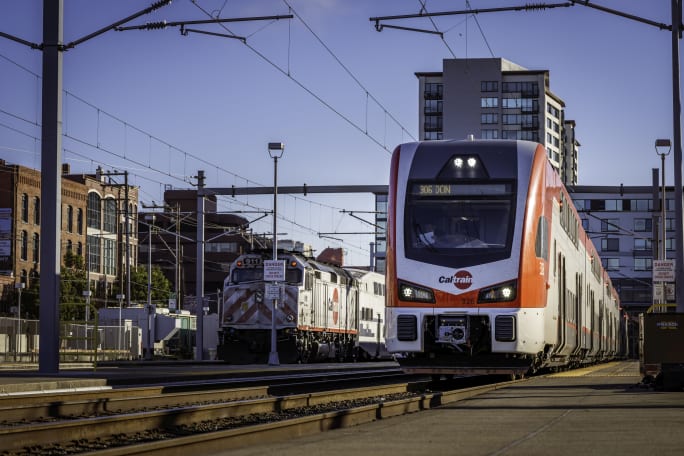
Photo: Caltrain
Features of Caltrain’s New Zero-Emission Trains
Each trainset will have seven cars, as opposed to the current five to six. The new trains accelerate and decelerate faster than the diesel fleet, allowing more frequent stops in the same amount of time.
Ad Loading...
Diesel trains may still be occasionally utilized along the corridor in certain circumstances, such as a maintenance issue or emergency situation. Diesel freight trains will also continue to operate on Caltrain tracks.
Teaming with Stadler
The trains were built by Stadler US at their facility in Salt Lake City. After they were assembled, they were sent to a test facility in Pueblo, Colo., where they were tested at high speeds under numerous conditions as required by the Federal Railroad Administration.
The trains were tested for braking, propulsion, ride quality, noise and vibration, door operation, positive train control, and electromagnetic interference over the course of eight months and were then tested over one thousand miles of travel before being certified for passenger service.
The trains first began service in August of this year.
From breaking down data silos to preparing for AI, Strada360 CEO Steve Lassey discusses how transit agencies can use technology to improve operations, customer information, and long-term decision-making.
The plan outlines investments in trolley modernization, new Metro and Regional Rail vehicles, accessible stations, and more frequent bus and rail service.
The federal agency closed its remaining special directive to the Massachusetts Department of Public Utilities following a safety review that began in 2022.
The agreement resolves a more than decade-long proceeding before the Surface Transportation Board concerning the terms and conditions for Amtrak services, such as the City of New Orleans, Illini/Saluki, and Wolverine.
Contract Four is the largest in the Second Avenue Subway Phase 2 project and includes construction of station infrastructure, tracks, and signals for the subway expansion, MTA officials said. Work on Contract Four will begin in 2027.
The Garden State Initiative analysis examines the roles of Amtrak infrastructure, fleet management, and agency operations while recommending a more performance-based approach to improving reliability.
Beginning in 2027, Stadler will provide on-site technical expertise, spare parts support, training, and obsolescence management to help extend the reliability and longevity of CapMetro’s GTW fleet.
In METRO's latest installment, we take a look at recent news from Complete Coach Works, Beep, FlixBus, and more partnerships making headlines across the transportation sector.