



Canada's TransLink Testing New Multimodal Mobility App
The new app will allow users to easily transfer between transit and each mode, with the goal of encouraging even more users to consider multimodal journeys.

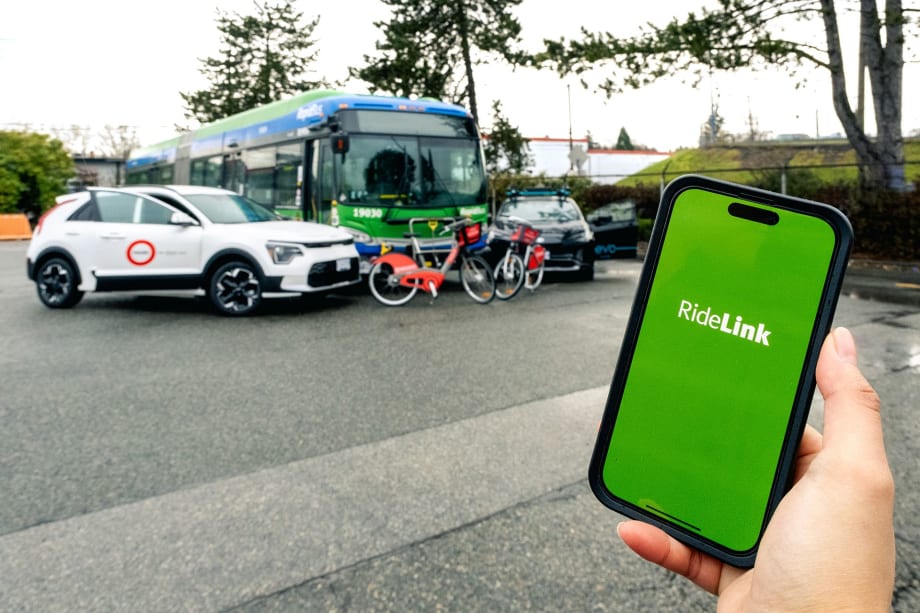
As part of the next phase of the trial, TransLink is accepting applications for 1,300 people to test the new multimodal app. The agency will then gather feedback from participants over a one-year period on the usability and ease of integration between the services.
Photo: TransLink
BC, Canada’s TransLink, Modo, Evo, and Mobi by Rogers are testing a new app, called RideLink, that brings together transit, carshare, and bikeshare services.
The app, which makes planning, booking, and paying for trips easier and more convenient, is now available to a limited number of people for a trial period and will eliminate the need for using several different apps or websites to provide a truly multimodal experience, according to TransLink.
RideLink App Features
Features of the RideLink app include:
Trip planning with transit, carshare, and bikeshare options with real-time information about vehicle and bike locations.
Simple booking and payments for carshare and bikeshare services.
Easy registration for Evo, Modo, and Mobi Bike services.
An upgraded Compass Card to tap into transit, Evo, and Modo vehicles as well as Mobi Bikes at bikeshare stations.
There are over 200,000 registered users of bikeshare and carshare in Metro Vancouver. The new app will allow users to easily transfer between transit and each mode, with the goal of encouraging even more users to consider multimodal journeys.
“People will consider multimodal transportation much more often if they can use one single app to plan, book and pay for their travel throughout the city, instead of needing to consult with several different apps to figure out where to sign up for a bike, or find a carshare that connects to the transit system,” said TransLink CEO Kevin Quinn. “This is the first step in creating a truly seamless multimodal experience and decreasing reliance on car ownership.”
Data Contributing to Single App Solution
Data from TransLink’s first Shared Mobility Pilot shows people are more likely to choose multimodal travel when booking and payment options are simplified.
In 2019, users received a Compass Card that worked on all four of these services, with one integrated billing account. Sixty percent of participants said they reduced personal vehicle use, and 56% said they tried a new mode of transportation due to the card.
As part of the next phase of the trial, TransLink is accepting applications for 1,300 people to test the new multimodal app. The agency will then gather feedback from participants over a one-year period on the usability and ease of integration between the services. The feedback will determine whether the app will become permanent in the future.
App development, beta testing, and integration is possible thanks to a $250,000 grant from the Federation of Canadian Municipalities through the Green Municipal Fund.
More Technology

From Hardware to Digital Partner: Luminator Charts Its Next Chapter
CEO Magnus Friberg discusses Luminator’s shift toward becoming a digital partner, the growing importance of software and interoperability, and how AI can help agencies improve operations and passenger experience.
Read More →
Beyond the Checklist: A Structured Approach to Transit Maintenance
Reliability-Centered Maintenance helps transit agencies move beyond routine checklists to focus limited resources on the assets and failures that have the greatest impact on safety, reliability, and service.
Read More →
NJ TRANSIT Advances Bus Technology Upgrades Across Statewide Fleet
More than 1,500 buses now feature upgraded technology designed to improve arrival predictions and provide free Wi-Fi, with deployment expected to reach nearly 2,000 buses by the end of 2026.
Read More →

Building a Flexible Path to Transit Electrification
John Hroncich discusses BAE Systems’ modular and scalable approach, lessons learned from decades of real-world operations, and how agencies can identify electrification strategies that fit their fleets.
Read More →
Biz Briefs: Alstom Lands Canadian Contract, LYT to Supply California TSP, and More
In METRO's latest installment, we take a look at recent news from Complete Coach Works, Beep, FlixBus, and more partnerships making headlines across the transportation sector.
Read More →
From Legacy Silos to Conversational Intelligence
What if transit leaders could ask any operational question and get a trusted answer in seconds? Conversational AI is transforming how agencies use their data.
Read More →
USDOT Announces Rail Vehicle Replacement Grants, Chattanooga AV Shuttle Funding
More than $191 million in federal funding will help three transit agencies replace aging rail vehicles and support a new autonomous shuttle service in Chattanooga.
Read More →
Bus Tech Talk: Keeping Transit Technicians Ahead of the Technology Curve
LA Metro’s Obed Mejia discusses technician training, evolving maintenance technology, fleet replacement, and strategies for getting the most out of today’s transit fleets.
Read More →
Biz Briefs: RIPTA Unveils New Frontrunners, Clevland RTA Adds New Siemens, and More
In METRO's latest installment, we take a look at recent news from Siemens, Prevost, Dodge, and more partnerships making headlines across the transportation sector.
Read More →
Why Simulating Pedestrian Movement Has Become Essential for Modern Rail Stations
Pedestrian microsimulation is helping rail planners identify bottlenecks, test station designs, and prepare complex transit hubs for growing passenger volumes.
Read More →