



TransLink Launches New Rapid Bus Line
The R6 will provide space for 20% more riders on the busiest bus corridor south of the Fraser River.

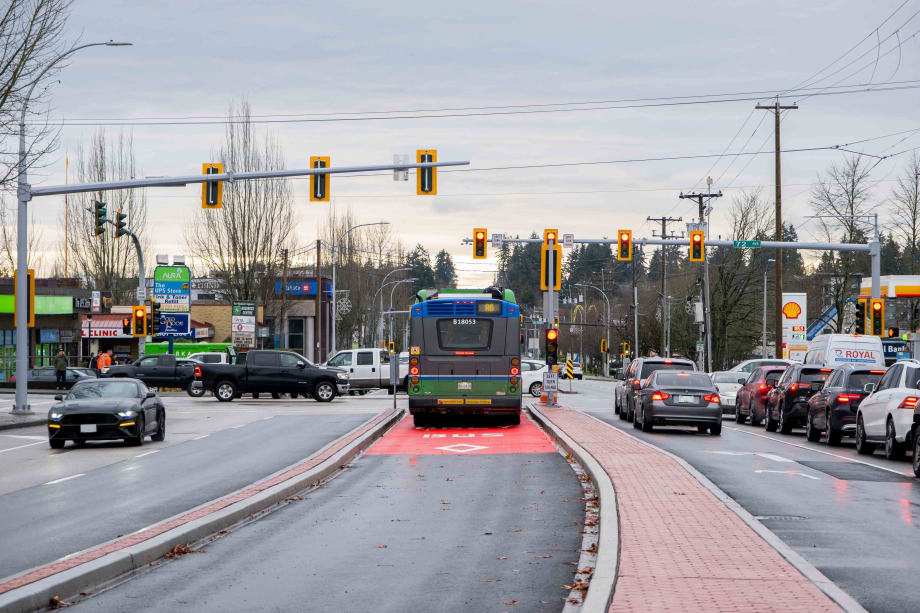
The R6 Scott Road RapidBus will help accommodate strong demand in Metro Vancouver’s fastest growing area for transit ridership, while the agency continues to seek funding for the Access for Everyone plan to substantially address overcrowding issues.
Photo: TransLink
TransLink’s R6 Scott Road RapidBus line launched, providing faster and more frequent bus service for Surrey and Delta residents, as well as Kwantlen Polytechnic University students.
The R6 will provide space for 20% more riders on the busiest bus corridor south of the Fraser River.
Customer travel time is now up to 10 minutes faster in each direction between Scott Road Station and Newton Exchange, due to bus speed and reliability improvements.
Answering Ridership Growth
Surrey and Delta’s transit ridership is part of the fastest growing area in Metro Vancouver, where bus boardings are exceeding 2019 ridership levels by 16%.
The R6 Scott Road RapidBus will help accommodate strong demand in Metro Vancouver’s fastest growing area for transit ridership, while the agency continues to seek funding for the Access for Everyone plan to substantially address overcrowding issues.
“The R6 RapidBus will save Surrey and Delta customers up to 20 minutes and provide much-needed relief on the busiest bus route south of the Fraser River,” said Kevin Quinn, CEO at TransLink. “Ridership in places like Surrey and Delta is growing faster than any other part of the region and it’s essential that transit services keep up as Metro Vancouver’s population grows.”
The R6 is TransLink’s largest service expansion since 2020 and is the sixth RapidBus throughout Metro Vancouver.
It features:
Fewer stops and all-door boarding.
Articulated buses with more capacity.
Bus priority lanes along the corridor to keep buses separated from congestion.
A center-median bus boarding area at Scott Road and 72nd Avenue to speed up boardings and bus travel times.
Improved bus stops with live next-bus digital signage and audio information available for customers who are blind or partially-sighted. (These signs will finish installing in the coming months. Temporary bus stop signs are in place in the interim.)
TransLink Features and Plans
Community art has been installed throughout the corridors by three local artists. This includes a mosaic for the median center-island bus boarding area, as well as bus shelter art at the stops located outside of Kwantlen Polytechnic University and at Scott Road and 72nd Avenue.
Street changes have also been implemented to enhance safety. This includes adding new crosswalks, protected left turn lanes, signal improvements, and allowance for making U-turns at selected locations.
Route 319 will continue to run alongside the R6, serving each local bus stop between Newton Exchange and Scott Road Station. The R6 will operate between 5 a.m. and 1 a.m. every day of the week, and both the R6 and the 319 will maintain 15-minute service or better all day. During peak hours, the R6 will arrive every seven and a half minutes and the 319 will arrive every ten minutes.
The $33 million investment was delivered jointly by TransLink, the City of Surrey, and the City of Delta. It was paid for through the Mayors’ 10-Year Vision, of which the Government of British Columbia contributed 40% of all capital costs.
TransLink plans to upgrade this route to bus rapid transit (BRT) and will continue to alleviate overcrowding through the Access for Everyone ten-year plan, should the plan receive funding.
More Bus

New York MTA Plans Largest Bus Fleet Upgrade in More Than a Decade
The agency is seeking manufacturers for 650 new CNG buses to replace aging vehicles, improve reliability, and advance its broader fleet modernization strategy.
Read More →
Building a Flexible Path to Transit Electrification
John Hroncich discusses BAE Systems’ modular and scalable approach, lessons learned from decades of real-world operations, and how agencies can identify electrification strategies that fit their fleets.
Read More →
Bus Tech Talk: Keeping Transit Technicians Ahead of the Technology Curve
LA Metro’s Obed Mejia discusses technician training, evolving maintenance technology, fleet replacement, and strategies for getting the most out of today’s transit fleets.
Read More →
Biz Briefs: RIPTA Unveils New Frontrunners, Clevland RTA Adds New Siemens, and More
In METRO's latest installment, we take a look at recent news from Siemens, Prevost, Dodge, and more partnerships making headlines across the transportation sector.
Read More →
People Movement: Holly Arnold Joins Transdev and More
In this edition, we also cover recent appointments and announcements at Pace, CamTran, MCI, and more, showcasing the individuals helping to shape the future of transportation.
Read More →
The High Cost of Transit Buses: Industry Leaders Look to Procurement Reform
Transit leaders and policymakers examine how standardized bus designs, streamlined procurement, and predictable funding could help agencies stretch budgets and deliver better service.
Read More →
The Business Voice Behind Public Transportation
As chair of APTA’s Business Members Board of Governors, Ray Melleady explains how more than 850 business members are partnering with transit agencies to advance funding, innovation, and industry-wide collaboration.
Read More →
From Surviving to Thriving: Building Stronger Transportation Organizations
Bus Business Consultants founder Brian Dickson shares lessons on leadership, organizational health, and creating options for long-term success in a changing transportation industry.
Read More →
Finding the ‘Happy Medium’: Optimizing Maintenance Without Sacrificing Reliability
The key to maintenance optimization isn’t doing less work—it’s doing the right work at the right time on the right assets.
Read More →
LA Metro, City of West Hollywood, and Partners Advance Smarter Bus Lane Enforcement
The award-winning partnership combines AI-powered detection with human oversight to improve bus reliability, accessibility, and enforcement efficiency.
Read More →