



Chicago retires 2400-series railcars
The cars, produced between 1976 to 1978, are being replaced as the CTA continues to upgrade its rail fleet as part of an aggressive modernization and infrastructure plan by Mayor Rahm Emanuel and CTA President Forrest Claypool.

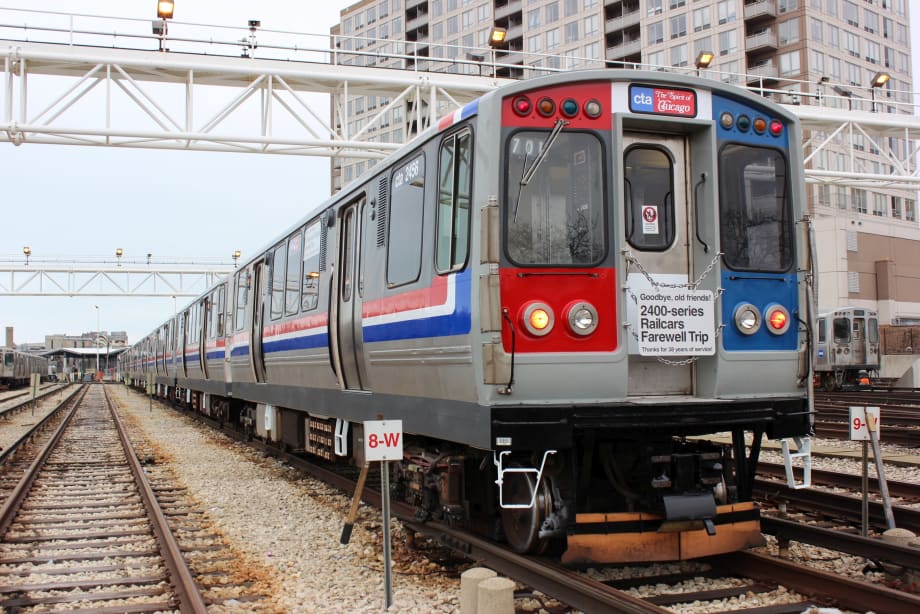
Chicago Transit Authority

After nearly 40 years of service and millions of trips, the Chicago Transit Authority’s (CTA) 2400-series railcars made their last in-service run last week.
The cars, produced between 1976 to 1978, are being replaced as the CTA continues to upgrade its rail fleet as part of an aggressive modernization and infrastructure plan by Mayor Rahm Emanuel and CTA President Forrest Claypool. The CTA continues to add its newest, state-of-the-art railcars, the 5000-series, with more than 600 deployed to the Red, Purple, Yellow, Pink and Green Lines with a total of 714 of the new cars expected to be in place by the end of 2015.
To commemorate the 2400-series’ nearly four decades of service, the CTA will host ceremonial last rides on the Brown and Green/Red Lines on a train made up of 2400-series cars that have been restored to their original look inside and out.
Some fun facts about 2400-series railcars:
Built by Boeing-Vertol, the car’s interior and exterior designs were developed by industrial design firm Sundberg-Ferar, who also worked on cars for the Washington Metropolitan Area Transit Authority, Bay Area Rapid Transit and Metropolitan Atlanta Rapid Transit Authority. The CTA’s 2400-series are the only heavy rail rapid transit cars Boeing ever manufactured.
The interiors of the cars were a departure from previous series in several aspects and set the standard by which “L” cars interiors would be designed for the next few decades, featuring fiberglass seats with padded colored inserts, walnut grain-pattern wainscot panels with beige molded plastic upper walls and chocolate colored rubber floors. The 2400-series cars are notable as featuring a return to wide sliding side doors instead of bi-fold blinker-type doors, which had been featured on all “L” cars built in the preceding 30 years. These sliding doors allowed for freer passenger flow and were more suitable for access by persons with disabilities.
The electrical equipment was updated and improved over that on the preceding 2200-series. A major change was the use of a motor-alternator to supply 230-volt 60-hertz alternating current power for all the auxiliary systems on the car, allowing less expensive components to be employed. These changes represented another step in the evolutionary path that eventually led to the modern 5000-series cars being delivered today, whose entire propulsion system is AC-powered.
The 2400-series cars are one of the few car series to have operated on every line on the “L” system. At various points in their service lives, they were assigned to the lines that make up seven of the eight “L” services today. While never formally assigned to the Yellow Line, they operated there on rare occasions when substitute equipment was needed, since they were stabled in the same yard as the normal Yellow Line equipment.
Two of the railcars were given to the Illinois Railway Museum, where they are on display today.
Nearly 200 2400-series cars were retired. CTA retains two dozen of the cars that have been modified to serve as maintenance/work trains. Some of the 2400-series railcars used in the CTA’s retirement ceremony will become part of its historic railcar fleet and will be used for special events and paid charters.
More Rail

Biz Briefs: STV teams with Amtrak, Motorcoach Operators Boost Fleet and Land Contracts, and More
From manufacturers and suppliers to transit agencies and motorcoach operators, these updates offer a snapshot of the projects, partnerships and business moves driving the industry forward.
Read More →
Metra Celebrates 100 Years of Electric Rail, Looks to the Future
The event was also a celebration of recent reforms to public transportation in the Chicago area, changes that could be as transformative in the future as the major civic achievement a century ago, said officials.
Read More →
LA Metro Marks Banner Year, Sets Ambitious Goals for New Fiscal Year
Incoming LA Metro Board Chair and Los Angeles Mayor Karen Bass joined outgoing Board Chair Fernando Dutra and LA Metro CEO Stephanie Wiggins to review accomplishments from fiscal year 2026, which included the opening of new rail extensions, advancement of major transit projects, expanded safety programs, and new rider amenities.
Read More →
DART Taps Nathaniel P. Ford Sr. as Next President/CEO
Since 2012, Ford has served as the CEO of the Jacksonville Transportation Authority
Read More →
California High-Speed Rail Authority Signs MOU to Advance High Desert Corridor
The agreement deepens collaboration between the California High-Speed Rail Authority and the High Desert Corridor Joint Powers Agency, supporting design integration, cost savings, and faster delivery of a key Southern California rail link.
Read More →
Building the Next Generation of Transit Technology
In this edition of METROspectives, Luminator CEO Magnus Friberg discusses the company's transformation, the growing role of AI and software, and what's next for transit technology.
Read More →
How Data, Strategy, and Community Engagement Are Reshaping Transit
In this edition of METROspectives, strada360 CEO Steve Lassey discusses how transit agencies can better align planning with operations, leverage data to improve decision-making, and build public trust as they prepare for the future of mobility.
Read More →
TTC Launches Camera Pilot to Curb Illegal Passing of Streetcars
During the pilot, the cameras will measure how often illegal streetcar passing occurs and test the technology's reliability for future automated enforcement.
Read More →
NJ TRANSIT Secures Capital Funding, Adopts FY2027 Budget
The budgets continue investments in infrastructure and equipment to maintain the system in a state of good repair and enhance the overall customer experience.
Read More →
Biz Briefs: Masabi Teams with St. Louis Metro and More
In METRO's latest installment, we take a look at recent news from Transdev, Hitachi, and more partnerships making headlines across the transportation sector.
Read More →