



Chicago's new railcars unveiled
Total cost of the railcars, built by Bombardier Transportation, is $1.137 billion, which is funded by two CTA bond issuances backed by sales tax receipts. The remainder is paid for by $150 million in federal funds.

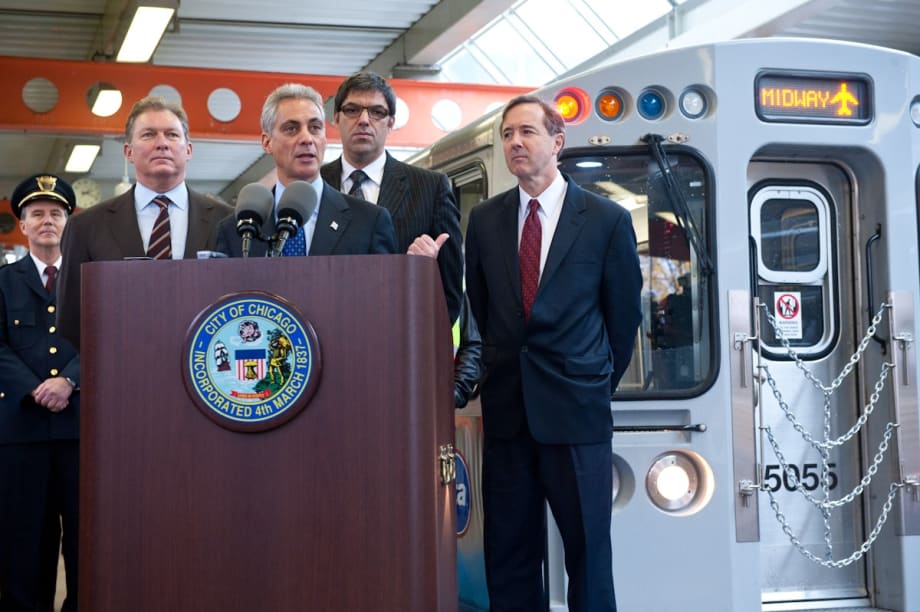
Photo credit: Patrick Pyszka, City of Chicago.
Photo
Patrick Pyszka, City of Chicago.
Mayor Rahm Emanuel and Chicago Transit Authority (CTA) President Forrest Claypool unveiled new 5000-series railcars, manufactured by Bombardier Transportation Corp., marking the first time there has been an addition to the rail fleet since 1992.
Following a successful prototype testing period, the first of 706 brand new, full production model cars will debut on the Pink Line. As more cars continue to arrive, they will be tested internally to ensure all components are operating properly before going into service.
The total cost of the railcars is $1.137 billion, which is funded by two CTA bond issuances backed by sales tax receipts. The remainder is paid for by $150 million in federal funds.
Emanuel and Claypool were joined for the inaugural run at the Midway station on the Orange Line by representatives from Bombardier Transportation, the manufacturer of the cars.
"The CTA remains the primary mode of transportation for many residents of Chicago, and these new railcars reflect the agency's commitment to its customers and to our city," said Mayor Rahm Emanuel. "In order for Chicago to grow, continue attracting new businesses and increase the quality of life for all Chicagoans we must continue to invest in public transportation, improving transit infrastructure and expanding service."
The railcars feature an aisle-facing seating configuration, which adds six inches to the narrowest portion of the aisle, allowing more room for customers carrying backpacks, packages, luggage, strollers and bikes. The aisle-facing seating also provides space for an additional wheelchair position, increasing the total to two per car.
Each railcar has multiple security cameras and will eventually transmit real time video to CTA's Control Center, the Office of Emergency Management and Communication, and the Chicago Police Department. CTA's Control Center will also have remote access to signs, giving them the ability to make emergency audio and text messages inside the trains if needed.
The addition of these new cars to the fleet will allow CTA to retire some of its oldest cars, which average between 32 and 41 years of age.
More Rail
Amtrak, CN Reach Agreements to Strengthen Passenger Rail Service, Safety
The agreement resolves a more than decade-long proceeding before the Surface Transportation Board concerning the terms and conditions for Amtrak services, such as the City of New Orleans, Illini/Saluki, and Wolverine.
Read More →
New York MTA Advances Final Contract for Second Avenue Subway Expansion
Contract Four is the largest in the Second Avenue Subway Phase 2 project and includes construction of station infrastructure, tracks, and signals for the subway expansion, MTA officials said. Work on Contract Four will begin in 2027.
Read More →
San Diego MTS Breaks Monthly Trolley Ridership Record
Agency officials said July’s ridership indicates MTS’s continued recovery from the pandemic.
Read More →
Report Examines NJ TRANSIT Reliability, Funding Challenges
The Garden State Initiative analysis examines the roles of Amtrak infrastructure, fleet management, and agency operations while recommending a more performance-based approach to improving reliability.
Read More →
Stadler, CapMetro Sign Long-Term Rail Fleet Support Agreement
Beginning in 2027, Stadler will provide on-site technical expertise, spare parts support, training, and obsolescence management to help extend the reliability and longevity of CapMetro’s GTW fleet.
Read More →
Biz Briefs: Alstom Lands Canadian Contract, LYT to Supply California TSP, and More
In METRO's latest installment, we take a look at recent news from Complete Coach Works, Beep, FlixBus, and more partnerships making headlines across the transportation sector.
Read More →
CATS Gold Line Marks 5 Years of Service, 2.8M Passenger Trips
With a six-mile expansion planned, the Charlotte streetcar is positioned to connect more neighborhoods and major transit hubs across the region.
Read More →
Why Simulating Pedestrian Movement Has Become Essential for Modern Rail Stations
Pedestrian microsimulation is helping rail planners identify bottlenecks, test station designs, and prepare complex transit hubs for growing passenger volumes.
Read More →
Amtrak Begins Major Construction at New York’s Sunnyside Yard
The new maintenance facility will support Amtrak’s Airo trainsets while improving maintenance efficiency and turnaround times in New York.
Read More →
Chicago Leaders Unveil Plans for O’Hare Airport Express Train
The privately developed project would offer a 15-minute trip between downtown and O’Hare’s Terminal 2, with trains operating every 15 minutes on a dedicated track. The service would use battery-electric trains and three existing freight rail rights-of-way.
Read More →