



FTA makes $21.9M available for public transportation safety
In addition to the funds, the agency also announced a flexible new policy, known as Safety Management Systems, which the U.S. DOT has officially adopted to help guide states and transit agencies alike in managing safety risks in a proactive, cost-effective way.

The Federal Transit Administration (FTA) announced that, for the first time, it is making $21.9 million available to help strengthen public transportation safety for millions of riders and transit workers nationwide.
In addition to the funds, the agency also announced a flexible new policy, known as Safety Management Systems (SMS), which the U.S. Department of Transportation (U.S. DOT) has officially adopted to help guide states and transit agencies alike in managing safety risks in a proactive, cost-effective way.
Together, these efforts reflect FTA’s commitment to begin implementing long-sought federal authority for transit safety granted under the Moving Ahead for Progress in the 21st Century Act (MAP-21) and help states and transit agencies begin meeting new safety-related responsibilities. This represents a fundamental shift in the way FTA and states will work together to ensure the safety of public transportation across the nation.
“Maintaining the safety of our nation’s transportation systems has always been our number-one priority,” said U.S. Transportation Secretary Ray LaHood. “We take our new responsibility to oversee transit safety as seriously as we do for railways, roadways, runways, and we will continue to find innovative ways to make transit even safer for the public and our workforce.”
As part of FTA’s new regulatory safety authority, every state with a rail fixed guideway public transportation system not subject to regulation by the Federal Railroad Administration must establish a state safety oversight agency (SSOA) that is legally and financially independent of the rail transit systems the SSOA will oversee, and states must ensure that their SSOAs have adequate authority and resources to oversee rail systems safety.
“FTA’s new safety authority marks a significant change in how we do business going forward to keep transit travel safe for millions of riders and transit workers,” said FTA Administrator Peter Rogoff. “We are working closely with state leaders, the transit industry, and trusted safety experts to build a foundation for common-sense policies and procedures that take into account the unique needs and circumstances of each transit agency.”
A notice in the Federal Register providing FTA’s Fiscal Year 2013 apportionment includes the proposed apportionment for the state safety oversight funds. As indicated in the notice, FTA seeks to ensure that, in order to meet these new requirements, each eligible state should receive a minimum funding level for designated SSOAs.
In August 2012, Secretary LaHood informed the governors of eligible states that they are required to provide a 20% match for these funds. The notice also describes the steps applicants must take, in consultation with FTA, to be ready to receive the funds and demonstrate compliance with new statutory requirements for safety oversight. The public is invited to comment on the proposed allocation of funds.
With respect to FTA’s adoption of a strategic framework for strengthening transit safety overall, SMS is a collaborative approach that brings management and labor together to build on the transit industry’s existing safety foundation to control risk better, detect and correct safety problems earlier, share and analyze safety data more effectively, and measure safety performance more carefully.
More Bus

Improving Transit Safety and Reliability Through AI
Hayden AI’s Chief Growth Officer, Charley Territo, discusses how AI-powered camera enforcement is helping transit agencies keep bus lanes and stops clear, improve accessibility, and move from pilot programs to full-scale deployments.
Read More →
Castro to Lead RTC of Southern Nevada and More in People Movement
In this edition, we also cover recent appointments and announcements at the STV, MCI, and more, showcasing the individuals helping to shape the future of transportation.
Read More →
Study: Denver RTD Generates $2.1 Billion in Annual Economic Activity
An economic impact study finds the agency supports approximately 17,500 jobs, delivers $1.6 billion in annual community and mobility benefits, and generates $2.42 in economic value for every dollar invested.
Read More →
Mark Aesch Nominated to Lead Federal Transit Administration
The former Rochester transit chief and TransPro founder, who has also contributed to METRO Magazine, brings decades of industry experience and a focus on performance, accountability, and financial sustainability to the nomination.
Read More →
Pierce Transit Moves to Expand Fleet Following Proposition 1 Approval
The agency authorized the purchase or refurbishment of up to 60 buses to support a 47% service expansion, as voters nationwide approved billions in new transit funding.
Read More →
Transit Expands Agency Partnerships, Reaching 200 Official App Partners
COO Jake Sion discusses Transit’s growth, the success of its Transit Royale program, and how technology is helping agencies improve the rider experience.
Read More →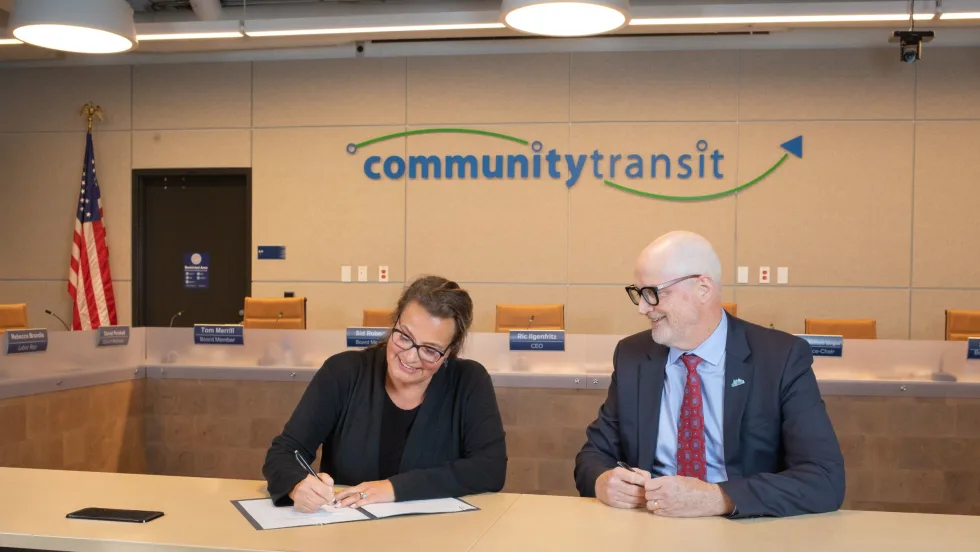
Everett Transit, Community Transit Approve Consolidation of Services
The agreement will bring Everett Transit into Community Transit’s network in April 2027, with plans to increase bus service by 50% by 2031 and expand regional connections.
Read More →
Brian Dickson on Building Stronger, More Resilient Transportation Organizations
Bus Business Consultants Founder Brian Dickson discusses the leadership principles, operational discipline, and strategic planning that separate transportation companies positioned for long-term success from those stuck in survival mode.
Read More →
LA Metro Breaks Ground on Vermont BRT Project
The 12.4-mile corridor is projected to serve 66,200 daily riders, reduce travel times by up to 24%, and create the nation's busiest bus rapid transit corridor.
Read More →
Roman Cornell on ABC Companies’ Evolution and the Future of Passenger Transportation
The company’s CEO discusses carrying forward a third-generation family legacy, ABC’s continued evolution in passenger transportation, support for increasingly complex fleets, and how technology and continued investment could help operators improve uptime.
Read More →