




Looking Back: Task Force Approves Actions To Guide Post-Pandemic Future of Bay Area Transit Network
Governor Newsom Signs $590 Million Emergency Loan Bill for Bay Area Transit Agencies
The 12-year loan stabilizes BART, Muni, Caltrain, and AC Transit as ridership rebounds and leaders pursue a 2026 tax measure.
February 23, 2026
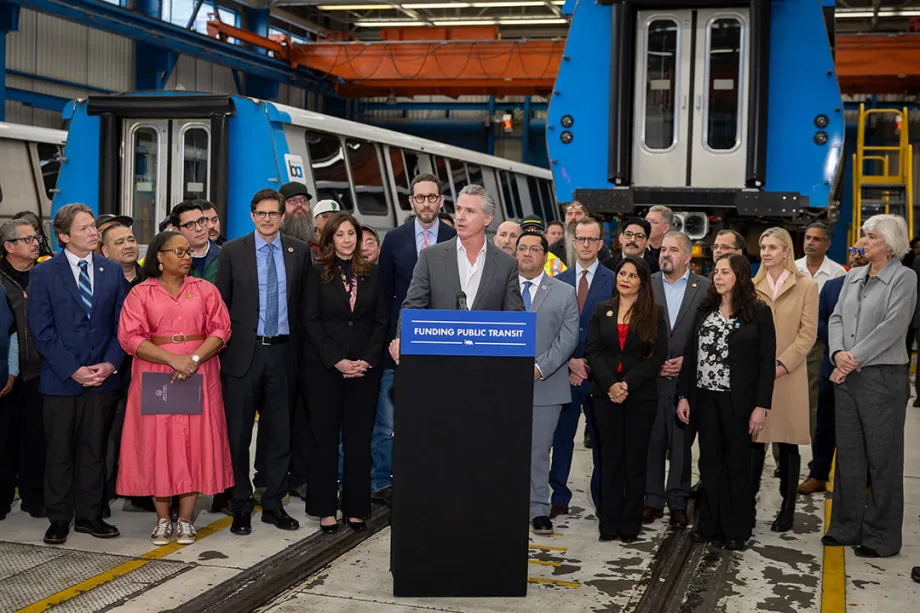
The Metropolitan Transportation Commission would use the loan proceeds to provide short-term operating loans to four Bay Area transit operators.
Credit:
Governor Newsom Press Office
2 min to read
California Governor Gavin Newsom, alongside state and community leaders, recently signed AB/SB 117, authorizing the California State Transportation Agency to loan $590 million to the Metropolitan Transportation Commission from the Transit and Intercity Rail Capital Program.
“California is stepping up to support Bay Area transit,” Governor Newsom said. “This agreement will help protect transit service for more than three million monthly riders. The benefits of a strong transit system are clear: growing ridership, cleaner air, and less congested roads.”
According to a release, the Bay Area Transit Loans measure will support and stabilize Bay Area transit services as the region continues to emerge from the pandemic's impacts and ridership rebounds.
The Metropolitan Transportation Commission would use the loan proceeds to provide short-term operating loans to four Bay Area transit operators and repay the loan in quarterly installments to the California State Transportation Agency over a period of 12 years, with interest-only payments during the first two years.
“Our public transit connects people to jobs, schools, healthcare, and opportunity,” said California Transportation Secretary Toks Omishakin. “This $590 million emergency loan helps ensure Bay Area communities continue to have reliable service as ridership returns and the region works towards a long-term funding solution.“
Ridership Recovery and Regional Progress
“Like transit systems across the country, BART, Muni, Caltrain, and AC Transit were hit hard by the pandemic, but all four operators have made strong progress in rebuilding ridership in recent years,” the governor’s office wrote in a release.
This emergency loan is structured as a bridge to support agencies while the region pursues a “long-term funding solution through a potential November 2026 regional sales tax measure authorized through the enactment of Senate Bill 63 (Wiener, 2025).”
If approved by voters, that measure would provide new operating funding beginning in July 2027. This financing would help cover operating deficits and advance a “financially resilient” transit system.
“This loan will avert a traffic catastrophe and save millions of Bay Area transit riders from losing their ride to work, family, and school,” said California Senator Scott Wiener. “We spent much of the past year negotiating this loan with regional stakeholders and the governor, and I’m immensely proud that we got it over the finish line. This is the latest in a yearslong effort to shore up funding for our transit systems and make them even cleaner, safer, and more reliable than ever.”
More Management

METRO Opens Submissions for 2026 Motorcoach Awards
Nominations are now being accepted for METRO Magazine’s Operator of the Year and Innovative Operator of the Year awards.
Read More →
New York MTA Advances Final Contract for Second Avenue Subway Expansion
Contract Four is the largest in the Second Avenue Subway Phase 2 project and includes construction of station infrastructure, tracks, and signals for the subway expansion, MTA officials said. Work on Contract Four will begin in 2027.
Read More →
Transit Agencies Highlight Safety Gains at National Summit
Leaders from 15 major transit systems shared crime-reduction results and safety initiatives while discussing the role of continued federal support.
Read More →

NITA Names New Leadership, Expands Reduced-Fare Program at First Board Meeting
The new regional transit authority appointed its first board chair and interim executive director while extending reduced fares across CTA, Metra, and Pace for eligible riders.
Read More →
Beyond the Checklist: A Structured Approach to Transit Maintenance
Reliability-Centered Maintenance helps transit agencies move beyond routine checklists to focus limited resources on the assets and failures that have the greatest impact on safety, reliability, and service.
Read More →
APTA 2026 Nominating Committee Selects Leadership Slate, Names Chair and Vice Chair Nominees
Leadership changes will help shape the association’s priorities and its representation of the transportation industry during the 2026–2027 term.
Read More →
DART Launches Major Security, Fare Enforcement Initiative
The 90-day demonstration will deploy coordinated security teams at five light rail stations while testing controlled access and gathering data to guide future investments.
Read More →
Sponsored•September 9, 2026
Advancing Fare Collection Through Technology and Innovation
Learn about delivering 1300 gates at 91 stations while managing fare evasion. Explore the large scale deployment, solution customization and real-world results that affect the region. Prepare for deployment in your region now.
Read More →
Game Day in Motion: Moving Millions During the 2026 World Cup
Between packed transit stations and team motorcoaches, see how agencies and operators across North America tackled the transportation demands of the 2026 FIFA World Cup.
Read More →
Surface Transportation Extension Averts Shutdown, Leaves Transit Funding Gap
The stopgap keeps federal transportation programs moving, but missing advance funding could complicate the transit and rail projects agencies are planning next.
Read More →