




An analysis of data compiled by the American Public Transportation Association indicates that for 40-foot buses built in 2017-18, the average diesel bus cost is $486,724 and the average CNG bus cost is $525,642.
Greater Portland METRO introduces new buses
Vehicles showcase an updated paint scheme -- a key element of Metro’s rebranding campaign, which also includes a new logo and color scheme, updated bus stop signs, and an improved website.
April 30, 2018
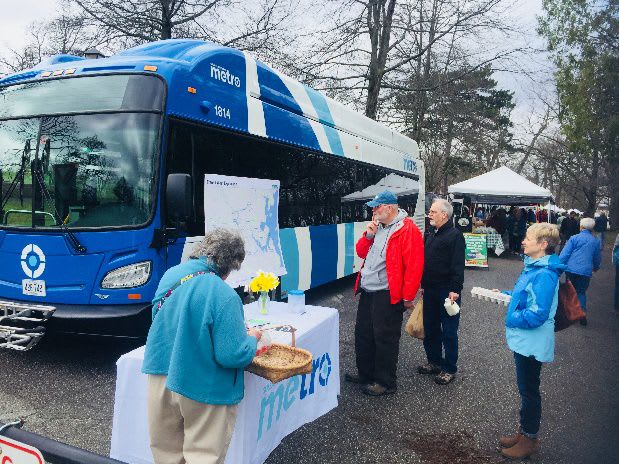
One of Greater Portland METRO's new buses, built by New Flyer, was on view at the Portland Farmers’ Market at Deering Oaks Park where visitors stopped by to get a closer look and meet with METRO staff. Photo: METRO
3 min to read
One of Greater Portland METRO's new buses, built by New Flyer, was on view at the Portland Farmers’ Market at Deering Oaks Park where visitors stopped by to get a closer look and meet with METRO staff. Photo: METRO
Greater Portland METRO unveiled new, 40-foot low-floor buses with modern, friendly features reflecting the agency’s vision of a more sustainable future.
Eleven buses are being delivered through May 2018. Eight of these buses will support Metro’s “Transit West” expansion, set to launch on August 27, 2018. Three of the new buses will replace vehicles that are over 20 years old. These 11 buses will be seen throughout the region over the next few months as they go through testing and bus operator training. The buses will be phased into passenger service between early July and August 27, 2018.
Five of the 11 buses are powered by Compressed Natural Gas (CNG). Six are powered by ultra-low sulfur diesel and include the latest emission control technology, which reduces air quality impacts. Up to 13 additional buses will be delivered in 2019 and 2020 which will replace vehicles that have exceeded their useful life.
The new buses are larger with 40 seats, compared to 31 to 35 seats in Metro’s older buses. The new buses feature two to three wheelchair positions, space for three bikes, Wi-Fi, additional security cameras, and in-seat USB ports. The interior cabin will be brighter due to stainless steel stanchions and panels, lighter colors for floors and panels, vibrant and colorful (and comfortable) seating, and clear emergency hatches. All buses are equipped with real-time arrival information.
The updated paint scheme is a key element of Metro’s rebranding campaign, which also includes a new logo and color scheme, updated bus stop signs, an improved website, and many other enhancements. Along with upcoming service improvements, the new logo and paint scheme are intended to signal that the Metro transit system is modernizing, effective at solving people’s mobility needs and a strong community asset.
Metro’s Transit West expansion launches August 27, 2018 and includes the following:
The new Husky Line will connect the communities of Portland, Westbrook, Gorham as well as the two USM campuses, with a limited stop, higher speed bus route.
A Transit Pass Program with the University of Southern Maine (USM) will provide free access to the Metro transit network for students, staff and faculty.
Bus stop improvements will be made at 30-35 sites across the Metro system which includes pedestrian and ADA improvements and bus shelters at 15-20 locations.
The buses are manufactured by New Flyer Industries, headquartered in St. Cloud, Minn. Following a 2016 competitive procurement, Metro awarded a contract to New Flyer for the production of 19 expansion and replacement buses with options to purchase an additional seven. For the first eleven buses, the diesel bus cost is $490,382 per unit while the CNG bus cost is $507,759 per unit.
Funding for the buses comes from federal grants which will cover 85% of the cost. The remaining 15% is covered by local sources of funding including revenue from fares, advertising, and state and local assistance.
Greater Portland METRO provides public transit services to Brunswick, Falmouth, Freeport, Portland, South Portland, Westbrook and Yarmouth. Metro’s 2017 ridership exceeded 1.85 million.
More Bus

New York MTA Plans Largest Bus Fleet Upgrade in More Than a Decade
The agency is seeking manufacturers for 650 new CNG buses to replace aging vehicles, improve reliability, and advance its broader fleet modernization strategy.
Read More →
Building a Flexible Path to Transit Electrification
John Hroncich discusses BAE Systems’ modular and scalable approach, lessons learned from decades of real-world operations, and how agencies can identify electrification strategies that fit their fleets.
Read More →
Bus Tech Talk: Keeping Transit Technicians Ahead of the Technology Curve
LA Metro’s Obed Mejia discusses technician training, evolving maintenance technology, fleet replacement, and strategies for getting the most out of today’s transit fleets.
Read More →
Biz Briefs: RIPTA Unveils New Frontrunners, Clevland RTA Adds New Siemens, and More
In METRO's latest installment, we take a look at recent news from Siemens, Prevost, Dodge, and more partnerships making headlines across the transportation sector.
Read More →
People Movement: Holly Arnold Joins Transdev and More
In this edition, we also cover recent appointments and announcements at Pace, CamTran, MCI, and more, showcasing the individuals helping to shape the future of transportation.
Read More →
The High Cost of Transit Buses: Industry Leaders Look to Procurement Reform
Transit leaders and policymakers examine how standardized bus designs, streamlined procurement, and predictable funding could help agencies stretch budgets and deliver better service.
Read More →
The Business Voice Behind Public Transportation
As chair of APTA’s Business Members Board of Governors, Ray Melleady explains how more than 850 business members are partnering with transit agencies to advance funding, innovation, and industry-wide collaboration.
Read More →
From Surviving to Thriving: Building Stronger Transportation Organizations
Bus Business Consultants founder Brian Dickson shares lessons on leadership, organizational health, and creating options for long-term success in a changing transportation industry.
Read More →
Finding the ‘Happy Medium’: Optimizing Maintenance Without Sacrificing Reliability
The key to maintenance optimization isn’t doing less work—it’s doing the right work at the right time on the right assets.
Read More →
LA Metro, City of West Hollywood, and Partners Advance Smarter Bus Lane Enforcement
The award-winning partnership combines AI-powered detection with human oversight to improve bus reliability, accessibility, and enforcement efficiency.
Read More →