



Joint venture wins award for design of Ottawa's Confederation Line
It is the first conversion of an exclusive bus rapid transit system into a light rail transit in North America.

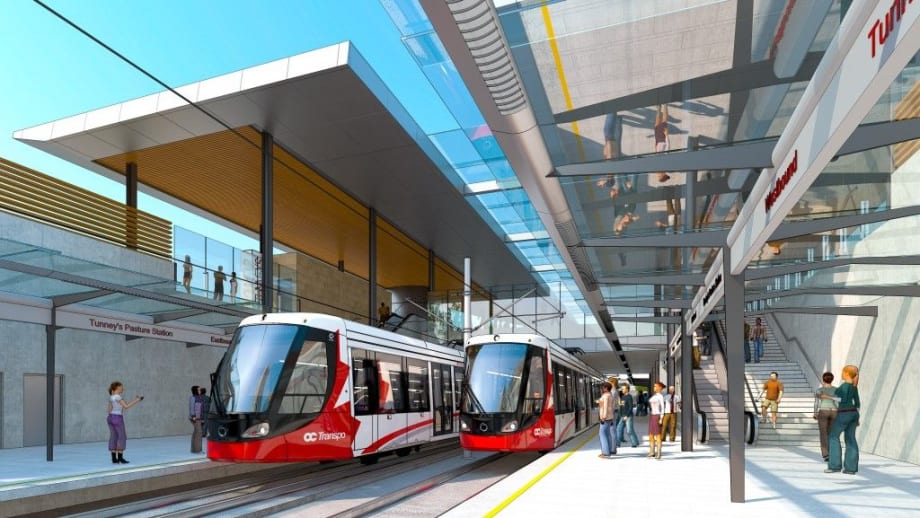
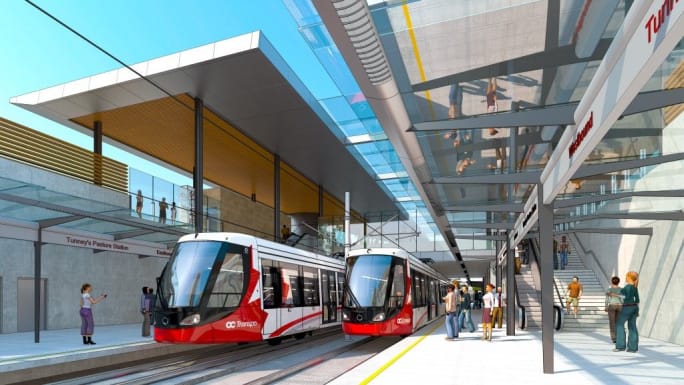
The Confederation Line runs approximately 7.8 miles and connects Ottawa’s Tunney’s Pasture and Blair Stations. City of Ottawa
The joint venture of STV, AECOM, Morrison Hershfield, and McMillen Jabobs Associates of Ottawa earned a National Recognition Award for exemplary engineering achievement in the American Council of Engineering Companies’ (ACEC) 53rd annual Engineering Excellence Awards (EEA) for designing the Stage 1 of the Confederation Line.
The Confederation Line runs approximately 7.8 miles and connects Ottawa’s Tunney’s Pasture and Blair Stations. The project consists of 13 stations — three of which are located within a 1.5 mile twin-track tunnel under downtown Ottawa — a new vehicle maintenance and storage facility, new light rail transit vehicles, traction power substations, and other associated infrastructure. It is the first conversion of an exclusive bus rapid transit system into a light rail transit in North America.
Initial ridership forecasts show that the Confederation Line would serve upwards of 10,700 passengers per hour in each direction during peak travel times. With Ottawa’s population expected to increase by at least 30% by 2031, it was critical for the system to be developed so that existing infrastructure could meet current demand while remaining responsive and adaptable to the anticipated surge in ridership growth.
The service runs zero-emission electric trains that reduce carbon dioxide emissions and the system was designed and built to better integrate with Ottawa’s bicycle infrastructure network.
The project is eligible for additional honors as part of a record 203 entries this year representing engineering excellence from throughout the nation and the world. Judging for the awards program — known industry-wide as the “Academy Awards of the engineering industry” — took place in February and was conducted by a national 35-member panel of built environment leaders, along with experts from government, the media and academia. Award criteria focused on uniqueness and originality, technical innovation, social and economic value, and generating excitement for the engineering profession.
Recognition of all award winners including top winners — 20 Honor Awards, 16 Grand Awards, and the prestigious “Grand Conceptor Award” for the year’s most outstanding overall engineering achievement — will take place at the annual EEA Dinner and Gala, originally scheduled for April 28, but will now take place in September on a date and location to be determined.
More Management

METRO Opens Submissions for 2026 Motorcoach Awards
Nominations are now being accepted for METRO Magazine’s Operator of the Year and Innovative Operator of the Year awards.
Read More →
New York MTA Advances Final Contract for Second Avenue Subway Expansion
Contract Four is the largest in the Second Avenue Subway Phase 2 project and includes construction of station infrastructure, tracks, and signals for the subway expansion, MTA officials said. Work on Contract Four will begin in 2027.
Read More →
Transit Agencies Highlight Safety Gains at National Summit
Leaders from 15 major transit systems shared crime-reduction results and safety initiatives while discussing the role of continued federal support.
Read More →

NITA Names New Leadership, Expands Reduced-Fare Program at First Board Meeting
The new regional transit authority appointed its first board chair and interim executive director while extending reduced fares across CTA, Metra, and Pace for eligible riders.
Read More →
Beyond the Checklist: A Structured Approach to Transit Maintenance
Reliability-Centered Maintenance helps transit agencies move beyond routine checklists to focus limited resources on the assets and failures that have the greatest impact on safety, reliability, and service.
Read More →
APTA 2026 Nominating Committee Selects Leadership Slate, Names Chair and Vice Chair Nominees
Leadership changes will help shape the association’s priorities and its representation of the transportation industry during the 2026–2027 term.
Read More →
DART Launches Major Security, Fare Enforcement Initiative
The 90-day demonstration will deploy coordinated security teams at five light rail stations while testing controlled access and gathering data to guide future investments.
Read More →
Advancing Fare Collection Through Technology and Innovation
Learn about delivering 1300 gates at 91 stations while managing fare evasion. Explore the large scale deployment, solution customization and real-world results that affect the region. Prepare for deployment in your region now.
Read More →
Game Day in Motion: Moving Millions During the 2026 World Cup
Between packed transit stations and team motorcoaches, see how agencies and operators across North America tackled the transportation demands of the 2026 FIFA World Cup.
Read More →
Surface Transportation Extension Averts Shutdown, Leaves Transit Funding Gap
The stopgap keeps federal transportation programs moving, but missing advance funding could complicate the transit and rail projects agencies are planning next.
Read More →