



Keolis, partners team for contactless payment in Dijon, France
The innovation, available throughout Dijon's two tram lines, will be extended to the city's bus routes in a second phase.

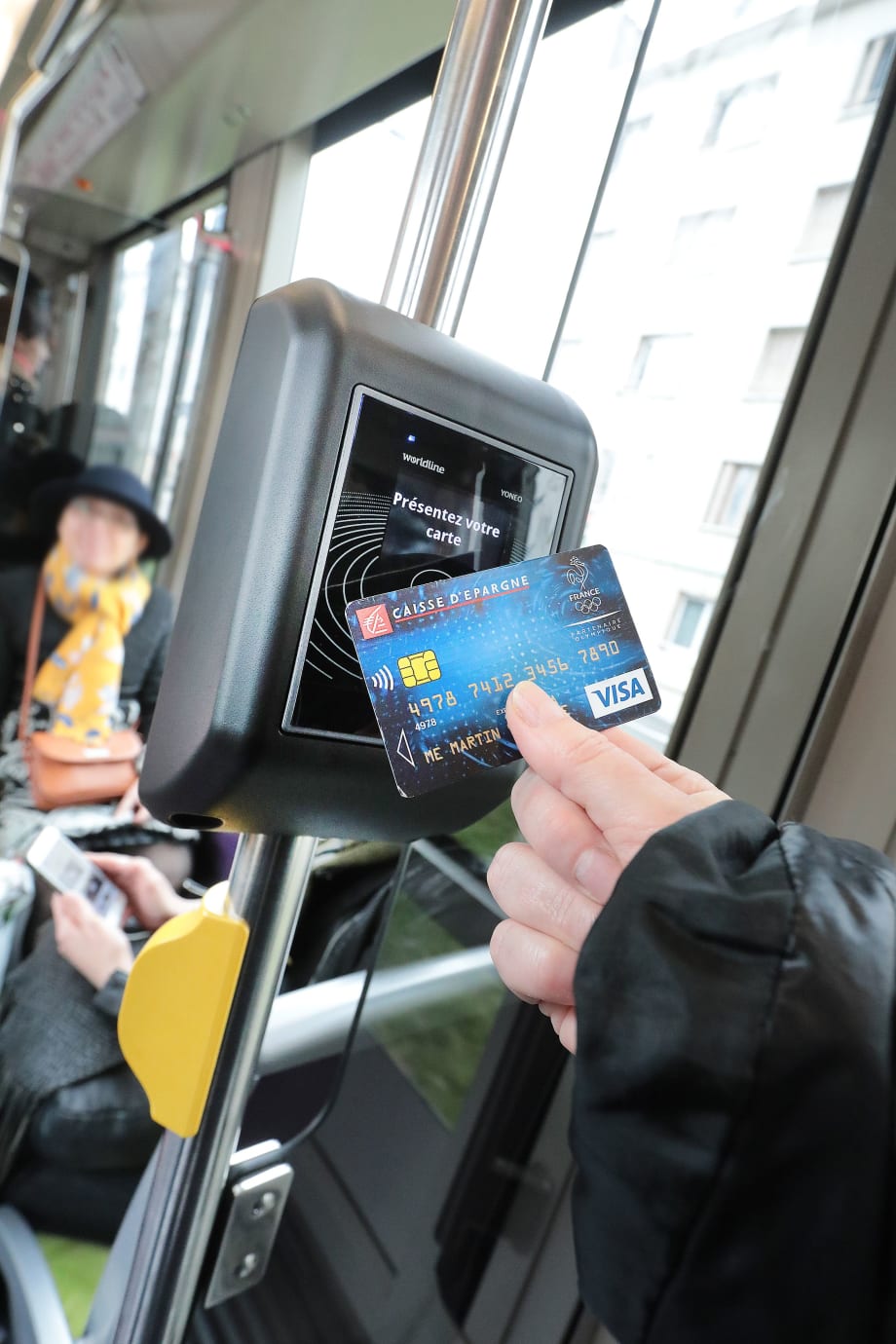
The new open payment solution enables users to avoid queuing and purchasing tickets from vending machines.
Keolis
The new open payment solution enables users to avoid queuing and purchasing tickets from vending machines.
Keolis
France’s Dijon Métropole, Keolis, the Caisse d'Epargne de Bourgogne Franche-Comté, Visa, and Worldline launched a new innovation in the field of open payment for public transport in Dijon. For the first time in France, when passengers (tourists, occasional travelers, regular passengers who have forgotten their ticket, etc.) board a tram, they will now be able to pay for their journey with a contactless payment card, regardless of their bank. This innovation, available throughout Dijon's two tram lines, will be extended to the city's bus routes in a second phase.
The new open payment solution enables users to avoid queuing and purchasing tickets from vending machines. All they have to do is board the trams and validate their journey by tapping their contactless payment card on the validation terminal provided for this purpose. They can then travel with total peace of mind, knowing that they always pay the lowest price for their journeys and will not have to present a paper ticket to controllers.
During inspections, a simple validation of the user's contactless payment card on the controller's terminal is sufficient to prove the user's right to travel. Finally, users of the service who want to view their travel history, or print their receipts if required, can simply go to the website and enter their bank card number. The dedicated page for this purpose is secured in accordance with banking standards.
After "On Dijon,” an innovative contract that is unique in the world for the creation and management of a connected "cockpit" of public space facilities in the 24 districts of the city that will be launched in late 2018, Dijon Métropole and its partners will continue with the transformation of their region. At the heart of the innovative policy led by François Rebsamen, Chair of Dijon Métropole, is a rich and varied heritage of remarkable diversity, bringing high quality development.
The capital and epicenter of the Bourgogne-Franche-Comté region, Dijon is a bold and radiant city on a human scale, a university and financial center with a rich history of solidarity, culture, and sport. This first in France, the contactless payment card transformed into a ticket, will facilitate the daily lives of the city's inhabitants. The innovation also positions Dijon Métropole as a model of sustainable development in the service of its citizens.
As a benchmark partner for the areas being transformed, Keolis is helping Dijon Métropole to design an optimized universal transport provision that is adapted to the needs of each passenger. With this open payment project, the company is developing a new connected transport experience that is both smoother and more enjoyable on a daily basis. By deploying this innovative system across the entire transport network, Keolis is supporting Dijon Métropole in its transformation into a smart city. The deployment of these services enables the company to optimize the transport experience for both regular and occasional passengers and to enhance culture and tourism in the city.
More Management

METRO Opens Submissions for 2026 Motorcoach Awards
Nominations are now being accepted for METRO Magazine’s Operator of the Year and Innovative Operator of the Year awards.
Read More →
New York MTA Advances Final Contract for Second Avenue Subway Expansion
Contract Four is the largest in the Second Avenue Subway Phase 2 project and includes construction of station infrastructure, tracks, and signals for the subway expansion, MTA officials said. Work on Contract Four will begin in 2027.
Read More →
Transit Agencies Highlight Safety Gains at National Summit
Leaders from 15 major transit systems shared crime-reduction results and safety initiatives while discussing the role of continued federal support.
Read More →

NITA Names New Leadership, Expands Reduced-Fare Program at First Board Meeting
The new regional transit authority appointed its first board chair and interim executive director while extending reduced fares across CTA, Metra, and Pace for eligible riders.
Read More →
Beyond the Checklist: A Structured Approach to Transit Maintenance
Reliability-Centered Maintenance helps transit agencies move beyond routine checklists to focus limited resources on the assets and failures that have the greatest impact on safety, reliability, and service.
Read More →
APTA 2026 Nominating Committee Selects Leadership Slate, Names Chair and Vice Chair Nominees
Leadership changes will help shape the association’s priorities and its representation of the transportation industry during the 2026–2027 term.
Read More →
DART Launches Major Security, Fare Enforcement Initiative
The 90-day demonstration will deploy coordinated security teams at five light rail stations while testing controlled access and gathering data to guide future investments.
Read More →
Advancing Fare Collection Through Technology and Innovation
Learn about delivering 1300 gates at 91 stations while managing fare evasion. Explore the large scale deployment, solution customization and real-world results that affect the region. Prepare for deployment in your region now.
Read More →
Game Day in Motion: Moving Millions During the 2026 World Cup
Between packed transit stations and team motorcoaches, see how agencies and operators across North America tackled the transportation demands of the 2026 FIFA World Cup.
Read More →
Surface Transportation Extension Averts Shutdown, Leaves Transit Funding Gap
The stopgap keeps federal transportation programs moving, but missing advance funding could complicate the transit and rail projects agencies are planning next.
Read More →