




L.A. Metro Taps Partner for Transit Ambassador Program
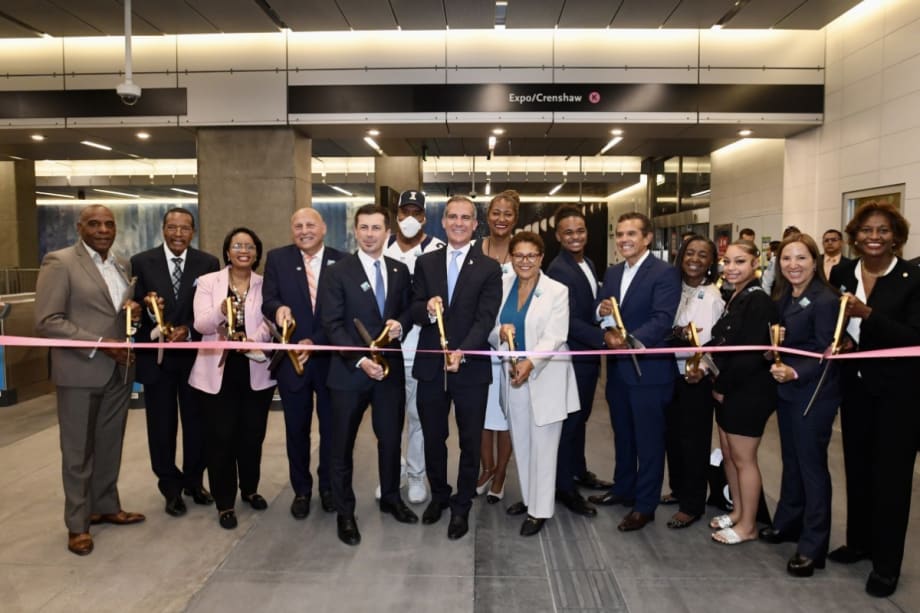
L.A. Metro Holds Celebration at Expo/Crenshaw Station
The Crenshaw/LAX Transit Project, now the K Line, represents a $2 billion public transportation investment from Metro’s federal, state, and local partners.
July 11, 2022
The project will extend light rail from the existing Metro E Line (Expo) at Crenshaw and Exposition Boulevards to the C Line (Green) in El Segundo.
Photo: L.A. Metro
3 min to read
In advance of the opening of the K Line later this year, the Los Angeles County Metropolitan Transportation Authority (Metro) held a new station dedication celebration at the future Expo/Crenshaw station in the Crenshaw District.
U.S. Secretary of Transportation Pete Buttigieg, FTA Administrator Nuria Fernandez, U.S. Congress members Maxine Waters and Karen Bass, Calif. Lieutenant Governor Eleni Kounalakis, Metro board chair and Glendale council member Ara Najarian, fellow board members, and Metro CEO Stephanie N. Wiggins joined local officials to recognize community leaders, advocates, and residents for their efforts to help the project reach this point.
"This is a monumental accomplishment that many have referred to as the most important investment in the heart of Los Angeles’ Black community in decades," said Buttigieg. "This is a good investment in good public transit that will bring new businesses, housing and economic development right here."
The Crenshaw/LAX Transit Project, now the K Line, represents a $2 billion public transportation investment from Metro’s federal, state, and local partners that will serve communities in the cities of Los Angeles, Inglewood, and El Segundo. This investment provides a link for passengers heading to key destinations in downtown Los Angeles, the Westside, and Los Angeles International Airport.
The project will extend light rail from the existing Metro E Line (Expo) at Crenshaw and Exposition Boulevards to the C Line (Green) in El Segundo. The Expo/Crenshaw station will serve as a transfer station for the E and K Lines, which will allow passengers to transfer between rail lines via a short walk. The eight-station K Line will travel 8.5 miles and serve communities in South Los Angeles and the South Bay.
The U.S. Department of Transportation provided an array of federal funding, which included funds from TIGER (Transportation Investment Generating Economic Recovery) grants, Congestion Mitigation and Air Quality Program, Highway Infrastructure Program, and the Surface Transportation Block Grant Program for a total of $263.9 million.
"Transit all over our country has the ability to be the great equalizer, bringing the same chance to work, learn and play to everyone who steps aboard," said Fernandez. "In this critically important part of Los Angeles, thousands of people will have a fast, safe, reliable way to connect with their community. When Metro Airport Connector is finished, it’s a short train ride to LAX, where they can connect with the whole world."
The project also received over $1.6 billion in local funding directly from L.A. County voter-approved initiatives such as Proposition A, Measures R and M, and Proposition C. Funds were also provided by local agency contributions and Metro’s general fund.
"The K Line is a long-awaited promise of transit equity for South Los Angeles," said Jacquelyn Dupont-Walker, Metro board first vice chair. "This line will be complemented by projects in the pipeline such as the K Line Northern Extension, the Airport Metro Connector and the C Line Extension, all of which, will serve as a nexus to other transit lines. Additionally, passengers will benefit from enhanced first/last mile connections, which include buses, bikes, Metro Micro, and walking."
The Crenshaw/LAX project also offered many residents within the alignment an opportunity to work on the project. As part of Metro’s Project Labor Agreement and construction careers policy, the project exceeded the following workforce requirements:
Metro’s goal to hire 40% targeted workers from an economically disadvantaged community was exceeded by 20%, reaching 60% of targeted workers on the project.
Metro’s goal to hire 20% apprentice workers actually reached 23.51%.
Metro’s goal to recruit and hire 10% disadvantaged workers or socially barriered individuals reached 10.31%.
"The K Line is integral to L.A.’s transportation future — and this station dedication shows how close we are bringing world-class public transportation to South Los Angeles," said Eric Garcetti, Los Angeles mayor. "Once complete this fall, this new line will open doors of opportunity for riders across Los Angeles — and is a clear indication of our commitment to make Los Angeles a more accessible, sustainable, and inclusive city."
More Rail

New York MTA Advances Final Contract for Second Avenue Subway Expansion
Contract Four is the largest in the Second Avenue Subway Phase 2 project and includes construction of station infrastructure, tracks, and signals for the subway expansion, MTA officials said. Work on Contract Four will begin in 2027.
Read More →
San Diego MTS Breaks Monthly Trolley Ridership Record
Agency officials said July’s ridership indicates MTS’s continued recovery from the pandemic.
Read More →
Report Examines NJ TRANSIT Reliability, Funding Challenges
The Garden State Initiative analysis examines the roles of Amtrak infrastructure, fleet management, and agency operations while recommending a more performance-based approach to improving reliability.
Read More →
Stadler, CapMetro Sign Long-Term Rail Fleet Support Agreement
Beginning in 2027, Stadler will provide on-site technical expertise, spare parts support, training, and obsolescence management to help extend the reliability and longevity of CapMetro’s GTW fleet.
Read More →
Biz Briefs: Alstom Lands Canadian Contract, LYT to Supply California TSP, and More
In METRO's latest installment, we take a look at recent news from Complete Coach Works, Beep, FlixBus, and more partnerships making headlines across the transportation sector.
Read More →
CATS Gold Line Marks 5 Years of Service, 2.8M Passenger Trips
With a six-mile expansion planned, the Charlotte streetcar is positioned to connect more neighborhoods and major transit hubs across the region.
Read More →
Why Simulating Pedestrian Movement Has Become Essential for Modern Rail Stations
Pedestrian microsimulation is helping rail planners identify bottlenecks, test station designs, and prepare complex transit hubs for growing passenger volumes.
Read More →
Amtrak Begins Major Construction at New York’s Sunnyside Yard
The new maintenance facility will support Amtrak’s Airo trainsets while improving maintenance efficiency and turnaround times in New York.
Read More →
Chicago Leaders Unveil Plans for O’Hare Airport Express Train
The privately developed project would offer a 15-minute trip between downtown and O’Hare’s Terminal 2, with trains operating every 15 minutes on a dedicated track. The service would use battery-electric trains and three existing freight rail rights-of-way.
Read More →
OCTA Maps Out 30-Year Strategy to Protect Coastal Rail Corridor
The draft feasibility report identifies strategies to protect the coastal rail line for decades as the agency continues near-term stabilization and sand placement efforts.
Read More →