



Las Vegas Bus Rapid Project Lands Fed Funding
The grant, for the new Maryland Parkway line, was funded by President Biden’s Bipartisan Infrastructure Law, which includes historic funding for public transit systems of all sizes.

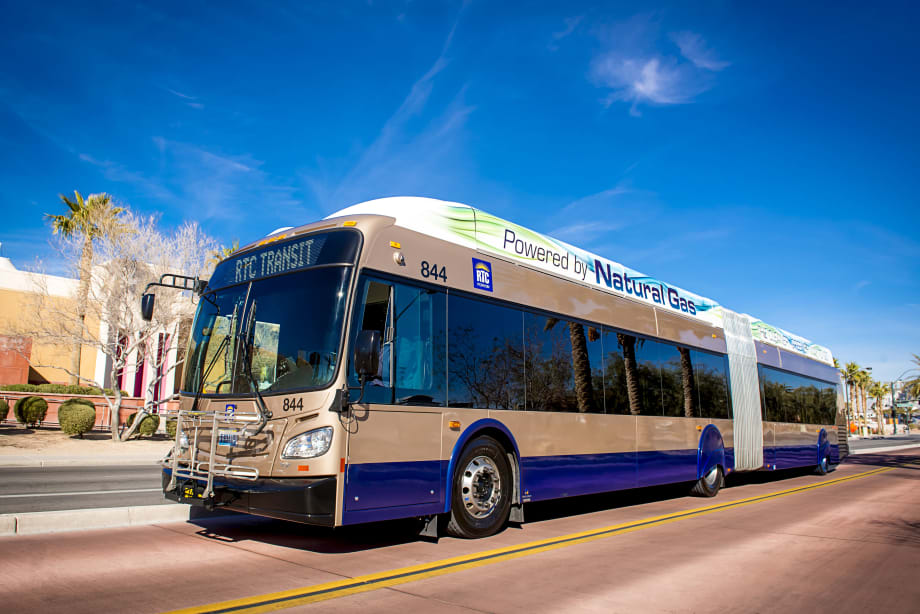
BRT service will replace traditional bus lines and connect to Harry Reid International Airport, the sixth busiest airport in the nation and one of the largest employers in the state.
Photo: RTC of Southern Nevada
The Federal Transit Administration (FTA) announced a $149.9 million grant award to the Regional Transportation Commission of Southern Nevada (RTC) to support the construction of a faster, more frequent bus route between downtown Las Vegas, the University of Nevada at Las Vegas, Harry Reid International Airport, and other popular destinations.
The grant, for the new Maryland Parkway line, was funded by President Biden’s Bipartisan Infrastructure Law, which includes historic funding for public transit systems of all sizes.
“The Biden Administration is proud to give Las Vegas residents and visitors faster, cleaner, more reliable bus service along 12 miles of Maryland Parkway,” said U.S. Transportation Secretary Pete Buttigieg. “With dedicated bus lanes, traffic signal priority, and new hydrogen-powered buses, this project will deliver a cleaner, better, faster commute.”
The RTC’s BRT Program
Thanks to this grant, 15 hydrogen fuel cell-powered, 60-foot articulated buses will be added to travel the 12.5-mile Maryland Parkway route.
Bus Rapid Transit (BRT) service will replace traditional bus lines and connect to Harry Reid International Airport, the sixth busiest airport in the nation and one of the largest employers in the state. In addition, it will link riders with 25 other bus routes via the Bonneville Transit Center and the South Strip Transit Terminal.
The buses will run in 7.2 miles of dedicated lanes and receive traffic signal priority while in mixed-flow traffic, reducing transit time for riders.
The transit agency estimates the new BRT service will decrease travel time for riders by about 20% compared to the current, traditional bus route that takes more than an hour to run 20 miles, saving valuable time for more than 80,000 workers employed in the area.
“While Las Vegas is normally thought of as a tourist mecca, we know that thousands of Nevadans depend on transit to move them around this growing, thriving city,” said FTA Acting Administrator Veronica Vanterpool. “The faster, more reliable, more convenient service provided by bus rapid transit has created an economic boost for communities across the country. We know it will bring that same impact to workers, students, and others who call Las Vegas home.”
Additional Benefits
The project also includes shared bus-bike lanes, wider sidewalks, and improvements to lighting and landscaping.
The federal support for the estimated $378.1 million project comes from FTA’s Capital Investment Grants program, which helps communities carry out transformational transit projects.
More Bus

New York MTA Plans Largest Bus Fleet Upgrade in More Than a Decade
The agency is seeking manufacturers for 650 new CNG buses to replace aging vehicles, improve reliability, and advance its broader fleet modernization strategy.
Read More →
Building a Flexible Path to Transit Electrification
John Hroncich discusses BAE Systems’ modular and scalable approach, lessons learned from decades of real-world operations, and how agencies can identify electrification strategies that fit their fleets.
Read More →
Bus Tech Talk: Keeping Transit Technicians Ahead of the Technology Curve
LA Metro’s Obed Mejia discusses technician training, evolving maintenance technology, fleet replacement, and strategies for getting the most out of today’s transit fleets.
Read More →
Biz Briefs: RIPTA Unveils New Frontrunners, Clevland RTA Adds New Siemens, and More
In METRO's latest installment, we take a look at recent news from Siemens, Prevost, Dodge, and more partnerships making headlines across the transportation sector.
Read More →
People Movement: Holly Arnold Joins Transdev and More
In this edition, we also cover recent appointments and announcements at Pace, CamTran, MCI, and more, showcasing the individuals helping to shape the future of transportation.
Read More →
The High Cost of Transit Buses: Industry Leaders Look to Procurement Reform
Transit leaders and policymakers examine how standardized bus designs, streamlined procurement, and predictable funding could help agencies stretch budgets and deliver better service.
Read More →
The Business Voice Behind Public Transportation
As chair of APTA’s Business Members Board of Governors, Ray Melleady explains how more than 850 business members are partnering with transit agencies to advance funding, innovation, and industry-wide collaboration.
Read More →
From Surviving to Thriving: Building Stronger Transportation Organizations
Bus Business Consultants founder Brian Dickson shares lessons on leadership, organizational health, and creating options for long-term success in a changing transportation industry.
Read More →
Finding the ‘Happy Medium’: Optimizing Maintenance Without Sacrificing Reliability
The key to maintenance optimization isn’t doing less work—it’s doing the right work at the right time on the right assets.
Read More →
LA Metro, City of West Hollywood, and Partners Advance Smarter Bus Lane Enforcement
The award-winning partnership combines AI-powered detection with human oversight to improve bus reliability, accessibility, and enforcement efficiency.
Read More →