



‘Living Lab’ for Transit Innovation Opens in Santa Clara, Calif.
The new initiative aims to rethink how VTA delivers bus, rail, roadway and other transportation services, said Santa Clara VTA GM Nuria Fernandez. As a catalyst for ingenuity, the center intends to pair itself with academics, startups, tech firms and nonprofits from the region. The center also will operate the VTA’s open data portal.

Images courtesy: Santa Clara VTA
By Jason Shueh
Images courtesy: Santa Clara VTA
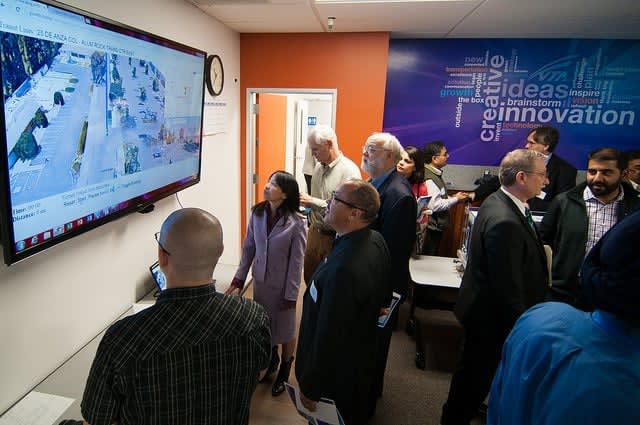
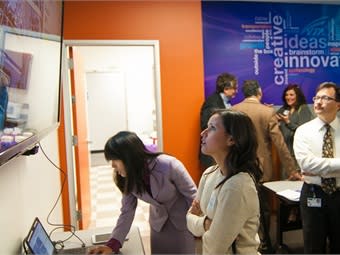
The room is a narrow cut of office space that could accommodate roughly 10 desks. Windows border one side; the other is an orange wall that opens to a nearby kitchen. It used to be a conference and lunch area.
But the Santa Clara Valley Transportation Authority in California’s Santa Clara County has big plans for this small space — it now serves as the VTA Innovation Center, adorned with flat screens, digital workstations and other gadgetry. A grand opening event on Feb. 18 brought technologists from across the Silicon Valley to hear about a program that will act as a “living laboratory” for testing new technologies.
Independent from the city and county of Santa Clara, the VTA serves the region as a quasi-governmental entity that funds, plans and manages transit operations throughout the county.

Santa Clara VTA GM Nuria Fernandez speaking during the event. Photo: Santa Clara VTA
“I’m hoping this Innovation Center is going to be the incubator of new ideas, but it will also develop and pilot existing ideas that have not yet been applied to public transportation or transportation in general,” said Nuria Fernandez, the VTA’s general manager.
“We can’t pave our way out of congestion, but we can certainly utilize our infrastructure that we have in better ways.”
Fernandez said the new initiative aims to rethink how VTA delivers bus, rail, roadway and other transportation services. As a catalyst for ingenuity, the center intends to pair itself with academics, startups, tech firms and nonprofits from the region. The center also will operate the VTA’s open data portal.
“We can’t pave our way out of congestion, but we can certainly utilize our infrastructure that we have in better ways. That’s why we’re gathered here today,” Fernandez said.
Santa Clara VTA
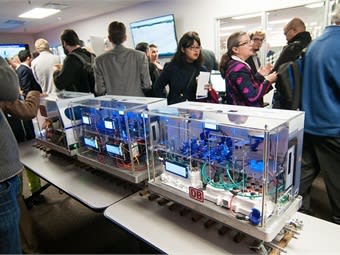
Current VTA projects include expanding Internet connectivity on buses and rail, improving county transit routing systems and installing sensors for clearer insights on traffic conditions. San Jose Vice Mayor and VTA Board Member Rose Herrera said innovations developed at the center are likely to be tested in the North San Jose Transportation Innovation Zone, an 11-mile stretch of roadways that contain 21 traffic signals, 670 street lights, a VTA bus yard and the intersection of two light rail lines. The area is well known as the testing grounds for Google’s self-driving cars.
“This will allow innovators to emulate real-world conditions for the testing of, for example, self-driving vehicles, automated traffic enforcement, vehicle-to-infrastructure communication, street light innovations, and sensors for collecting data on traffic, noise and air quality,” Herrera said.
Santa Clara VTA
Tech startups and civic hackers will play a significant role at the center as well. The county is working with Transitmix, a company that sprouted from the civic tech organization Code for America, to deploy a system to route buses on the fly based on geospatial data such as population metrics from U.S. Census data. The startup AmigoCloud also is adding to VTA’s suite of mapping tools. The company is prototyping what the VTA tentatively calls its Multimodal Trip Planner, a tool that estimates trip times and costs for routes where multiple forms of travel are used.
Moving forward, collaborations are in the works with San Jose State University’s Mineta Transportation Institute and the San Jose Environmental Innovation Center for research and joint innovation endeavors. On June 6, the VTA also plans to use the center for the National Day of Civic Hacking where it will launch Hack My Ride 2015, an annual hackathon to generate apps, data visualizations, prototypes and ideas to improve Santa Clara’s transit experience. The event will be coupled with a four-month-long app challenge to focus on accessibility and open data usage.
This story originally was published by Government Technology and govtech.com.
Santa Clara VTA

Santa Clara VTA
More Management

METRO Opens Submissions for 2026 Motorcoach Awards
Nominations are now being accepted for METRO Magazine’s Operator of the Year and Innovative Operator of the Year awards.
Read More →
New York MTA Advances Final Contract for Second Avenue Subway Expansion
Contract Four is the largest in the Second Avenue Subway Phase 2 project and includes construction of station infrastructure, tracks, and signals for the subway expansion, MTA officials said. Work on Contract Four will begin in 2027.
Read More →
Transit Agencies Highlight Safety Gains at National Summit
Leaders from 15 major transit systems shared crime-reduction results and safety initiatives while discussing the role of continued federal support.
Read More →

NITA Names New Leadership, Expands Reduced-Fare Program at First Board Meeting
The new regional transit authority appointed its first board chair and interim executive director while extending reduced fares across CTA, Metra, and Pace for eligible riders.
Read More →
Beyond the Checklist: A Structured Approach to Transit Maintenance
Reliability-Centered Maintenance helps transit agencies move beyond routine checklists to focus limited resources on the assets and failures that have the greatest impact on safety, reliability, and service.
Read More →
APTA 2026 Nominating Committee Selects Leadership Slate, Names Chair and Vice Chair Nominees
Leadership changes will help shape the association’s priorities and its representation of the transportation industry during the 2026–2027 term.
Read More →
DART Launches Major Security, Fare Enforcement Initiative
The 90-day demonstration will deploy coordinated security teams at five light rail stations while testing controlled access and gathering data to guide future investments.
Read More →
Advancing Fare Collection Through Technology and Innovation
Learn about delivering 1300 gates at 91 stations while managing fare evasion. Explore the large scale deployment, solution customization and real-world results that affect the region. Prepare for deployment in your region now.
Read More →
Game Day in Motion: Moving Millions During the 2026 World Cup
Between packed transit stations and team motorcoaches, see how agencies and operators across North America tackled the transportation demands of the 2026 FIFA World Cup.
Read More →
Surface Transportation Extension Averts Shutdown, Leaves Transit Funding Gap
The stopgap keeps federal transportation programs moving, but missing advance funding could complicate the transit and rail projects agencies are planning next.
Read More →