



Lower obesity rates linked with public transportation use, study shows
A single percentage-point increase in mass transit ridership is associated with a 0.473 percentage-point lower obesity rate.

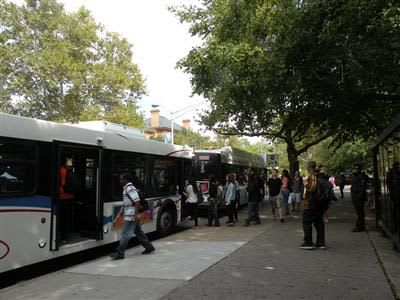
Organizations like the Champaign-Urbana Mass Transit District (MTD) not only save riders money on parking and vehicle maintenance, but they also give its users a leg up on fighting obesity. Photo: Champaign-Urbana Mass Transit District

Public transportation systems provide numerous economic benefits for a community. An added public health bonus provided by such systems may be lower obesity rates.
A new study by researchers from the University of Illinois at Urbana-Champaign and Georgia Tech compared and analyzed county data from 2001 and 2009. They found that a single percentage-point increase in mass transit ridership is associated with a 0.473 percentage-point lower obesity rate in counties across the U.S.
“Opting for mass transit over driving creates opportunities for exercise that may otherwise not exist,” said Sheldon H. Jacobson, a co-author of the study and a Founder Professor of Computer Science at Illinois. “Instead of just stepping out of the house and into his car, riders need to walk from their home to a bus stop and from their stop to their destination.”
The results of the study, published in the journal Transportation Research Part A: Policy and Practice, details a computational analysis of publicly available health, transportation, and census data across 227 counties from 45 states in 2001 and 2009. Differences in economic and lifestyle factors including leisure-time exercise, household income, health care coverage, and public transit funding were included in the analysis.
The new analysis is consistent with previous work by the researchers — which found that each percentage-point increase in a county’s public transit ridership was associated with a 0.221 percentage-point lower obesity rate.
“The new work takes a longitudinal approach, meaning that we examined differences between 2001 and 2009, allowing us to better control for factors that could otherwise influence the analysis,” said co-author Douglas M. King, a Senior Lecturer in the Department of Industrial and Enterprise Systems Engineering at Illinois. “For example, factors like weather or physical geography that can influence the obesity rate of a county in both 2001 and 2009 are controlled since their impact is present in both time periods.”
While the calculated estimates from the two studies differ in magnitude, they do not differ in a statistically significant way, the researchers note. However, both studies suggest that increasing public transit usage is associated with a reduction in a county’s obesity rate.
“Because this analysis is at the county level, the implications for an average person are not clear,” Jacobson said. “The results indicate that when more people opt to use public transit, the county-level obesity rate tends to drop, though it does not necessarily imply that any one particular person is less likely to be obese if they ride transit frequently.”
This study focuses on data collected in 2001 and 2009, when rail and bus were the primary modes of public transportation in the U.S.
“It will be interesting to see how Uber and Lyft, as well as bike-share programs will influence this type of analysis in the future,” Jacobson said. “Our research suggests that investing in public transit can provide more efficient transportation options that not only help the environment but may also offer public health benefits.”
More Bus

PSTA Modernizes Workforce Management with Digital Bidding System
The award-winning Workforce Transit Modernization project replaced paper bidding with a transparent digital platform, cutting administrative effort while improving access for operators.
Read More →
Washington's Community Transit Sets Six-Year Roadmap for Growth, Expansion
Approved TDP targets more bus service, new mobility options, Swift BRT expansion, and a potential Everett Transit annexation.
Read More →
DART Customer Satisfaction Reaches Six-Year High
Overall satisfaction rose to 74.9%, while the agency’s Net Promoter Score reached a record 33.7.
Read More →
How DART's GoPass Is Redefining Regional Mobility
Serving 14 transit agencies, GoPass simplifies multimodal travel by allowing riders to plan, pay for, and manage an entire trip through one app.
Read More →
Biz Briefs: OCTA Taps Clean Energy for Hydrogen Station, Stadler to Supply Via Rail Vehicles, and More
From manufacturers and suppliers to transit agencies and motorcoach operators, these updates offer a snapshot of the projects, partnerships and business moves driving the industry forward.
Read More →
METRO Magazine Announces 2026 Innovative Solutions Awards Winners
Projects Recognized for Advancing Mobility Through Technology, Accessibility, Workforce Innovation, and Operational Excellence
Read More →
Biz Briefs: STV teams with Amtrak, Motorcoach Operators Boost Fleet and Land Contracts, and More
From manufacturers and suppliers to transit agencies and motorcoach operators, these updates offer a snapshot of the projects, partnerships and business moves driving the industry forward.
Read More →
LA Metro Marks Banner Year, Sets Ambitious Goals for New Fiscal Year
Incoming LA Metro Board Chair and Los Angeles Mayor Karen Bass joined outgoing Board Chair Fernando Dutra and LA Metro CEO Stephanie Wiggins to review accomplishments from fiscal year 2026, which included the opening of new rail extensions, advancement of major transit projects, expanded safety programs, and new rider amenities.
Read More →
DART Taps Nathaniel P. Ford Sr. as Next President/CEO
Since 2012, Ford has served as the CEO of the Jacksonville Transportation Authority
Read More →
AC Transit’s Cecil Blandon on Building the Next Generation of Transit Maintenance Leaders
The agency’s maintenance chief discusses leadership, workforce development, zero-emission technology, and preparing technicians for the future of public transportation.
Read More →