




RELATED: March Networks introduces new 'Incident Search' tool
March Networks announces compact IP recorders
The recorders provide transportation agencies with sharp megapixel video evidence, automated wireless downloading, Power over Ethernet, and search and investigation capabilities.
September 12, 2017
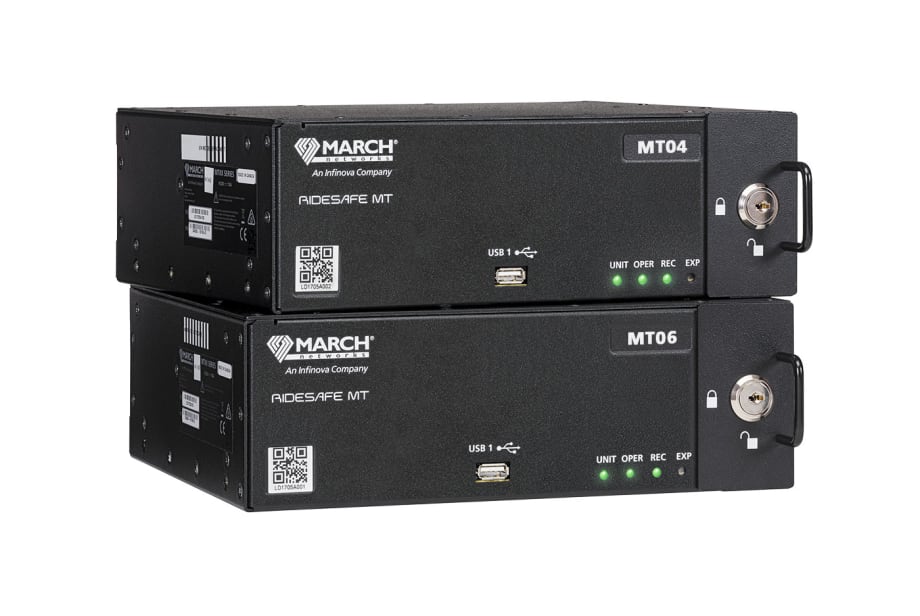
Available in 4 and 6-channel models, the compact IP recorders are ideal for mid-sized vehicles and paratransit fleets ready to transition to all-IP video capture. Photo: March Networks
1 min to read
Available in 4 and 6-channel models, the compact IP recorders are ideal for mid-sized vehicles and paratransit fleets ready to transition to all-IP video capture. Photo: March Networks
March Networks introduced its RideSafe MT Series IP Recorders, built to capture high-definition IP video and integrated vehicle data in demanding bus environments.
The recorders provide transportation agencies with sharp megapixel video evidence, automated wireless downloading, Power over Ethernet, and search and investigation capabilities.
Available in 4 and 6-channel models, the compact IP recorders are ideal for mid-sized vehicles and paratransit fleets ready to transition to all-IP video capture.
The RideSafe MT Series IP Recorders also integrate with vehicle Computer Aided Dispatch and Automated Vehicle Location data. Transit agencies can use the solution to search for recorded events, including vehicle hardbrakes, speed, GPS location, door malfunctions, and driver-tagged incidents, and review these incidents along with the associated video. The clear video and metadata enable fleet operators to investigate complaints, liability claims, and other events quickly and cost-effectively to see what actually occurred and arm themselves with compelling video evidence.
The RideSafe MT Series recorders incorporate an embedded Linux OS to eliminate unnecessary background services, front-panel diagnostic LEDs, solid state disk drives, and internal battery backup. In addition, they are built to withstand the wide temperature ranges, humidity, shock, vibration, and other environmental pressures common on mobile vehicles, and support enterprise-class remote health monitoring via the Command software.
More Technology

From Hardware to Digital Partner: Luminator Charts Its Next Chapter
CEO Magnus Friberg discusses Luminator’s shift toward becoming a digital partner, the growing importance of software and interoperability, and how AI can help agencies improve operations and passenger experience.
Read More →
Beyond the Checklist: A Structured Approach to Transit Maintenance
Reliability-Centered Maintenance helps transit agencies move beyond routine checklists to focus limited resources on the assets and failures that have the greatest impact on safety, reliability, and service.
Read More →
NJ TRANSIT Advances Bus Technology Upgrades Across Statewide Fleet
More than 1,500 buses now feature upgraded technology designed to improve arrival predictions and provide free Wi-Fi, with deployment expected to reach nearly 2,000 buses by the end of 2026.
Read More →

Building a Flexible Path to Transit Electrification
John Hroncich discusses BAE Systems’ modular and scalable approach, lessons learned from decades of real-world operations, and how agencies can identify electrification strategies that fit their fleets.
Read More →
Biz Briefs: Alstom Lands Canadian Contract, LYT to Supply California TSP, and More
In METRO's latest installment, we take a look at recent news from Complete Coach Works, Beep, FlixBus, and more partnerships making headlines across the transportation sector.
Read More →
Sponsored•September 8, 2026
From Legacy Silos to Conversational Intelligence
What if transit leaders could ask any operational question and get a trusted answer in seconds? Conversational AI is transforming how agencies use their data.
Read More →
USDOT Announces Rail Vehicle Replacement Grants, Chattanooga AV Shuttle Funding
More than $191 million in federal funding will help three transit agencies replace aging rail vehicles and support a new autonomous shuttle service in Chattanooga.
Read More →
Bus Tech Talk: Keeping Transit Technicians Ahead of the Technology Curve
LA Metro’s Obed Mejia discusses technician training, evolving maintenance technology, fleet replacement, and strategies for getting the most out of today’s transit fleets.
Read More →
Biz Briefs: RIPTA Unveils New Frontrunners, Clevland RTA Adds New Siemens, and More
In METRO's latest installment, we take a look at recent news from Siemens, Prevost, Dodge, and more partnerships making headlines across the transportation sector.
Read More →
Why Simulating Pedestrian Movement Has Become Essential for Modern Rail Stations
Pedestrian microsimulation is helping rail planners identify bottlenecks, test station designs, and prepare complex transit hubs for growing passenger volumes.
Read More →