




Read More: Grant to Help UCLA Boost Electric Bus, Charging Program
May Mobility Expands Autonomous Driver-Out Vehicle Operations
May Mobility expands driver-out autonomous vehicle testing to Ann Arbor Michigan as they continue to bring driver-out vehicle services to the U.S. and Japan commercially.
November 20, 2024
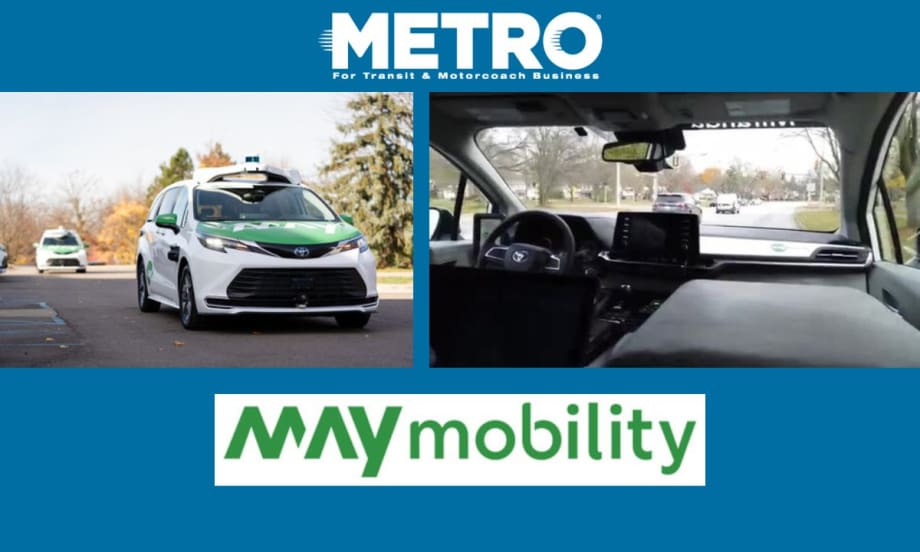
May Mobility is bringing driverless Automated Vehicles to Ann Arbor Michigan.
Photo: May Mobilty/Canva
2 min to read
May Mobility announced its second driverless operation in the U.S. is coming to Ann Arbor, MI. Testing driver-out in Ann Arbor is the next step toward expanding autonomous driverless vehicle services commercially across the U.S. and Japan alongside key partners including Toyota, NNT, and Lyft.
The driver-out testing in Ann Arbor involves significant complexity of traffic, weather patterns, and pedestrian density and operates in and around approximately 2 square miles of Ann Arbor surface streets.
May Mobility showcased its driver-out capabilities with 30-minute autonomous vehicle rides on public roads during its Technology Day in Ann Arbor.
"Starting driver-out operations in our second city in under a year shows the scalability of our technology while expanding our capabilities to challenging weather, higher speeds and busy traffic," said Edwin Olson, CEO and co-founder of May Mobility.
May Mobility’s vehicles are equipped with its unique Multi-Policy Decision Making (MPDM technology that leverages in-situ AI to interpret data in real-time, continuously learning and adapting to new, complex, and even unpredictable driving conditions to create a safer, more comfortable ride.
MPDM solves the industry’s biggest challenge, adapting to unexpected, dynamic conditions or “edge cases,” and allows the company to scale quickly and efficiently to new environments. May Mobility has additionally continued to develop and advance the technology to handle an increasingly complex operational design domain.
As part of May Mobility’s newest driver-out operations, the company introduced its latest generation of autonomy hardware and UX upgrades. During each ride, passengers will get a view of the vehicle’s perception and decision-making ability while it navigates.
The vehicles have also been upgraded with accessibility in mind, including automated audio announcements and a physical keypad that includes brail.
Without a safety operator behind the wheel, May Mobility has implemented a robust Tele-Assist platform for consistent monitoring of vehicle behavior to provide vehicle assistance as needed. As a result, riders with questions or concerns can connect with customer support at the touch of a button.
May Mobility has successfully demonstrated AD technology through multiple commercial deployments, including 10 active deployments which will increase to 13 by the end of this year. The company launched driver-out in Sun City, AZ less than a year ago, becoming the third company to operate driverless on public roads. May Mobility is currently working with Peachtree Corners, GA to bring driverless operations to the smart city in 2025 and also recently announced its partnership with Lyft, including plans to transition future deployments to driver-out over time.
More Technology

From Hardware to Digital Partner: Luminator Charts Its Next Chapter
CEO Magnus Friberg discusses Luminator’s shift toward becoming a digital partner, the growing importance of software and interoperability, and how AI can help agencies improve operations and passenger experience.
Read More →
Beyond the Checklist: A Structured Approach to Transit Maintenance
Reliability-Centered Maintenance helps transit agencies move beyond routine checklists to focus limited resources on the assets and failures that have the greatest impact on safety, reliability, and service.
Read More →
NJ TRANSIT Advances Bus Technology Upgrades Across Statewide Fleet
More than 1,500 buses now feature upgraded technology designed to improve arrival predictions and provide free Wi-Fi, with deployment expected to reach nearly 2,000 buses by the end of 2026.
Read More →

Building a Flexible Path to Transit Electrification
John Hroncich discusses BAE Systems’ modular and scalable approach, lessons learned from decades of real-world operations, and how agencies can identify electrification strategies that fit their fleets.
Read More →
Biz Briefs: Alstom Lands Canadian Contract, LYT to Supply California TSP, and More
In METRO's latest installment, we take a look at recent news from Complete Coach Works, Beep, FlixBus, and more partnerships making headlines across the transportation sector.
Read More →
Sponsored•September 8, 2026
From Legacy Silos to Conversational Intelligence
What if transit leaders could ask any operational question and get a trusted answer in seconds? Conversational AI is transforming how agencies use their data.
Read More →
USDOT Announces Rail Vehicle Replacement Grants, Chattanooga AV Shuttle Funding
More than $191 million in federal funding will help three transit agencies replace aging rail vehicles and support a new autonomous shuttle service in Chattanooga.
Read More →
Bus Tech Talk: Keeping Transit Technicians Ahead of the Technology Curve
LA Metro’s Obed Mejia discusses technician training, evolving maintenance technology, fleet replacement, and strategies for getting the most out of today’s transit fleets.
Read More →
Biz Briefs: RIPTA Unveils New Frontrunners, Clevland RTA Adds New Siemens, and More
In METRO's latest installment, we take a look at recent news from Siemens, Prevost, Dodge, and more partnerships making headlines across the transportation sector.
Read More →
Why Simulating Pedestrian Movement Has Become Essential for Modern Rail Stations
Pedestrian microsimulation is helping rail planners identify bottlenecks, test station designs, and prepare complex transit hubs for growing passenger volumes.
Read More →