



MCI unveils a new Commuter Coach and more at EXPO
It’s the first APTA-EXPO Annual Meeting and equipment gathering where MCI will be on the show floor with New Flyer, featuring both leading brands, and positioned to be one of the biggest newsmakers at Atlanta’s Georgia World Congress Center.

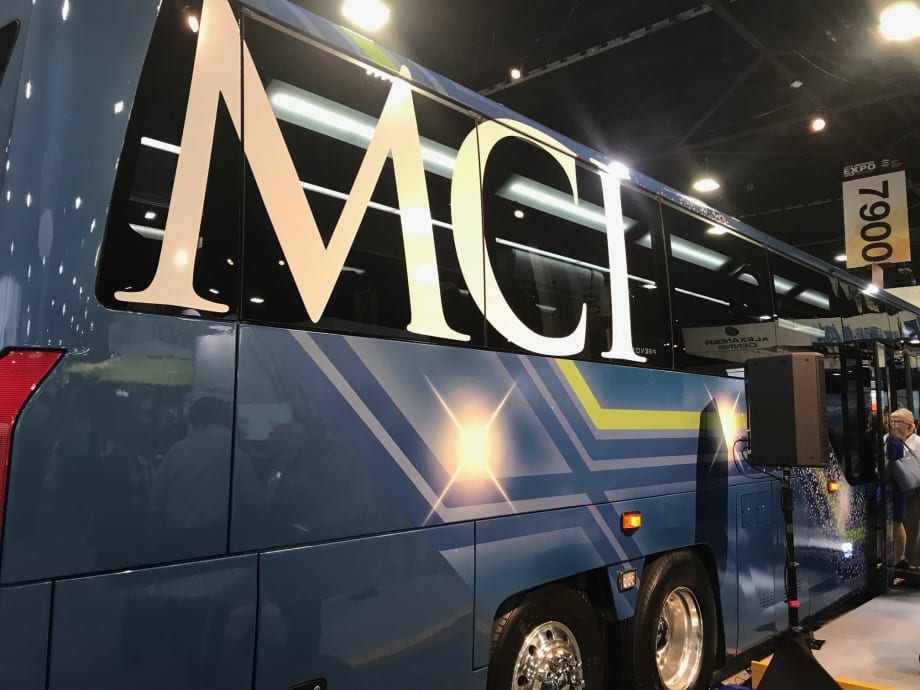
Motor Coach Industries (MCI), a subsidiary of New Flyer Industries Inc., plans for a busy and exciting APTA EXPO, including the unveiling of a new commuter coach with game-changing passenger accessibility features; expansion in parts, service and training support; and details on the electric commuter coach model.
It’s the first APTA-EXPO Annual Meeting and equipment gathering where MCI will be on the show floor with New Flyer, featuring both leading brands, and positioned to be one of the biggest newsmakers at Atlanta’s Georgia World Congress Center.
Offerings set for the show floor include:
• The latest Reliability Driven models in the MCI Commuter Coach Family, displaying a new standard of utility and comfort to serve local service and regional Commuter Rapid Transit (CRT)/Bus Rapid Transit (BRT) operations.
• Unparalleled accessibility for all public transportation passengers, including those using mobility devices.
• Plus one-stop, industry-wide service in transit parts, service and training.
“We’ve always been excited to come to APTA, but 2017 is a landmark year for us in terms of our products and where we see public transportation going,” said Ian Smart, MCI President. “The partnership of MCI and New Flyer within the NFI Group is less than two years old, but it couldn’t have come at a better time — we fully intend to redefine road- and highway-based public transportation in North America.”
The Commuter Coach
Both New Flyer and MCI have a philosophy based on reliability of product, service, and support. The latest Commuter Coach models prove that philosophy is stronger than ever.
At Booth #7819, attendees will have the chance to inspect a current 2017 MCI Commuter Coach that comes with an impressive set of features, including Kiel North America Avance 2010 seating for 55 passengers, a Transmark Mobile View nine-camera color surveillance system, 110-volt power outlets with USB plugs at every seat, and slide-out baggage bay bike racks.
The MCI Commuter Coach, which is Buy America-compliant and Altoona-tested, is specifically designed for express service at highway speeds. As for total low cost of operation, it offers the highly competitive per-seat price and workhorse reliability long-time MCI customers have come to expect. And as distance transit systems like CRT continue to grow, the MCI Commuter Coach’s Reliability Driven reputation makes it the industry’s best choice for this flexible, economical, and environmentally sound mass transit alternative.
Next-generation D Series model
MCI also plans to advance the North American commuting paradigm with an all-new model that improves passenger accessibility for all. “We want to give public transportation agencies the ultimate Commuter Coach model that offers the comfort and safety features our operators expect while delivering the latest operational efficiencies with faster boarding and dwell-times,” said Patrick Scully, MCI VP, sales and marketing.
APTA attendees will be among the first to see the new model at its unveiling on Monday.
As for comfort and performance, the new model expands MCI’s legacy for reliability, safety and performance.
“It offers a rugged semi-monocoque structure and comfortable seating, advanced safety features and a new, exciting modern-styling,” explains Tom Wagner, MCI VP, public sector. “Transit systems will find a vehicle that not only provides greatly enhanced accessibility; they’ll have a workhorse which enables expansion of commuter service into new areas.”
As one of the industry’s earliest advocates for green transportation, MCI is going to make its most versatile and accessible coach in an electric version with order availability in 2018 and deliveries starting 2020. The electric model will leverage New Flyer technology, taking advantage of its extensive manufacturing and multiple varieties of zero-emission buses (ZEBs) including battery-electric, trolley-electric, and hydrogen fuel-cell electric.
At APTA, attendees will also have plenty of opportunities to learn all about MCI’s latest advances in clean-diesel, diesel-electric, and CNG on the show floor.
Parts, service, and training
MCI has been supplying parts, service, and training advice for more than 80 years to every brand in the coach and bus market. Still, there’s more room to go — and grow.
MCI parts representatives will showcase a wide range of components for most transit bus makes and models, as well as those for MCI Commuter Coaches. MCI’s parts organization includes an entire team focused on responding quickly to procurements for transit parts. MCI has been making major investments in its inventory of both OEM and Coach Guard parts, with a special transit team to handle complex bids, facilitate ordering, and offer technical support.
In addition, MCI staff will be on hand to demonstrate the MCI Companion App also gives coach operators 24/7 access to parts and service ordering and advice for regular operations and emergencies.
Attendees will also get the chance to learn about its fast-growing MCI Academy division, which just became the motorcoach industry’s first-ever training provider to receive National Institute for Automotive Service Excellence accreditation. MCI joins an elite group of companies serving the entire automotive and trucking industry with MCI Academy’s unique onsite and online programing educating mechanical teams at MCI’s Louisville training headquarters and at operator sites throughout North America.
APTA EXPO Booth#7819
More Bus

New York MTA Plans Largest Bus Fleet Upgrade in More Than a Decade
The agency is seeking manufacturers for 650 new CNG buses to replace aging vehicles, improve reliability, and advance its broader fleet modernization strategy.
Read More →
Building a Flexible Path to Transit Electrification
John Hroncich discusses BAE Systems’ modular and scalable approach, lessons learned from decades of real-world operations, and how agencies can identify electrification strategies that fit their fleets.
Read More →
Bus Tech Talk: Keeping Transit Technicians Ahead of the Technology Curve
LA Metro’s Obed Mejia discusses technician training, evolving maintenance technology, fleet replacement, and strategies for getting the most out of today’s transit fleets.
Read More →
Biz Briefs: RIPTA Unveils New Frontrunners, Clevland RTA Adds New Siemens, and More
In METRO's latest installment, we take a look at recent news from Siemens, Prevost, Dodge, and more partnerships making headlines across the transportation sector.
Read More →
People Movement: Holly Arnold Joins Transdev and More
In this edition, we also cover recent appointments and announcements at Pace, CamTran, MCI, and more, showcasing the individuals helping to shape the future of transportation.
Read More →
The High Cost of Transit Buses: Industry Leaders Look to Procurement Reform
Transit leaders and policymakers examine how standardized bus designs, streamlined procurement, and predictable funding could help agencies stretch budgets and deliver better service.
Read More →
The Business Voice Behind Public Transportation
As chair of APTA’s Business Members Board of Governors, Ray Melleady explains how more than 850 business members are partnering with transit agencies to advance funding, innovation, and industry-wide collaboration.
Read More →
From Surviving to Thriving: Building Stronger Transportation Organizations
Bus Business Consultants founder Brian Dickson shares lessons on leadership, organizational health, and creating options for long-term success in a changing transportation industry.
Read More →
Finding the ‘Happy Medium’: Optimizing Maintenance Without Sacrificing Reliability
The key to maintenance optimization isn’t doing less work—it’s doing the right work at the right time on the right assets.
Read More →
LA Metro, City of West Hollywood, and Partners Advance Smarter Bus Lane Enforcement
The award-winning partnership combines AI-powered detection with human oversight to improve bus reliability, accessibility, and enforcement efficiency.
Read More →