




RELATED: MIT program offers free public transit to employees
MIT, Ford partner for on-demand, electric shuttle project
The project will introduce a fleet of on-demand electric vehicle shuttles that use LiDAR sensors and cameras to measure pedestrian flow, which ultimately helps predict demand for the shuttles.
August 1, 2016
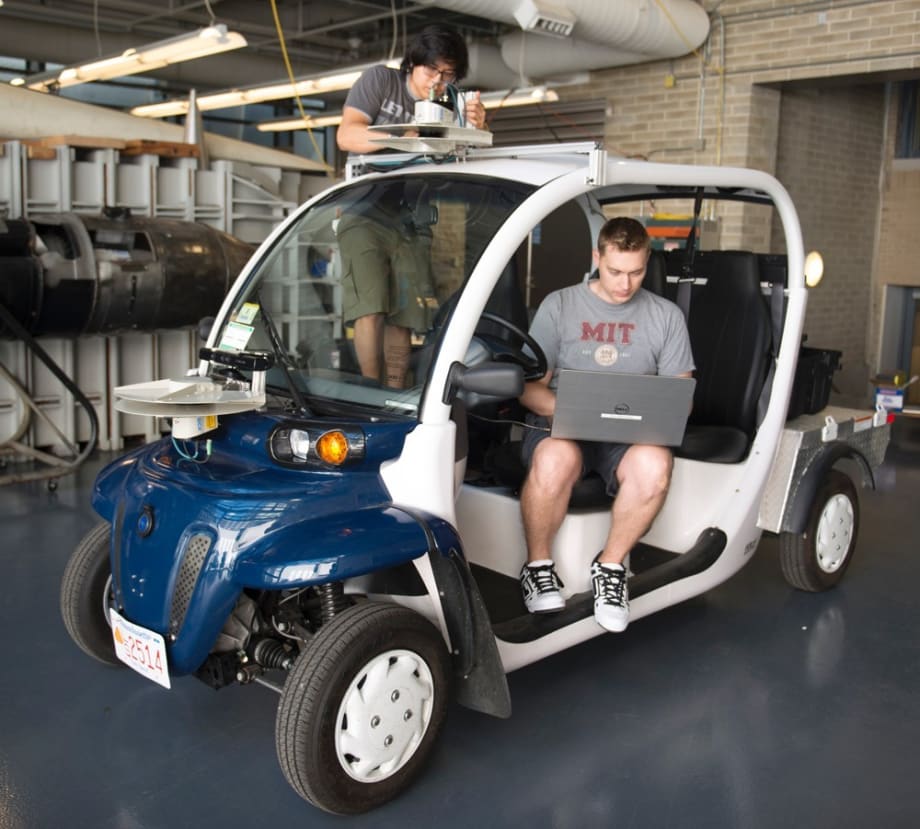
An on-demand electric shuttle that will operate on both city roads and campus walkways on MIT's campus.Photo: Ford
2 min to read
An on-demand electric shuttle that will operate on both city roads and campus walkways on MIT's campus.Photo: Ford
Ford and the Massachusetts Institute of Technology (MIT) are collaborating on a new research project that measures how pedestrians move in urban areas to improve certain public transportation services, such as ride-hailing and point-to-point shuttles services.
The project will introduce a fleet of on-demand electric vehicle shuttles that operate on both city roads and campus walkways on the university’s Cambridge, Mass., campus. The vehicles use LiDAR sensors and cameras to measure pedestrian flow, which ultimately helps predict demand for the shuttles. This, in turn, helps researchers and drivers route shuttles toward areas with the highest demand to better accommodate riders.
“The onboard sensors and cameras gather pedestrian data to estimate the flow of foot traffic,” said Ken Washington, vice president of Research and Advanced Engineering at Ford. “This helps us develop efficient algorithms that bring together relevant data. It improves mobility-on-demand services, and aids ongoing pedestrian detection and mapping efforts for autonomous vehicle research.”
Hailing a ride
Ford and MIT researchers plan to introduce the service to a group of students and faculty beginning in September. This group will use a mobile application to hail one of three electric urban vehicles to their location and request to be dropped off at another destination on campus.
The electric vehicles are small enough to be able to navigate the campus’s sidewalks, while still leaving plenty of room for traditional pedestrian traffic. Each is outfitted with weatherproof enclosures that shield out inclement weather – a feature particularly useful for New England’s punishing winters.
After requesting the shuttles via a smartphone app, MIT students and faculty won’t be waiting long for their ride to arrive.
During the past five months, Ford and MIT have used LiDAR sensors and cameras mounted to the vehicles to document pedestrian flow between different points on campus. LiDAR is the most efficient way to detect and localize objects from the environment surrounding the shuttles. The technology is much more accurate than GPS, emitting short pulses of laser light to precisely pinpoint the vehicles’ location on a map and detect the movement of nearby pedestrians and objects.
Using this data, researchers study the overall pattern of how pedestrian traffic moves across campus, which helps the researchers anticipate where the most demand for the shuttles will be at any given moment. This allows the shuttles to be carefully pre-positioned and routed to serve the MIT population as efficiently as possible.
Researchers also take into account other factors that affect pedestrian movement on MIT’s campus, such as varying weather conditions, class schedules, and the dynamic habits of students and professors across different semesters.
More Bus

New York MTA Plans Largest Bus Fleet Upgrade in More Than a Decade
The agency is seeking manufacturers for 650 new CNG buses to replace aging vehicles, improve reliability, and advance its broader fleet modernization strategy.
Read More →
Building a Flexible Path to Transit Electrification
John Hroncich discusses BAE Systems’ modular and scalable approach, lessons learned from decades of real-world operations, and how agencies can identify electrification strategies that fit their fleets.
Read More →
Bus Tech Talk: Keeping Transit Technicians Ahead of the Technology Curve
LA Metro’s Obed Mejia discusses technician training, evolving maintenance technology, fleet replacement, and strategies for getting the most out of today’s transit fleets.
Read More →
Biz Briefs: RIPTA Unveils New Frontrunners, Clevland RTA Adds New Siemens, and More
In METRO's latest installment, we take a look at recent news from Siemens, Prevost, Dodge, and more partnerships making headlines across the transportation sector.
Read More →
People Movement: Holly Arnold Joins Transdev and More
In this edition, we also cover recent appointments and announcements at Pace, CamTran, MCI, and more, showcasing the individuals helping to shape the future of transportation.
Read More →
The High Cost of Transit Buses: Industry Leaders Look to Procurement Reform
Transit leaders and policymakers examine how standardized bus designs, streamlined procurement, and predictable funding could help agencies stretch budgets and deliver better service.
Read More →
The Business Voice Behind Public Transportation
As chair of APTA’s Business Members Board of Governors, Ray Melleady explains how more than 850 business members are partnering with transit agencies to advance funding, innovation, and industry-wide collaboration.
Read More →
From Surviving to Thriving: Building Stronger Transportation Organizations
Bus Business Consultants founder Brian Dickson shares lessons on leadership, organizational health, and creating options for long-term success in a changing transportation industry.
Read More →
Finding the ‘Happy Medium’: Optimizing Maintenance Without Sacrificing Reliability
The key to maintenance optimization isn’t doing less work—it’s doing the right work at the right time on the right assets.
Read More →
LA Metro, City of West Hollywood, and Partners Advance Smarter Bus Lane Enforcement
The award-winning partnership combines AI-powered detection with human oversight to improve bus reliability, accessibility, and enforcement efficiency.
Read More →