



MTA Announces Future Role of Station Agents
Station agents will shift from working exclusively in booths to performing core customer service functions throughout the station.

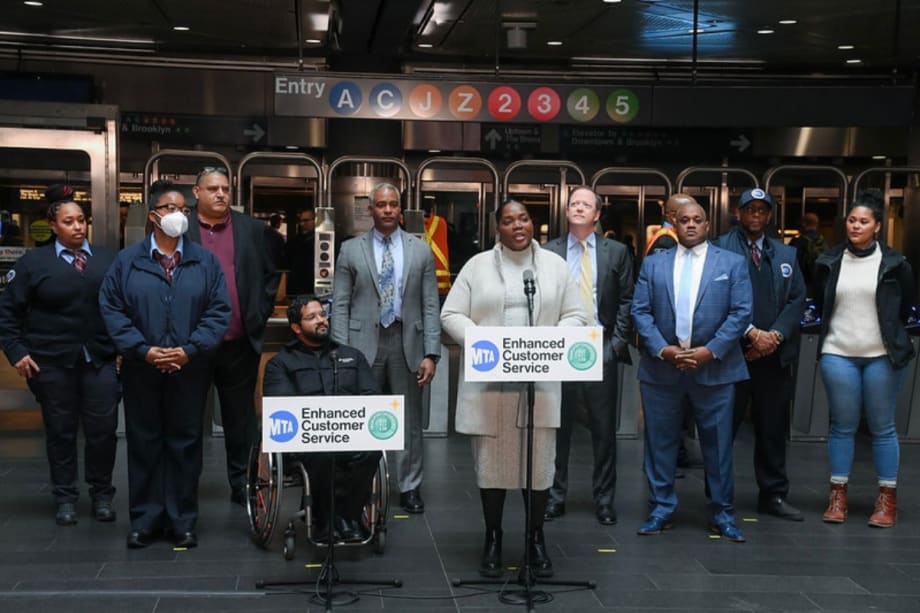
The MTA said it will begin to phase in the new station agent role starting in early 2023
Photo: MTA
The Metropolitan Transportation Authority (MTA) and Transport Workers Union (TWU) Local 100 announced an agreement on the future of the station agent's role in the subway system. This agreement will enable station agents to support customer service needs more effectively in subway stations, according to the MTA's news release.
Station agents will shift from working exclusively in booths to performing core customer service functions throughout the station, including at turnstiles, MetroCard machines, and on platforms.
“Providing the best possible experience for customers is our North Star at New York City Transit,” said Richard Davey, NYC Transit president. “To customers, station agents often represent the face of the transit system, dating back to the era of token booths. By enhancing the station agent role, the era of customer support being offered only through a glass wall has gone the way of the token itself, and agents will be able to connect directly with the riders they’re serving.”
The new station agent role follows a commitment by Davey in November to achieve at least 70% customer satisfaction on subways and buses by June 2024. NYC Transit instituted monthly “pulse” surveys in May 2022 to better gauge customer satisfaction, and in September 2022, customer satisfaction amongst subway riders was 59%, 10 points higher than four months earlier. In November, NYC Transit announced the expansion of its Station ReNEWvation Program to 12 additional stations following work on nine stations in the Bronx completed in 2022.
The new station agent role will provide customer support out-of-booth through:
Wayfinding throughout the transit system.
Assistance for customers with disabilities and seniors.
Assistance at fare machines.
Enhanced customer service during service disruptions and major planned changes.
OMNY guidance and information, including conversion and use.
Timely reporting of any issues related to customer amenities, including elevators, escalators, digital signage, Help Points, and turnstiles.
Maintenance of a safe and clean customer environment.
Reporting of quality-of-life issues.
The MTA said it will begin to phase in the new station agent role starting in early 2023, with training currently underway on enhanced customer service and OMNY equipment.
NYC Transit began filling vacant station agent positions in November 2021. So far, 288 station agents have been hired, and the Authority added that it anticipates filling the remaining 235 station agent vacancies through the first half of 2023.
More Rail

New York MTA Advances Final Contract for Second Avenue Subway Expansion
Contract Four is the largest in the Second Avenue Subway Phase 2 project and includes construction of station infrastructure, tracks, and signals for the subway expansion, MTA officials said. Work on Contract Four will begin in 2027.
Read More →
San Diego MTS Breaks Monthly Trolley Ridership Record
Agency officials said July’s ridership indicates MTS’s continued recovery from the pandemic.
Read More →
Report Examines NJ TRANSIT Reliability, Funding Challenges
The Garden State Initiative analysis examines the roles of Amtrak infrastructure, fleet management, and agency operations while recommending a more performance-based approach to improving reliability.
Read More →
Stadler, CapMetro Sign Long-Term Rail Fleet Support Agreement
Beginning in 2027, Stadler will provide on-site technical expertise, spare parts support, training, and obsolescence management to help extend the reliability and longevity of CapMetro’s GTW fleet.
Read More →
Biz Briefs: Alstom Lands Canadian Contract, LYT to Supply California TSP, and More
In METRO's latest installment, we take a look at recent news from Complete Coach Works, Beep, FlixBus, and more partnerships making headlines across the transportation sector.
Read More →
CATS Gold Line Marks 5 Years of Service, 2.8M Passenger Trips
With a six-mile expansion planned, the Charlotte streetcar is positioned to connect more neighborhoods and major transit hubs across the region.
Read More →
Why Simulating Pedestrian Movement Has Become Essential for Modern Rail Stations
Pedestrian microsimulation is helping rail planners identify bottlenecks, test station designs, and prepare complex transit hubs for growing passenger volumes.
Read More →
Amtrak Begins Major Construction at New York’s Sunnyside Yard
The new maintenance facility will support Amtrak’s Airo trainsets while improving maintenance efficiency and turnaround times in New York.
Read More →
Chicago Leaders Unveil Plans for O’Hare Airport Express Train
The privately developed project would offer a 15-minute trip between downtown and O’Hare’s Terminal 2, with trains operating every 15 minutes on a dedicated track. The service would use battery-electric trains and three existing freight rail rights-of-way.
Read More →
OCTA Maps Out 30-Year Strategy to Protect Coastal Rail Corridor
The draft feasibility report identifies strategies to protect the coastal rail line for decades as the agency continues near-term stabilization and sand placement efforts.
Read More →