




MTA Launches Process to Enhance Bicycle, Micromobility Access
MTA Set to Launch Redesigned Bronx Local Bus Network
The redesigned network brings foundational improvements that will deliver more reliable bus service, improve connections, and more.
June 22, 2022
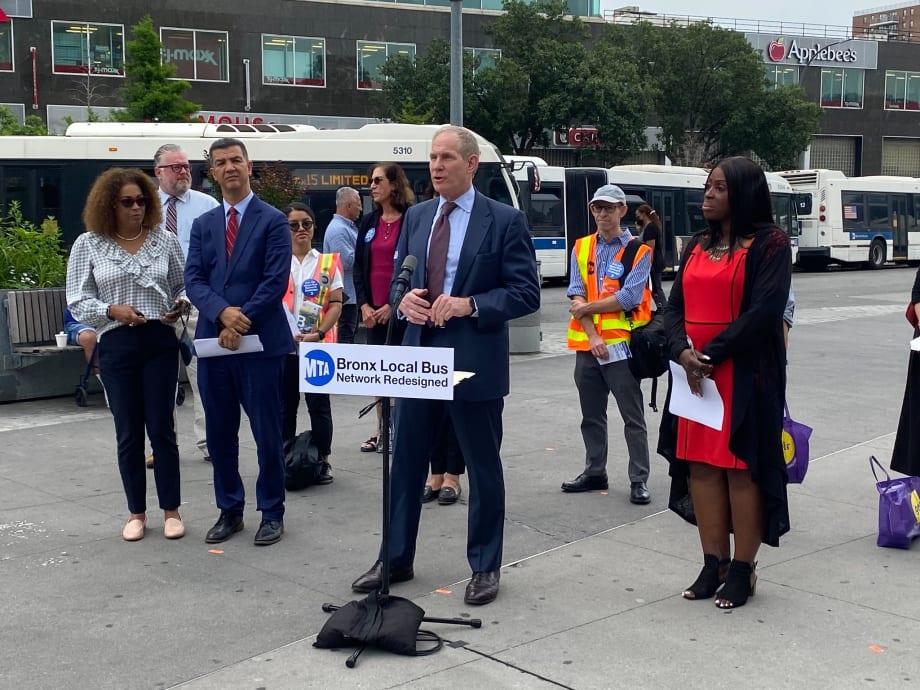
MTA Chair and Ceo Janno Lieber, New York City Transit President Richard Davey are joined by DOT Commissioner Ydanis Rodriguez, Bronx Borough President Vaness Gibson, community leaders and transit advocate groups on Tuesday, June 21 to preview launch of the new local bus network that will deliver faster and more efficient Bronx bus service, effective Sunday, June 26.
Photo: Ray Raimundi/MTA
3 min to read
The Metropolitan Transportation Authority (MTA) joined community leaders, elected officials, transit advocate groups, and the New York City Department of Department of Transportation (DOT) at Fordham Plaza in the Bronx to preview the launch of the borough's local bus network redesign on Sunday, June 26.
The redesigned network brings foundational improvements that will deliver more reliable bus service, improve connections, reduce wait times, and increase bus speeds. It reallocates resources to the portions of the borough and lays out an adaptable framework to meet real-time travel patterns of current and future bus customers.
“In 2019, over 420,000 customers relied on the Bronx bus network to get them to their destinations,” said Janno Lieber, MTA chair/CEO. “Making sure that all New Yorkers have equal opportunity depends on equal access to reliable transit, and buses are vital — especially for seniors, schoolkids and people who don’t live close to subways. I am thrilled to launch a more efficient local bus network that would help deliver better service, and access to jobs, education and opportunity – both within the borough and throughout the City.”
The redesigned network consists of thirteen significantly modified routes, two new routes, and changes on most routes in respect to bus stops and schedules.
The redesign focuses on:
Bus stop balancing. Increasing stop spacing is an effective method that allows buses to travel at greater speeds. Bronx bus speeds are among the slowest in the nation, with distances between bus stops averaging 800 feet, compared to 1,000 to 1,680 feet, which is the international average.
More direct routes. Streamlining circuitous routes and adjusting routes in known areas of street congestion improves travel time due to the reduction of turns and avoidance of traffic.
Better connections. Route changes strengthen interborough travel to Manhattan and improve accessibility to other areas of the MTA’s transportation network, including subway stations that are ADA accessible. Improved east-west bus connections strengthen intraborough travel.
More all-day service. The new local bus network includes additional trips during off-peak hours, weekends, and increases service frequencies on eleven routes and nine key corridors.
The MTA will continue its customer ambassador program leading to implementation and two weeks following the launch to assist customers in the transition to the new bus network.
“This is a great plan and the Bronx is a better borough because of it,” said Vanessa Gibson, Bronx Borough president. “The MTA has now built a 21st century network that is responsive to the transit needs of communities throughout the Bronx. The bus network redesign will truly provide a more reliable service to connect bus riders to and from many different locations including work, medical appointments, and visiting family members and friends. It will spur economic growth in our borough at a time when it is truly needed.”
More Bus

New York MTA Plans Largest Bus Fleet Upgrade in More Than a Decade
The agency is seeking manufacturers for 650 new CNG buses to replace aging vehicles, improve reliability, and advance its broader fleet modernization strategy.
Read More →
Building a Flexible Path to Transit Electrification
John Hroncich discusses BAE Systems’ modular and scalable approach, lessons learned from decades of real-world operations, and how agencies can identify electrification strategies that fit their fleets.
Read More →
Bus Tech Talk: Keeping Transit Technicians Ahead of the Technology Curve
LA Metro’s Obed Mejia discusses technician training, evolving maintenance technology, fleet replacement, and strategies for getting the most out of today’s transit fleets.
Read More →
Biz Briefs: RIPTA Unveils New Frontrunners, Clevland RTA Adds New Siemens, and More
In METRO's latest installment, we take a look at recent news from Siemens, Prevost, Dodge, and more partnerships making headlines across the transportation sector.
Read More →
People Movement: Holly Arnold Joins Transdev and More
In this edition, we also cover recent appointments and announcements at Pace, CamTran, MCI, and more, showcasing the individuals helping to shape the future of transportation.
Read More →
The High Cost of Transit Buses: Industry Leaders Look to Procurement Reform
Transit leaders and policymakers examine how standardized bus designs, streamlined procurement, and predictable funding could help agencies stretch budgets and deliver better service.
Read More →
The Business Voice Behind Public Transportation
As chair of APTA’s Business Members Board of Governors, Ray Melleady explains how more than 850 business members are partnering with transit agencies to advance funding, innovation, and industry-wide collaboration.
Read More →
From Surviving to Thriving: Building Stronger Transportation Organizations
Bus Business Consultants founder Brian Dickson shares lessons on leadership, organizational health, and creating options for long-term success in a changing transportation industry.
Read More →
Finding the ‘Happy Medium’: Optimizing Maintenance Without Sacrificing Reliability
The key to maintenance optimization isn’t doing less work—it’s doing the right work at the right time on the right assets.
Read More →
LA Metro, City of West Hollywood, and Partners Advance Smarter Bus Lane Enforcement
The award-winning partnership combines AI-powered detection with human oversight to improve bus reliability, accessibility, and enforcement efficiency.
Read More →