



New Flyer debuts new standard bus model
Fuel economy is anticipated to increase due to reduced weight and lower maintenance costs are achieved through a number of product advancements.

[IMAGE]NewFlyerPRIMO-065-450p.jpg[/IMAGE]
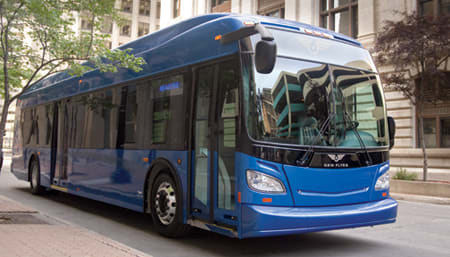
New Flyer Industries Inc. introduced its newest standard transit bus model, the Xcelsior today at the APTA EXPO in San Diego.
Xcelsior is lighter weight than New Flyer’s current standard bus designs by approximately 10 percent. The lighter weight of the vehicle is expected to immediately deliver improved fuel economy.
Key features include upgraded styling, a redesigned bumper and LED headlamps, as well as a single-reduction axle, all-wheel disc brakes and improved access. Accessibility has been greatly improved with a wider door and entry area, a lower front step and an improved ramp angle.
The single-reduction axle, along with the rooftop AC and improved insulation, is expected to reduce noise. Passengers and drivers will enjoy an improved ride quality, better visibility, interior LED lighting and many other interior advancements.
“Xcelsior incorporates the reliability and quality of our proven low-floor platform while delivering many new features,” said John Marinucci, New Flyer’s President and CEO. "Through a comprehensive market analysis, we were able to identify opportunities to deliver maximum benefits to customers at lower projected life cycle costs.”
Customer-driven objectives were established and progress against these objectives was measured throughout the design and build process. Evolving market demands and an increased focus on reducing operating and maintenance costs were at the core of the development process.
Fuel economy is anticipated to increase du eto reduced weight and lower maintenance costs are achieved through a number of product advancements.
More Management

LIT Marks 10-Year Milestone at Annual Summit
Hosted by the COTA from September 10 to 13, the Summit carried the theme “Celebrating 10 Years of Excellence, Leadership, and Impact,” with every part of the program honoring the people, agencies, and partners who built LIT over its first decade.
Read More →
People Movement: Dan Dipert Coaches Adds Third-Generation Leader, Keolis Names New Valley Metro VP/GM, and More
In this edition, we also cover recent appointments and announcements at the Wabtec, SilverRide, HNTB, and more, showcasing the individuals helping to shape the future of transportation.
Read More →
METRO Opens Submissions for 2026 Motorcoach Awards
Nominations are now being accepted for METRO Magazine’s Operator of the Year and Innovative Operator of the Year awards.
Read More →

New York MTA Advances Final Contract for Second Avenue Subway Expansion
Contract Four is the largest in the Second Avenue Subway Phase 2 project and includes construction of station infrastructure, tracks, and signals for the subway expansion, MTA officials said. Work on Contract Four will begin in 2027.
Read More →
Transit Agencies Highlight Safety Gains at National Summit
Leaders from 15 major transit systems shared crime-reduction results and safety initiatives while discussing the role of continued federal support.
Read More →
NITA Names New Leadership, Expands Reduced-Fare Program at First Board Meeting
The new regional transit authority appointed its first board chair and interim executive director while extending reduced fares across CTA, Metra, and Pace for eligible riders.
Read More →
Beyond the Checklist: A Structured Approach to Transit Maintenance
Reliability-Centered Maintenance helps transit agencies move beyond routine checklists to focus limited resources on the assets and failures that have the greatest impact on safety, reliability, and service.
Read More →
APTA 2026 Nominating Committee Selects Leadership Slate, Names Chair and Vice Chair Nominees
Leadership changes will help shape the association’s priorities and its representation of the transportation industry during the 2026–2027 term.
Read More →
DART Launches Major Security, Fare Enforcement Initiative
The 90-day demonstration will deploy coordinated security teams at five light rail stations while testing controlled access and gathering data to guide future investments.
Read More →
Advancing Fare Collection Through Technology and Innovation
Learn about delivering 1300 gates at 91 stations while managing fare evasion. Explore the large scale deployment, solution customization and real-world results that affect the region. Prepare for deployment in your region now.
Read More →