



PPP tapped to build, operate Denver commuter rail project
Denver Transit Partners’ proposal is $300M lower than RTD’s budget estimate and it plans to open the line to the airport by January 2016, 11 months ahead of RTD’s deadline.

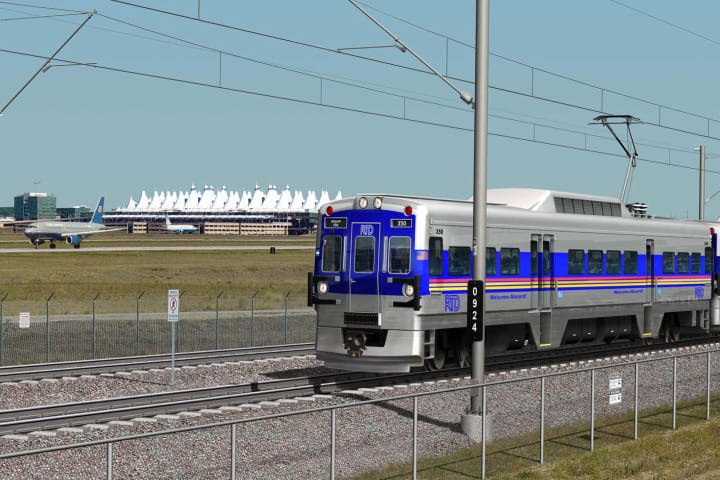
Denver Transit Partners for the single-largest FasTracks contract to build and operate commuter rail lines to Denver International Airport (rendering shown), Arvada-Wheat Ridge and south Westminster. Image courtesy of RTD.
[IMAGE]Denver-Eagle-project-sim-full.jpg[/IMAGE]Denver's Regional Transportation District (RTD) has selected Denver Transit Partners for the single-largest FasTracks contract to build and operate commuter rail lines to Denver International Airport (DIA), Arvada-Wheat Ridge and south Westminster.
Denver Transit Partners’ proposal is $300 million lower than RTD’s budget estimate and it plans to open the line to DIA by January 2016, 11 months ahead of RTD’s deadline. Denver Transit Partners’ proposal along with RTD’s project costs total $2.085 billion, compared with RTD’s budget estimate of $2.385 billion. The RTD “best-value” evaluation rated it both the higher technical proposal and the lower cost proposal of the two bidding teams.
The sponsoring members of consortium are Fluor Enterprises Inc. and Macquarie Capital Group Ltd. They are joined by major partners Ames Construction, Balfour Beatty Rail Inc., Alternate Concepts Inc. and HDR.
“It is a remarkable achievement for RTD to get a project of this magnitude through a public-private partnership that meets our goal of contracting under our budget and ahead of our schedule,” said RTD Chair Lee Kemp. “We said three years ago that public-private partnerships would be a vital part of keeping our FasTracks program moving forward. The decision tonight shows that the faith placed in us by the Federal Transit Administration and our stakeholders through some difficult times was justified has been rewarded.”
With this decision, RTD will have 47 miles of new rail under construction or under contract, more than double the amount of rail in RTD’s existing light rail system. It also represents nearly 40 percent of the total FasTracks rail network now under contract.
The Eagle P3 Project packages several FasTracks projects into a single contract to design and construct the East Corridor to DIA, the Gold Line to Arvada-Wheat Ridge, a short segment of the Northwest Rail corridor to south Westminster and the commuter rail maintenance facility in north Denver.
This design-build method is similar to how RTD and the Colorado Department of Transportation (CDOT) implemented the Transportation Expansion (T-REX) light rail and highway project, which was completed under budget and ahead of schedule in 2006.
Eagle P3 takes public-private partnerships to a broader level. In addition to final design and construction, Denver Transit Partners is bringing private financing to the table and, under a concession contract, will also operate and maintain the rail service on these lines for 40 years. In return, RTD will make annual payments to Denver Transit Partners based on its performance in meeting RTD’s service standards.
Through this arrangement, called Design-Build-Finance-Operate-Maintain, RTD reduces its need for upfront cash. RTD also expects the project to attract $1 billion next year through the Federal Transit Administration (FTA) Full Funding Grant Agreement process. Anthony Loui, FTA’s Eagle Project Team Leader, attended the RTD board meeting from Washington as a representative of FTA Administrator Peter Rogoff. The FTA has been a fully supportive partner in RTD’s pursuit of a P3 project.
Early construction work, such as relocation of utilities and freight tracks along the East Corridor, is projected to start by late summer.
Two teams spent the past two years working on proposals. RTD will pay the other team, Mountain-Air Transit Partners, a $2.5-million stipend in exchange for the intellectual property in its proposal. That gives RTD the option to use cost-saving ideas from the non-selected proposal.
The two proposals were thoroughly evaluated over two months by more than 120 people including RTD staff and representatives of cities and counties on the Eagle corridors – Adams County, Arvada, Aurora, Denver, Westminster and Wheat Ridge – along with staff from CDOT and DIA. RTD had technical, financial and legal input from consultants Jacobs Engineering, Goldman Sachs, J.P. Morgan and Freshfields Bruckhaus Deringer.
“This is a significant, prestigious and strategic selection,” said Patrick Flaherty, head of Fluor’s Infrastructure business. “We expect this to be the first of many public-private partnership transit projects procured under the available method in the U.S. in the coming year. We are delighted to have been selected by the Denver RTD. Our entire team is looking forward to helping the RTD realize its FasTracks vision and we are committed to working closely with local businesses and other stakeholders to involve them in the project and increase the long-term competitiveness of the Denver area,” said Flaherty.
Eagle P3 is a key part of RTD’s strategy to keep FasTracks moving forward in the difficult economic environment that has affected large public projects nationwide.
“RTD is the first transit agency in the United States to pursue this type of comprehensive public-private partnership that includes not only the design and construction, but the financing and ultimate operation and maintenance of the end product,” said RTD General Manager Phil Washington. “RTD has always been on the front line of finding innovative methods for delivering projects. Now this project can get on with creating thousands of jobs.”
FasTracks is RTD’s voter-approved transit program to expand rail and bus service throughout the RTD service area. FasTracks will build 122 miles of commuter rail and light rail, 18 miles of bus rapid transit service, add 21,000 new parking spaces, redevelop Denver Union Station and redirect bus service to better connect the eight-county District. The FasTracks investment initiative is projected to create more than 10,000 construction-related jobs during the height of construction, and will pump billions of dollars into the regional economy.
More Rail

New York MTA Advances Final Contract for Second Avenue Subway Expansion
Contract Four is the largest in the Second Avenue Subway Phase 2 project and includes construction of station infrastructure, tracks, and signals for the subway expansion, MTA officials said. Work on Contract Four will begin in 2027.
Read More →
San Diego MTS Breaks Monthly Trolley Ridership Record
Agency officials said July’s ridership indicates MTS’s continued recovery from the pandemic.
Read More →
Report Examines NJ TRANSIT Reliability, Funding Challenges
The Garden State Initiative analysis examines the roles of Amtrak infrastructure, fleet management, and agency operations while recommending a more performance-based approach to improving reliability.
Read More →
Stadler, CapMetro Sign Long-Term Rail Fleet Support Agreement
Beginning in 2027, Stadler will provide on-site technical expertise, spare parts support, training, and obsolescence management to help extend the reliability and longevity of CapMetro’s GTW fleet.
Read More →
Biz Briefs: Alstom Lands Canadian Contract, LYT to Supply California TSP, and More
In METRO's latest installment, we take a look at recent news from Complete Coach Works, Beep, FlixBus, and more partnerships making headlines across the transportation sector.
Read More →
CATS Gold Line Marks 5 Years of Service, 2.8M Passenger Trips
With a six-mile expansion planned, the Charlotte streetcar is positioned to connect more neighborhoods and major transit hubs across the region.
Read More →
Why Simulating Pedestrian Movement Has Become Essential for Modern Rail Stations
Pedestrian microsimulation is helping rail planners identify bottlenecks, test station designs, and prepare complex transit hubs for growing passenger volumes.
Read More →
Amtrak Begins Major Construction at New York’s Sunnyside Yard
The new maintenance facility will support Amtrak’s Airo trainsets while improving maintenance efficiency and turnaround times in New York.
Read More →
Chicago Leaders Unveil Plans for O’Hare Airport Express Train
The privately developed project would offer a 15-minute trip between downtown and O’Hare’s Terminal 2, with trains operating every 15 minutes on a dedicated track. The service would use battery-electric trains and three existing freight rail rights-of-way.
Read More →
OCTA Maps Out 30-Year Strategy to Protect Coastal Rail Corridor
The draft feasibility report identifies strategies to protect the coastal rail line for decades as the agency continues near-term stabilization and sand placement efforts.
Read More →