



Profile: Calif. campus tries to grow non-vehicle transportation usage
To help encourage fewer vehicles on campus, UC Irvine offers a number of sustainable commuting options, including carpool matching services, vanpools, carpools, Zipride and Zimride car sharing programs, and train subsidies to reduce monthly transportation expenses and the university's overall carbon footprint.

The goal of the University of California, Irvine (UCI) Sustainable Transportation Services, a branch of Parking and Transportation Services, is to reduce the total number of vehicle trips made to campus by faculty, staff and students. This goal serves the California clean-air effort and reduces campus and community vehicle congestion. As part of its compliance program, the campus conducts an employee commuter survey each April.
Currently, the university's Average Vehicle Ridership (AVR) is 1.89 persons per vehicle, which puts them near the top of the South Coast Air Quality Management District's (AQMD) list for large institutions in Southern California. Mike Davis, interim manager of sustainable transportation at UCI, explained that number has grown as the university has evolved from its commuter campus beginnings.
"We stated really as a small commuter campus. Right now, we have a total population of approximately 36,000 people," he said. "Over the years, we have built a lot of on-campus and near-campus housing, which has helped the university switch over to be majority residential for students."
To help encourage fewer vehicles on campus, Parking and Transportation Services offers a number of sustainable commuting options, including carpool matching services, vanpools, carpools, Zipride and Zimride car sharing programs, and train subsidies to reduce monthly transportation expenses and the university's overall carbon footprint. It has also raised parking fees approximately 30 percent over the last five years and created a zone parking system.
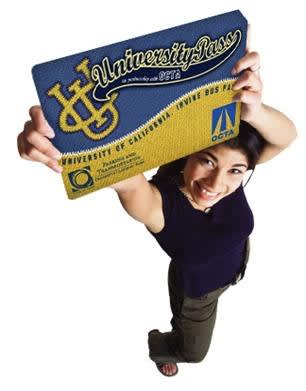
[IMAGE]UCI2-2.jpg[/IMAGE]UCI also partnered with the Orange County Transportation Authority (OCTA) to offer a U-Pass program that enables students, staff and faculty to purchase a yearly pass for $155 — a 74 percent reduction in cost versus purchasing OCTA monthly passes — in addition to offering the 20 percent subsidy for everybody on campus that uses local Amtrak or Metrolink train service.
Meanwhile, the Anteater Express, which is operated by the Associated Students Government and partially funded by Parking and Transportation Services, provides shuttle services around and outside campus.
"That program through the years has changed its focus in different ways," said Davis. "We have zone parking, so students have to pick a zone and can't move their car around campus, which has eliminated quite a bit of emissions. It also means you park once a day and then leave. Because of that and our fairly large campus, the shuttles help get students around the campus. Some routes also go off campus to bigger residential areas to help bring in people that live nearby."
Some of the Anteater Express' routes even go two or three miles off campus and as far away as nearby Newport Beach. Up until this year it was free for students, but now some of the shuttle that go further off campus require a fee that can be purchased on a quarterly basis, according to Davis.
With both on-campus and near-campus housing continuing to grow, the university is focusing more on its bike programs, explained Davis.
"More than 50 percent of our population lives within two miles of the campus, but a lot are within a mile or two, so biking to campus is a really good option," he said. "Because of that, we've been increasing the number of bike paths on campus, created more signage and developed BEEP — Bike Education and Enforcement Program.
[IMAGE]UCI-2.jpg[/IMAGE]In October 2009, UCI launched its ZotWheels bike sharing program at four different locations around campus. The university charges its members an annual fee of $40 to utilize the service. Members are able to obtain one of the 40 bikes for up to three hours by scanning their RFID (radio-frequency identification) cards at the vending machine-style stations.
"We hope to expand the program into the outlying areas right now," said Davis. "They are getting a fair amount of use, but we realized they would get a lot more use if we had some in the periphery, especially in the outlying residential areas. Our hope is at some point to add eight more stations, starting with one or two this year."
UCI is also growing its Zipcar program from nine cars to 14 by the fall, potentially growing that number to 19 by the end of the year.
"Both the bike share and car share programs are really a support to our other measures," said Davis. "It's for people who already are coming to campus using another mode of transportation, and at times, need a bike or car to get around campus. So, it's a good support for them."
Parking and Transportation Services has also increased its outreach programs on campus, including the creation of its "Surviving UC Irvine Without A Car: A Guide To Getting Around" to help incoming students learn more about their options.
The hard work has paid off. Currently, 30 percent of students walk to campus, one percent less than those who drive alone. Additionally, 18 percent bike and 7 percent use OCTA, rail or the campus shuttle.
UCI expects those numbers of students leaving their cars to continue to grow as more housing is built around campus, according to Davis.
More New Mobility

From Hardware to Digital Partner: Luminator Charts Its Next Chapter
CEO Magnus Friberg discusses Luminator’s shift toward becoming a digital partner, the growing importance of software and interoperability, and how AI can help agencies improve operations and passenger experience.
Read More →
Biz Briefs: Alstom Lands Canadian Contract, LYT to Supply California TSP, and More
In METRO's latest installment, we take a look at recent news from Complete Coach Works, Beep, FlixBus, and more partnerships making headlines across the transportation sector.
Read More →
CharterUP’s Armir Harris on Technology, AI, and the Future of Group Mobility
In a recent episode of METROspectives, CharterUP Founder/CEO Armir Harris discussed the company’s evolution from an online charter bus marketplace into a technology platform supporting public- and private-sector mobility and much more.
Read More →
Jacksonville’s NAVI Project Charts a New Course for Autonomous Public Transportation
Through its NAVI program, JTA is showing how autonomous vehicles, intelligent infrastructure, and coordinated operations can work together to deliver everyday public transportation.
Read More →
Biz Briefs: Luminator Marks Milestone and More
From manufacturers and suppliers to transit agencies and motorcoach operators, these updates offer a snapshot of the projects, partnerships and business moves driving the industry forward.
Read More →
New Tricks for Old Bureaucracies: Joshua Schank on Making Transit Innovation Stick
Former LA Metro Chief Innovation Officer Joshua Schank discusses why good ideas aren't enough, how transit agencies can overcome resistance to change, and why today's challenges demand more innovation.
Read More →
How DART's GoPass Is Redefining Regional Mobility
Serving 14 transit agencies, GoPass simplifies multimodal travel by allowing riders to plan, pay for, and manage an entire trip through one app.
Read More →
Biz Briefs: OCTA Taps Clean Energy for Hydrogen Station, Stadler to Supply Via Rail Vehicles, and More
From manufacturers and suppliers to transit agencies and motorcoach operators, these updates offer a snapshot of the projects, partnerships and business moves driving the industry forward.
Read More →CharterUP Expands Into New Mobility and Autonomous Transportation
Vice President of New Mobility Stephen Joos discusses how CharterUP is leveraging its nationwide transportation network, technology platform, and autonomous vehicle partnerships to expand into workforce mobility, campus shuttles, and transit solutions.
Read More →
METRO Magazine Announces 2026 Innovative Solutions Awards Winners
Projects Recognized for Advancing Mobility Through Technology, Accessibility, Workforce Innovation, and Operational Excellence
Read More →