



Santa Monica's Big Blue Bus earns APTA Gold Safety, Security Award
BBB has steadily decreased its preventable accident rate from 2.21 accidents per 100,000 miles in fiscal year 2015 to 1.83 accidents per 100,000 miles in FY 2017.


BBB highlighted its proactive approach to reducing preventable accidents and improving system safety by enhancing its existing programs and introducing new ones.
Big Blue Bus
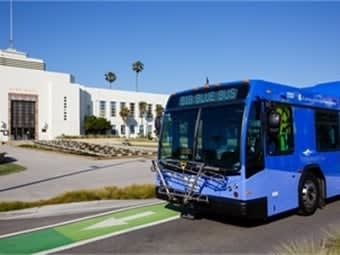
BBB highlighted its proactive approach to reducing preventable accidents and improving system safety by enhancing its existing programs and introducing new ones.
Big Blue Bus
Santa Monica, Calif.’s Big Blue Bus (BBB) was awarded the 2018 Bus Safety and Security Gold Award by the American Public Transportation Association (APTA) in the category of Safety for transit agencies with more than four million but fewer than 20 million passenger trips annually.
The Gold Award honors organizations with the best overall bus safety and security program for all transit organizations throughout the U.S. Additionally, recipients play an integral part in benchmarking successful programs that can be adopted by other public transit systems aiming for similar benefits.
“I would like to thank every BBB staff member for their contributions, especially our motorcoach operators who operate our fleet of 200 buses in one of the most congested and challenging service areas in the country,” said Ed King, director, transit services. “We have invested significant resources over the last three years to launch a comprehensive employee safety program that provides intensive training and retraining programs for all BBB staff. These strategic investments are paying off with a tangible reduction in preventable accident rates and passenger injuries. We are honored to have the hard work of staff recognized by APTA with this top award.”
BBB highlighted its proactive approach to reducing preventable accidents and improving system safety by enhancing its existing programs and introducing new ones. These enhancements included:
Rollout of a comprehensive and interactive accident review and retraining process.
Extensive rail safety education campaign prior to the inauguration of Metro’s Expo Line in 2016.
Relaunch of BBB’s “Hazard/Near Miss” employee safety reporting program.
Mandatory quarterly safety meetings for all Motor Coach Operators with safety topics focused on service delivery.
As a result, BBB has steadily decreased its preventable accident rate from 2.21 accidents per 100,000 miles in fiscal year (FY) 2015 to 1.83 accidents per 100,000 miles in FY 2017. The passenger injury rate also decreased from 1.89 injuries per 100,000 miles in FY 2015 to .41 injuries per 100,000 miles in FY 2017.
More Bus

New York MTA Plans Largest Bus Fleet Upgrade in More Than a Decade
The agency is seeking manufacturers for 650 new CNG buses to replace aging vehicles, improve reliability, and advance its broader fleet modernization strategy.
Read More →
Building a Flexible Path to Transit Electrification
John Hroncich discusses BAE Systems’ modular and scalable approach, lessons learned from decades of real-world operations, and how agencies can identify electrification strategies that fit their fleets.
Read More →
Bus Tech Talk: Keeping Transit Technicians Ahead of the Technology Curve
LA Metro’s Obed Mejia discusses technician training, evolving maintenance technology, fleet replacement, and strategies for getting the most out of today’s transit fleets.
Read More →
Biz Briefs: RIPTA Unveils New Frontrunners, Clevland RTA Adds New Siemens, and More
In METRO's latest installment, we take a look at recent news from Siemens, Prevost, Dodge, and more partnerships making headlines across the transportation sector.
Read More →
People Movement: Holly Arnold Joins Transdev and More
In this edition, we also cover recent appointments and announcements at Pace, CamTran, MCI, and more, showcasing the individuals helping to shape the future of transportation.
Read More →
The High Cost of Transit Buses: Industry Leaders Look to Procurement Reform
Transit leaders and policymakers examine how standardized bus designs, streamlined procurement, and predictable funding could help agencies stretch budgets and deliver better service.
Read More →
The Business Voice Behind Public Transportation
As chair of APTA’s Business Members Board of Governors, Ray Melleady explains how more than 850 business members are partnering with transit agencies to advance funding, innovation, and industry-wide collaboration.
Read More →
From Surviving to Thriving: Building Stronger Transportation Organizations
Bus Business Consultants founder Brian Dickson shares lessons on leadership, organizational health, and creating options for long-term success in a changing transportation industry.
Read More →
Finding the ‘Happy Medium’: Optimizing Maintenance Without Sacrificing Reliability
The key to maintenance optimization isn’t doing less work—it’s doing the right work at the right time on the right assets.
Read More →
LA Metro, City of West Hollywood, and Partners Advance Smarter Bus Lane Enforcement
The award-winning partnership combines AI-powered detection with human oversight to improve bus reliability, accessibility, and enforcement efficiency.
Read More →