




RELATED: Trash can-free rail station pilot yields positive results in NYC
Scientists map bedbug genome, follow pest through NYC subway
The new work could help combat pesticide resistance in the unwelcome parasite.
February 3, 2016
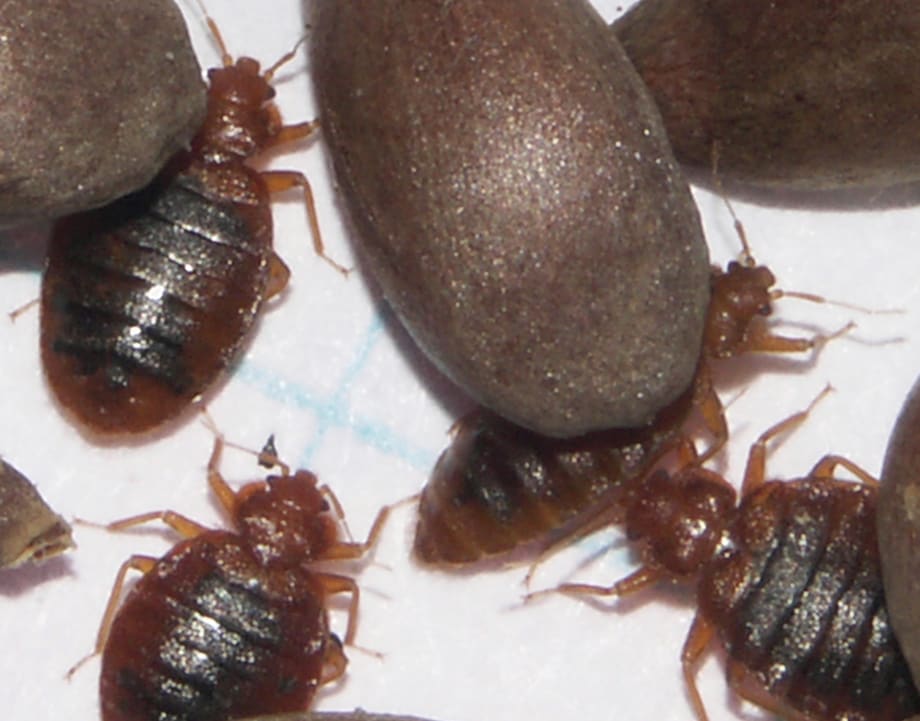
Male and female adult bedbugs in both unfed and fed conditions in comparison to apple seeds.
Photo credit: © AMNH/L. Sorkin
3 min to read
Male and female adult bedbugs in both unfed and fed conditions in comparison to apple seeds.
Photo
© AMNH/L. Sorkin
Scientists have assembled the first complete genome of one of humanity's oldest and least-loved companions: the bedbug. The new work could help combat pesticide resistance in the unwelcome parasite. The data also provides a rich genetic resource for mapping bedbug activity in human hosts and in cities, including subways.
The study was led by researchers at the American Museum of Natural History and Weill Cornell Medicine, and published Feb. 2 in Nature Communications.
"Bedbugs are one of New York City's most iconic living fossils, along with cockroaches, meaning that their outward appearance has hardly changed throughout their long lineage," said one of the paper's corresponding authors Dr. George Amato, director of the museum's Sackler Institute for Comparative Genomics. "But despite their static look, we know that they continue to evolve, mostly in ways that make it harder for humans to dissociate with them. This work gives us the genetic basis to explore the bedbug's basic biology and its adaptation to dense human environments."
The common bedbug (Cimex lectularius) has been coupled with humans for thousands of years. This species is found in temperate regions and prefers to feed on human blood. In recent decades, the prevalence of heated homes and global air travel has accelerated infestations in urban areas, where bedbugs have constant access to blood meals and opportunities to migrate to new hosts. A resurgence in bedbug infestations since the late 1990s is largely associated with the evolution of the insects' resistance to known pesticides, many of which are not suitable for indoor application.
"Bedbugs all but vanished from human lives in the 1940s because of the widespread use of DDT, but unfortunately, overuse contributed to resistance issues quite soon after that in bedbugs and other insect pests," said Louis Sorkin, an author on the paper and a senior scientific assistant in the Museum's Division of Invertebrate Zoology. "Today, a very high percentage of bedbugs have genetic mutations that make them resistant to the insecticides that were commonly used to battle these urban pests. This makes the control of bedbugs extremely labor intensive."
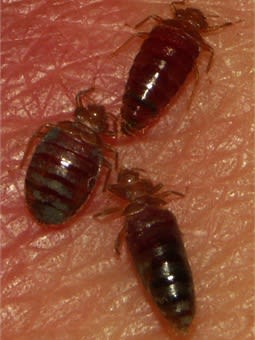
Three bedbugs on human skin.
Photo
© AMNH/L. Sorkin
The researchers extracted DNA and RNA from preserved and living collections, including samples from a population that was first collected in 1973 and has been maintained by museum staff members since then. RNA was sampled from males and females representing each of the bug's six life stages, before and after blood meals, in order to paint a full picture of the bedbug genome.
The researchers found that the number of genes was fairly consistent throughout the bedbug life cycle, but they observed notable changes in gene expression, especially after the first blood meal. Some genes, expressed only after the bedbug first drinks blood, are linked to insecticide resistance, including mechanisms that result in better detoxification and thicker chitin, or skin.
The bedbug microbiome also contains more than 1,500 genes that map to more than 400 different species of bacteria, indicating that bedbugs harbor a rich suite of endosymbionts that are likely essential for their growth and reproduction. This indicates that antibiotics that attack bacteria beneficial to bed bugs (but that are non-essential to humans) could complement control of the insects via pesticides.
In addition, the study incorporated DNA data collected concurrently from more than 1,400 locations across New York City, including every subway station, to look at microbial diversity. For this work, the researchers used the new genomic data to focus exclusively on the diversity of bedbugs. They found differences in the genetic makeup of bedbugs that reside in different parts of the city, as measured by traces of DNA on east-west versus north-south subway lines, as well as between borough locations and among surfaces (e.g., benches vs. turnstiles). The findings suggest that areas of the city in close proximity to each other have bedbug populations that are related, and that bedbugs from one borough can be distinct from those in another borough. This kind of information can be used to map the pathways of migration of bedbug infestations in established and new urban environments.
More Rail

New York MTA Advances Final Contract for Second Avenue Subway Expansion
Contract Four is the largest in the Second Avenue Subway Phase 2 project and includes construction of station infrastructure, tracks, and signals for the subway expansion, MTA officials said. Work on Contract Four will begin in 2027.
Read More →
San Diego MTS Breaks Monthly Trolley Ridership Record
Agency officials said July’s ridership indicates MTS’s continued recovery from the pandemic.
Read More →
Report Examines NJ TRANSIT Reliability, Funding Challenges
The Garden State Initiative analysis examines the roles of Amtrak infrastructure, fleet management, and agency operations while recommending a more performance-based approach to improving reliability.
Read More →
Stadler, CapMetro Sign Long-Term Rail Fleet Support Agreement
Beginning in 2027, Stadler will provide on-site technical expertise, spare parts support, training, and obsolescence management to help extend the reliability and longevity of CapMetro’s GTW fleet.
Read More →
Biz Briefs: Alstom Lands Canadian Contract, LYT to Supply California TSP, and More
In METRO's latest installment, we take a look at recent news from Complete Coach Works, Beep, FlixBus, and more partnerships making headlines across the transportation sector.
Read More →
CATS Gold Line Marks 5 Years of Service, 2.8M Passenger Trips
With a six-mile expansion planned, the Charlotte streetcar is positioned to connect more neighborhoods and major transit hubs across the region.
Read More →
Why Simulating Pedestrian Movement Has Become Essential for Modern Rail Stations
Pedestrian microsimulation is helping rail planners identify bottlenecks, test station designs, and prepare complex transit hubs for growing passenger volumes.
Read More →
Amtrak Begins Major Construction at New York’s Sunnyside Yard
The new maintenance facility will support Amtrak’s Airo trainsets while improving maintenance efficiency and turnaround times in New York.
Read More →
Chicago Leaders Unveil Plans for O’Hare Airport Express Train
The privately developed project would offer a 15-minute trip between downtown and O’Hare’s Terminal 2, with trains operating every 15 minutes on a dedicated track. The service would use battery-electric trains and three existing freight rail rights-of-way.
Read More →
OCTA Maps Out 30-Year Strategy to Protect Coastal Rail Corridor
The draft feasibility report identifies strategies to protect the coastal rail line for decades as the agency continues near-term stabilization and sand placement efforts.
Read More →