



Transit reliability could stimulate ridership, reduce congestion
The report, which analyzes the D.C. Metro system, proposes that greater reliability of transit schedules could motivate more people to leave their vehicles at home and ride the bus.


WMATA photo by Larry Levine.
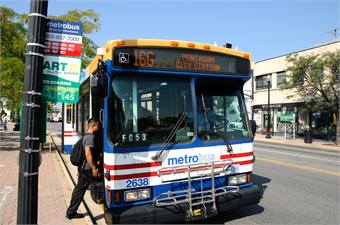
WMATA photo by Larry Levine.
Greater reliability of transit schedules could motivate more people to leave their vehicles at home and ride the bus, according to a new peer-reviewed report.
The report, “Reliability of Bus Transit Schedules in Washington D.C.,” was authored by Stephen Arhin, PhD, Errol D. Noel, PhD, and Janet Thomas, all of Howard University and working under the sponsorship of the Mineta National Transit Research Consortium.
“Before they decide to ride transit, people place great importance on its reliability, especially in urban areas,” said Dr. Arhin. “Will the bus or train arrive on time? Can passengers make their connections? Will they be standing in the rain waiting for a late bus? This is why most transit agencies set certain performance criteria, including on-time arrival and departure. Our research goal was to determine whether the Washington Metropolitan Transit Authority (Metro) achieved its own performance criterion for timeliness and to recommend improvements.”
The generally accepted standard for “on time” is one minute early and five minutes late. The Metro criterion was broader — two minutes early and seven minutes late. After analyzing 15 Metro lines for one year, the researchers found the bus system met its own performance goal 75% of the time, on average.
However, it met the industry standard criterion only 61% of the time, on average. The report includes individual performance results for each of the 15 studied lines.
The research team recommended that Metro adapt the industry standard criterion for on-time performance. A second recommendation stipulated that scheduled arrival studies should be conducted periodically on several representative Metro bus lines and routes so adjustments could be made and progress could be monitored.
A third recommendation suggested Metro conduct a travel and run-time study using automated data collection to gauge the efficiency of bus travel on heavily traveled and patronized routes.
The team also recommended data should be routinely compiled and analyzed for Metro’s performance or reliability indicators on three-year to five-year cycles, because characteristics of routes could change over time.
In addition to the on-time arrival metric at bus stops, industry literature recommended travel time, dwell time at stops, run time and transit level of service should also be considered in evaluating schedule performance. One reliability survey noted its transit riders generally have a favorable opinion of transit reliability, whereas non-riders of non-frequent riders generally do not.
The 52-page report includes 19 figures and 12 tables. To download the full report at no cost, click here.
More Bus

New York MTA Plans Largest Bus Fleet Upgrade in More Than a Decade
The agency is seeking manufacturers for 650 new CNG buses to replace aging vehicles, improve reliability, and advance its broader fleet modernization strategy.
Read More →
Building a Flexible Path to Transit Electrification
John Hroncich discusses BAE Systems’ modular and scalable approach, lessons learned from decades of real-world operations, and how agencies can identify electrification strategies that fit their fleets.
Read More →
Bus Tech Talk: Keeping Transit Technicians Ahead of the Technology Curve
LA Metro’s Obed Mejia discusses technician training, evolving maintenance technology, fleet replacement, and strategies for getting the most out of today’s transit fleets.
Read More →
Biz Briefs: RIPTA Unveils New Frontrunners, Clevland RTA Adds New Siemens, and More
In METRO's latest installment, we take a look at recent news from Siemens, Prevost, Dodge, and more partnerships making headlines across the transportation sector.
Read More →
People Movement: Holly Arnold Joins Transdev and More
In this edition, we also cover recent appointments and announcements at Pace, CamTran, MCI, and more, showcasing the individuals helping to shape the future of transportation.
Read More →
The High Cost of Transit Buses: Industry Leaders Look to Procurement Reform
Transit leaders and policymakers examine how standardized bus designs, streamlined procurement, and predictable funding could help agencies stretch budgets and deliver better service.
Read More →
The Business Voice Behind Public Transportation
As chair of APTA’s Business Members Board of Governors, Ray Melleady explains how more than 850 business members are partnering with transit agencies to advance funding, innovation, and industry-wide collaboration.
Read More →
From Surviving to Thriving: Building Stronger Transportation Organizations
Bus Business Consultants founder Brian Dickson shares lessons on leadership, organizational health, and creating options for long-term success in a changing transportation industry.
Read More →
Finding the ‘Happy Medium’: Optimizing Maintenance Without Sacrificing Reliability
The key to maintenance optimization isn’t doing less work—it’s doing the right work at the right time on the right assets.
Read More →
LA Metro, City of West Hollywood, and Partners Advance Smarter Bus Lane Enforcement
The award-winning partnership combines AI-powered detection with human oversight to improve bus reliability, accessibility, and enforcement efficiency.
Read More →