




Read More: Transdev, TriMet Expand Partnership with New Services
TriMet Works to Combat Drug Use On Board
TriMet has been working to keep the use of illicit drugs in its community off its buses and trains.
September 8, 2023
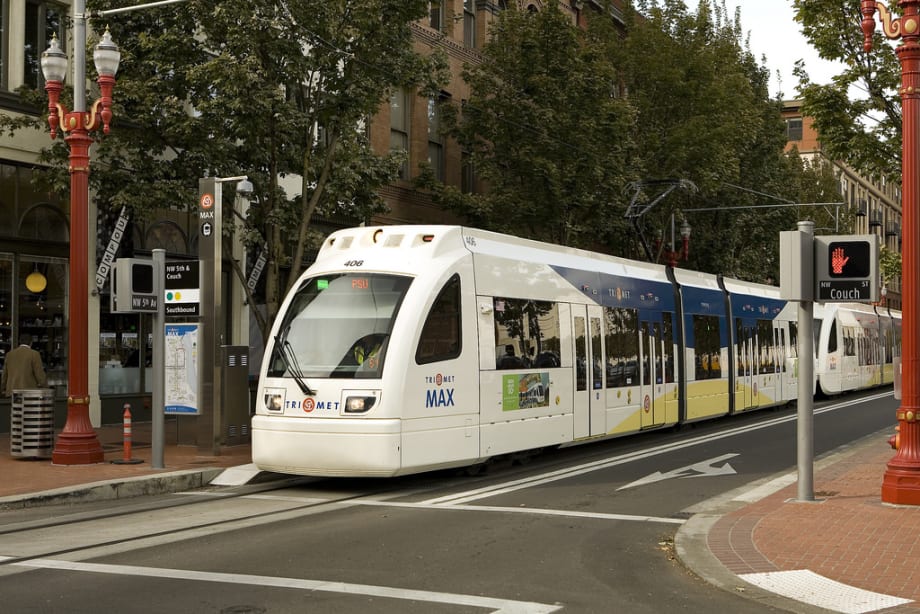
TriMet and its union, the Amalgamated Transit Union (ATU) 757, continue its call to state and local officials and lawmakers to deliver the policy changes and enforcement necessary to curb what has become an epidemic of rampant public consumption of drugs in its region.
Photo: TriMet
6 min to read
While levels of drugs detected in the University of Washington’s study of air and surfaces on transit were described as “extremely low,” TriMet said it urges regional crackdown on public drug use.
TriMet has been working to keep the use of illicit drugs in its community off its buses and trains. In the past two years, the general manager and other leadership have testified before Oregon lawmakers, city councilors, and county commissioners asking state and regional leaders to address drugs and crime before they extend onto its transit system.
The University of Washington released the results of that study, which included testing on some TriMet MAX trains.
The study did not assess the health impacts on its riders and operators from the traces found in air and surface samples, so TriMet sought the expertise of health experts.
Among them, Dr. Robert Hendrickson, a professor of emergency medicine and medical toxicologist at OHSU and the medical director of the Oregon Poison Center.
“The concentration of drugs detected in the air and on surfaces in this study were extremely low and would not cause harm to TriMet riders and operators,” Hendrickson said. “There is no threat to the public related to these study results, and individuals who use public transportation for travel needs should continue to feel safe doing so.”
Despite the low levels of drug residue found in the University of Washington research, TriMet said it wants to keep drugs off its transit system completely. But Oregon law poses challenges for keeping the smoking of fentanyl and meth out of public spaces, such as transit.
TriMet and its union, the Amalgamated Transit Union (ATU) 757, continue its call to state and local officials and lawmakers to deliver the policy changes and enforcement necessary to curb what has become an epidemic of rampant public consumption of drugs in its region.
“Our riders, operators, and other employees deserve to use our system without being exposed to drug use,” said TriMet GM Sam Desue, Jr. “More needs to be done to ensure that transit and other public spaces are safe and comfortable for everyone.”
UW Overall Findings
Researchers placed air pumps on board and collected surface samples from seats, windows, and doors in 30 transit buses and trains. Across all five agencies, 180 samples (78 air samples and 102 surface samples) were collected.
The measurements found may be challenging to comprehend as they are small and abstract. A microgram is a millionth of a gram and one-thousandth of a milligram.
A nanogram is one-billionth of a gram, one-millionth of a milligram, and one-thousandth of a microgram. Some liken a microgram to a single cell in the human body. Or, consider a grain of sand.
While the size of a grain of sand can vary, generally a grain of sand weighs approximately 23 micrograms. Another comparison could be a crystal of sugar. A single fine sugar crystal in those little packets you find at restaurants generally is about 20 milligrams. That’s 20 million times larger than one nanogram and 20,000 times larger than a microgram
Extremely low levels of fentanyl were detected in 25% of the air samples. Extremely low levels of fentanyl also were detected in 46% of the surface samples, ranging from one-hundredth of a nanogram to under a nanogram.
UW researchers also tested the 180 samples taken on the transit agencies’ buses and trains for remnants of methamphetamine. All the air samples tested positive for very low levels of meth and 98% of the surface samples found very low levels of meth as well.
TriMet Findings
In Portland, on TriMet, researchers collected samples on MAX trains. They gathered the air and surface samples from ten two-car trains and one single-car train over a two-day period (June 20-21) between 7 p.m. and 12 a.m.
The trains traveled through areas where we’ve had incidents of drug smoking reported.
The air samples were collected by pumps installed on the ceiling of the train cars, just inside the door to the operator cab and on the outside of the door, in the passenger area.
Surface samples were mainly taken on the outside of the operator cab door, in the passenger area, as well as on seats/dividers in the middle of the trains and in the bench seating at the back of the vehicles.
Overall, very low levels of fentanyl, meth, and cocaine were detected in the air (less than two-tenths of a microgram) and on surfaces (less than two and a half nanograms). A few samples were also tested for cocaine. As with the positive fentanyl and meth results, the level of cocaine found was very low as well.
Combatting Drug Use On Board
“We saw this wave of fentanyl and meth use rolling through our community, and we took action,” said TriMet Chief Safety Officer Andrew Wilson. “We have taken a number of steps to try to keep drug use off our buses and trains, and we won’t stop. It will be a continuous effort.”
TriMet has doubled the number of personnel on its security teams since the start of 2022, to increase presence on board. Its security teams will inform anyone seen smoking on board that it is not allowed and supervisors and/or police will be contacted if the person refuses to leave or stop smoking.
TriMet's Customer Safety Supervisors enforce TriMet Code, including issuing citations or exclusions for smoking. A year ago, it had 18 Customer Safety Supervisors; today, it has 46.
In addition to increasing security personnel, the agency changed the TriMet Code in early 2022, to include non-criminal violations of laws or ordinances as actions prohibited on TriMet.
Since possessing a small amount of drugs and drug use are now categorized as a violation under Oregon law (ORS Chapter 153), by prohibiting violations of those activities, security personnel can further address the behavior, with a citation or exclusion.
TriMet has added a Safety Response Team, which has now expanded to 58 personnel. Team members connect people in need on and around its transit system with social services such as shelters, mental health resources, and addiction services.
In recent years, TriMet has updated its standard operating procedures. Workers focused on cleaning its vehicles wipe down touch points each night before the bus or train goes into service the next day. TriMet also has procedures to address smoke when it is reported on board. It upgraded the filters in its buses and trains during the COVID-19 pandemic.
The HVAC system on its fixed-route buses uses a MERV-12 rated filter and its FX articulated buses use a MERV-13 filter. The TriMet MAX trains use the highest level of filter possible for their HVAC systems, a MERV-10.
All the air in the MAX car passes through the HVAC unit about every 74 seconds. The frequent opening and closing of bus and train doors provides additional ventilation. While on-board air is recycled, the fresh air from opening and closing doors and windows, as well as the air passing through the ventilation filters, helps to clean it.
More Security and Safety

Transit Agencies Highlight Safety Gains at National Summit
Leaders from 15 major transit systems shared crime-reduction results and safety initiatives while discussing the role of continued federal support.
Read More →
DART Launches Major Security, Fare Enforcement Initiative
The 90-day demonstration will deploy coordinated security teams at five light rail stations while testing controlled access and gathering data to guide future investments.
Read More →
RTD Launches NextRide App to Consolidate Trip Planning, Fares, Security Reporting
The app expands on RTD’s existing NextRide web application and allows customers to view real-time vehicle locations and service alerts, purchase and store digital fares, and access customer support.
Read More →

TAPTCO Updates OSHA Compliance Training for Transit Maintenance Operations
The revamped program addresses 26 OSHA standards for maintenance facilities, with TAPTCO pointing to training, documentation, and everyday shop hazards as continuing challenges for transit operations.
Read More →
Sponsored•August 18, 2026
How VaporVision Adds Value to Transit Door Systems
Wabtec engineers explain how the system improves doorway detection, strengthens diagnostics and gives transit agencies and OEMs greater operating flexibility.
Read More →
FRA Announces $5.3B in Rail Investments, Including $2B for Amtrak
Funding will support grade-crossing improvements, infrastructure upgrades, and new Amtrak equipment in 23 states.
Read More →
Chicago, Maryland Expand Non-Law-Enforcement Safety, Rider Support
The CTA and MTA are launching new programs aimed at de-escalation, crisis response, rider assistance, and greater transparency.
Read More →
LA Metro, City of West Hollywood, and Partners Advance Smarter Bus Lane Enforcement
The award-winning partnership combines AI-powered detection with human oversight to improve bus reliability, accessibility, and enforcement efficiency.
Read More →
LA Metro Reports 57% Decline in Homelessness on Transit System Since 2024
The agency's latest homelessness count offers new data on how care-based services and cross-sector partnerships can complement traditional transit security strategies.
Read More →
FTA Launches 'Transit Moves America' Dashboard to Highlight Agency Safety and Performance
The online dashboard transforms National Transit Database information into a public-facing resource that allows users to compare transit agencies on key operational and safety metrics.
Read More →