




RELATED: U.S., China kickoff 'Race to Zero Emissions Challenge'
U.S. transportation sector increases carbon footprint, study says
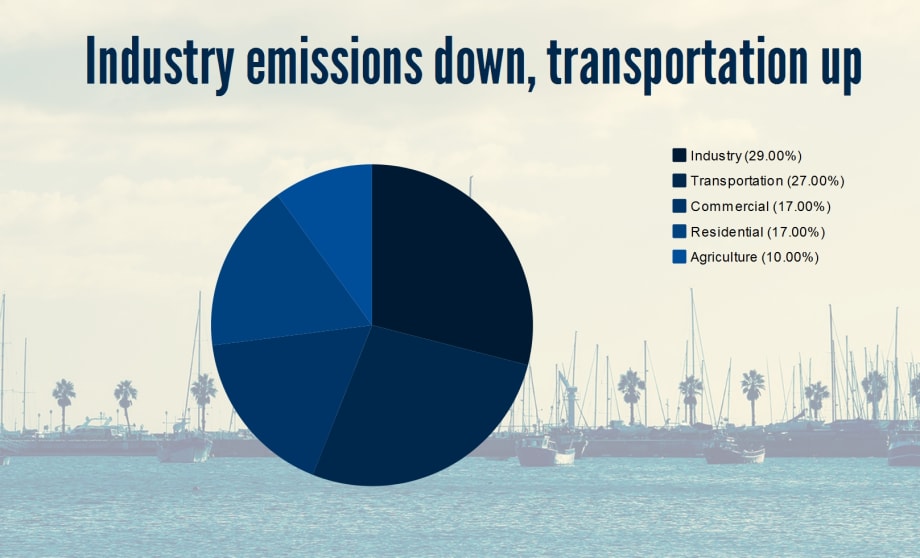
Industry, still the nation's largest emitter, accounts for about 29% of all emissions — down from nearly 36% in 1990. However, transportation — the country's second-largest contributor to greenhouse emissions — has increased its share from 24% in 1990 to 27% in 2014.
July 25, 2016
University of Michigan
2 min to read
University of Michigan
While industry in the U.S. has made solid strides in reducing greenhouse gas emissions over the past 25 years, the transportation sector has increased its carbon footprint, say University of Michigan researchers.
Industry, still the nation's largest emitter, accounts for about 29% of all emissions — down from nearly 36% in 1990. However, transportation — the country's second-largest contributor to greenhouse emissions — has increased its share from 24% in 1990 to 27% in 2014.
The relative contributions of the commercial, residential and agricultural sectors have also increased since 1990. Emissions are now about 17% for the commercial sector, 17% for the residential sector and 10% for agriculture.
Michael Sivak, research professor at the U-M Transportation Research Institute, said that these overall trends occurred because of two underlying trends: 1) absolute emissions from the industrial sector decreased by 11%, despite the increases in population and GDP, and 2) the absolute emissions from transportation, commercial, residential and agricultural sectors increased 17%, 21%, 20% and 10%, respectively.
Sivak and colleague Brandon Schoettle examined data from the U.S. Environmental Protection Agency from 1990 to 2014.
"Because of the major progress in reducing emissions from industry, we can expect an increased emphasis on reducing emissions from the other economic sectors, including transportation," Sivak said. "In addition, because of the large increase in the contribution of medium- and heavy-duty trucks to total emissions, we can expect increased emphasis on reducing emissions from these classes of vehicles."
According to the study, absolute emissions of medium- and heavy-duty trucks jumped 76%, from about 15% of transportation emissions in 1990 to 22% in 2014. At the same time, the relative contributions of passenger cars, light-duty trucks and commercial and other aircraft decreased — although cars and light trucks still account for 61% of transportation emissions.
Overall, the relative contribution of medium- and heavy-duty trucks to total emissions has grown to 6%. This compares with a slight rise to 16% for passenger cars and light-duty trucks, despite a large increase in the number of these vehicles on the road today.
More Technology

From Hardware to Digital Partner: Luminator Charts Its Next Chapter
CEO Magnus Friberg discusses Luminator’s shift toward becoming a digital partner, the growing importance of software and interoperability, and how AI can help agencies improve operations and passenger experience.
Read More →
Beyond the Checklist: A Structured Approach to Transit Maintenance
Reliability-Centered Maintenance helps transit agencies move beyond routine checklists to focus limited resources on the assets and failures that have the greatest impact on safety, reliability, and service.
Read More →
NJ TRANSIT Advances Bus Technology Upgrades Across Statewide Fleet
More than 1,500 buses now feature upgraded technology designed to improve arrival predictions and provide free Wi-Fi, with deployment expected to reach nearly 2,000 buses by the end of 2026.
Read More →

Building a Flexible Path to Transit Electrification
John Hroncich discusses BAE Systems’ modular and scalable approach, lessons learned from decades of real-world operations, and how agencies can identify electrification strategies that fit their fleets.
Read More →
Biz Briefs: Alstom Lands Canadian Contract, LYT to Supply California TSP, and More
In METRO's latest installment, we take a look at recent news from Complete Coach Works, Beep, FlixBus, and more partnerships making headlines across the transportation sector.
Read More →
Sponsored•September 8, 2026
From Legacy Silos to Conversational Intelligence
What if transit leaders could ask any operational question and get a trusted answer in seconds? Conversational AI is transforming how agencies use their data.
Read More →
USDOT Announces Rail Vehicle Replacement Grants, Chattanooga AV Shuttle Funding
More than $191 million in federal funding will help three transit agencies replace aging rail vehicles and support a new autonomous shuttle service in Chattanooga.
Read More →
Bus Tech Talk: Keeping Transit Technicians Ahead of the Technology Curve
LA Metro’s Obed Mejia discusses technician training, evolving maintenance technology, fleet replacement, and strategies for getting the most out of today’s transit fleets.
Read More →
Biz Briefs: RIPTA Unveils New Frontrunners, Clevland RTA Adds New Siemens, and More
In METRO's latest installment, we take a look at recent news from Siemens, Prevost, Dodge, and more partnerships making headlines across the transportation sector.
Read More →
Why Simulating Pedestrian Movement Has Become Essential for Modern Rail Stations
Pedestrian microsimulation is helping rail planners identify bottlenecks, test station designs, and prepare complex transit hubs for growing passenger volumes.
Read More →