




Related: 8 Wash. agencies testing Mobileye collision avoidance system
Volvo Buses unveils pedestrian and cyclist detection system
The system will be introduced on Volvo’s European city bus fleet in 2017.
September 22, 2016
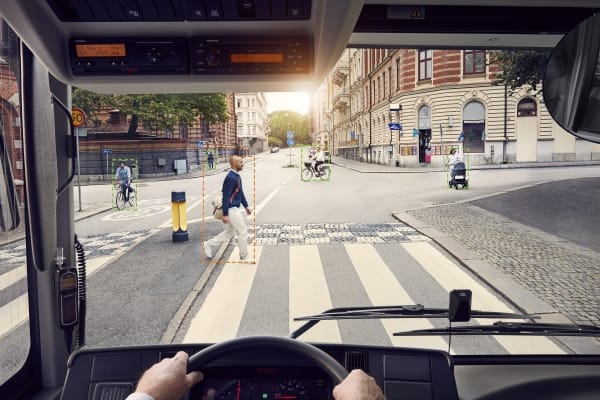
Photo: Volvo Buses
2 min to read
Photo: Volvo Buses
Volvo Buses is taking steps to reduce the 1.25 million annual road traffic deaths by unveiling a pedestrian and cyclist detection system, according to the company. Launching at the IAA in Hanover, the system will be introduced on Volvo’s European city bus fleet in 2017.
“Accidents involving buses and unprotected road-users seldom occur, but when they do the consequences may be very serious. In order to minimize the risks, it is important that drivers and anyone moving around near buses – such as at bus stops and pedestrian crossings – pays close attention to the traffic. In this context the pedestrian and cyclist detection system offers excellent support,” says Peter Danielsson, director, vehicle features and safety at Volvo Buses.
The pedestrian and cyclist detection system continuously monitors the bus’s vicinity using a camera. When the system detects unprotected road-users near the bus, it transmits a sound to warn other road-users that the bus is approaching. At the same time, the driver is alerted via sound and light signals inside the vehicle. If there is an imminent risk of an incident, the bus’s horn is activated.
“Several of the components in our system are based on the same tried and tested technology found in many cars. But we are the only vehicle manufacturer to offer a solution that simultaneously notifies both driver and unprotected road-user,” says Peter Danielsson.
Volvo Buses’ introduction of this type of warning system is part of the company’s electromobility drive. As the proportion of electrified vehicles in urban traffic continues to grow, exhaust fumes and noise continue to disappear. At the same time, however, it is important to also eliminate any risks that might arise as the vehicles in the urban environment operate much more quietly.
“The bus can be heard – but without being disruptive. We’ve solved this problem by developing a synthetic background sound with a frequency range that is not perceived as disruptive. For instance, it does not penetrate windows with triple glazing, unlike the low-frequency noise made by a diesel engine,” explains Peter Danielsson.
This video animation illustrates how the system works:
More Bus

New York MTA Plans Largest Bus Fleet Upgrade in More Than a Decade
The agency is seeking manufacturers for 650 new CNG buses to replace aging vehicles, improve reliability, and advance its broader fleet modernization strategy.
Read More →
Building a Flexible Path to Transit Electrification
John Hroncich discusses BAE Systems’ modular and scalable approach, lessons learned from decades of real-world operations, and how agencies can identify electrification strategies that fit their fleets.
Read More →
Bus Tech Talk: Keeping Transit Technicians Ahead of the Technology Curve
LA Metro’s Obed Mejia discusses technician training, evolving maintenance technology, fleet replacement, and strategies for getting the most out of today’s transit fleets.
Read More →
Biz Briefs: RIPTA Unveils New Frontrunners, Clevland RTA Adds New Siemens, and More
In METRO's latest installment, we take a look at recent news from Siemens, Prevost, Dodge, and more partnerships making headlines across the transportation sector.
Read More →
People Movement: Holly Arnold Joins Transdev and More
In this edition, we also cover recent appointments and announcements at Pace, CamTran, MCI, and more, showcasing the individuals helping to shape the future of transportation.
Read More →
The High Cost of Transit Buses: Industry Leaders Look to Procurement Reform
Transit leaders and policymakers examine how standardized bus designs, streamlined procurement, and predictable funding could help agencies stretch budgets and deliver better service.
Read More →
The Business Voice Behind Public Transportation
As chair of APTA’s Business Members Board of Governors, Ray Melleady explains how more than 850 business members are partnering with transit agencies to advance funding, innovation, and industry-wide collaboration.
Read More →
From Surviving to Thriving: Building Stronger Transportation Organizations
Bus Business Consultants founder Brian Dickson shares lessons on leadership, organizational health, and creating options for long-term success in a changing transportation industry.
Read More →
Finding the ‘Happy Medium’: Optimizing Maintenance Without Sacrificing Reliability
The key to maintenance optimization isn’t doing less work—it’s doing the right work at the right time on the right assets.
Read More →
LA Metro, City of West Hollywood, and Partners Advance Smarter Bus Lane Enforcement
The award-winning partnership combines AI-powered detection with human oversight to improve bus reliability, accessibility, and enforcement efficiency.
Read More →