




RELATED: Helsinki launching self-driving bus into regular service
Volvo, tech. univ. to develop autonomous electric buses in Singapore
For Volvo, this will be its first autonomous application in public transportation anywhere in the world.
January 16, 2018
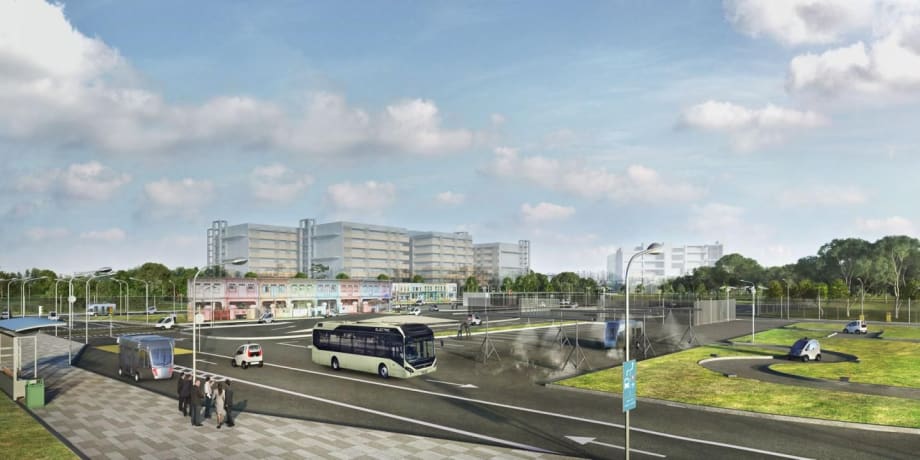
NTU and Volvo will begin testing autonomous electric passenger buses at the CETRAN test centre from 2019 and the 40-seater buses will be equipped with GPS and integrated navigation systems that will enable it to drive, park and even charge itself. (Image: JTC)
2 min to read
NTU and Volvo will begin testing autonomous electric passenger buses at the CETRAN test centre from 2019 and the 40-seater buses will be equipped with GPS and integrated navigation systems that will enable it to drive, park and even charge itself. (Image: JTC)
Nanyang Technological University, Singapore (NTU Singapore) and Volvo Buses announced that they will begin testing autonomous electric passenger buses in Singapore in 2019.
For Volvo, this will be its first autonomous application in public transportation anywhere in the world. The 40-foot Volvo 7900 Electric bus is already in service around the world, providing a quiet and emission-free operation, and requiring 80 percent less energy than an equivalent-sized diesel bus, according to the company.
The 40-seater buses to be deployed in Singapore will be equipped with autonomous driving technologies. These include GPS and LIDAR laser technology systems for charting, positioning and detecting obstacles around the vehicle, and an integrated navigation system that includes automated steering, gear-changing, and speed-throttling technologies.
The buses will be tested from early 2019 at the Centre of Excellence for Testing and Research of Autonomous vehicles at NTU (CETRAN). The autonomous vehicle test circuit, which is modelled after real road conditions in Singapore, provides a safe and controlled environment to test autonomous vehicles.
The autonomous electric buses will be tested on campus at CETRAN, which replicates different elements of Singapore's roads, with common traffic schemes, road infrastructure, and traffic rules.
The circuit features a rain simulator and flood zone to test autonomous vehicles' navigation abilities under tropical weather conditions. It also helps improve overall safety and efficiency by allowing researchers to assess the vehicles' interaction with pedestrians.
Singapore's public transport operator SMRT will also play a critical role in determining the roadworthiness of autonomous vehicles and assist in operational trials.
One of the buses will undergo tests at a local bus depot managed by SMRT. This would test the vehicle's capabilities to autonomously navigate into vehicle washing bays and park safely at charging areas.
For the development and deployment of fast-charging stations based on the OppCharge interface, Volvo and NTU will be partnering ABB, a developer of charging solutions for electric vehicles.
The charging station is capable of providing 300kW of charging power in three to six minutes, during the layover times at the bus route's end points.
More New Mobility

From Hardware to Digital Partner: Luminator Charts Its Next Chapter
CEO Magnus Friberg discusses Luminator’s shift toward becoming a digital partner, the growing importance of software and interoperability, and how AI can help agencies improve operations and passenger experience.
Read More →
Biz Briefs: Alstom Lands Canadian Contract, LYT to Supply California TSP, and More
In METRO's latest installment, we take a look at recent news from Complete Coach Works, Beep, FlixBus, and more partnerships making headlines across the transportation sector.
Read More →
CharterUP’s Armir Harris on Technology, AI, and the Future of Group Mobility
In a recent episode of METROspectives, CharterUP Founder/CEO Armir Harris discussed the company’s evolution from an online charter bus marketplace into a technology platform supporting public- and private-sector mobility and much more.
Read More →
Jacksonville’s NAVI Project Charts a New Course for Autonomous Public Transportation
Through its NAVI program, JTA is showing how autonomous vehicles, intelligent infrastructure, and coordinated operations can work together to deliver everyday public transportation.
Read More →
Biz Briefs: Luminator Marks Milestone and More
From manufacturers and suppliers to transit agencies and motorcoach operators, these updates offer a snapshot of the projects, partnerships and business moves driving the industry forward.
Read More →
New Tricks for Old Bureaucracies: Joshua Schank on Making Transit Innovation Stick
Former LA Metro Chief Innovation Officer Joshua Schank discusses why good ideas aren't enough, how transit agencies can overcome resistance to change, and why today's challenges demand more innovation.
Read More →
How DART's GoPass Is Redefining Regional Mobility
Serving 14 transit agencies, GoPass simplifies multimodal travel by allowing riders to plan, pay for, and manage an entire trip through one app.
Read More →
Biz Briefs: OCTA Taps Clean Energy for Hydrogen Station, Stadler to Supply Via Rail Vehicles, and More
From manufacturers and suppliers to transit agencies and motorcoach operators, these updates offer a snapshot of the projects, partnerships and business moves driving the industry forward.
Read More →CharterUP Expands Into New Mobility and Autonomous Transportation
Vice President of New Mobility Stephen Joos discusses how CharterUP is leveraging its nationwide transportation network, technology platform, and autonomous vehicle partnerships to expand into workforce mobility, campus shuttles, and transit solutions.
Read More →
METRO Magazine Announces 2026 Innovative Solutions Awards Winners
Projects Recognized for Advancing Mobility Through Technology, Accessibility, Workforce Innovation, and Operational Excellence
Read More →