



Web Extra: New Monterey, Calif. route to connect University, community
Will provide a direct route to and from the city of Salinas — where 25 percent of registered students live — as well as shopping and other commercial locations. Vehicles are equipped with bike racks and wheelchair lifts to ensure more convenience for students.

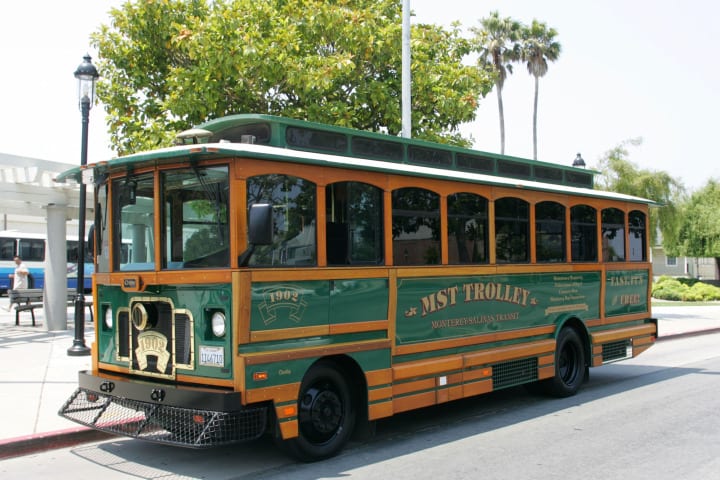
The Monterey Salinas Transit (MST) Trolley will travel from the Salinas Transit Center (pictured) to California State University, Monterey Bay.
[IMAGE]MST-TrolleyFULL.jpg[/IMAGE] Beginning in September, California State University Monterey Bay (CSUMB) students, faculty and staff will be able to commute more easily from their homes or jobs to campus. Monterey Salinas Transit (MST) will add a new bus line that will connect downtown Salinas, Hartnell College, CSUMB, the Dunes Shopping Center and other commercial locations in the city of Marina.
Carl Sedoryk, GM/CEO of the transit agency, said that last year, MST identified a large untapped market of CSUMB students, faculty and employees that were not being well-served by public transit. “There was an issue [with] getting the funding together to provide more regular service,” he explained.
Over the past several years, MST worked on small projects with the University, which was developed as part of a base re-use of the former Fort Ord. MST, in attempting to plan for the growth on the base, did a study to identify future markets. The largest and most immediate of those was CSUMB students, Sedoryk said. Twenty-five percent of registered students at CSUMB list the city of Salinas as their primary residence. MST does not currently have a direct route from Salinas to the University; several transfers are required.
“We saw this as an opportunity to provide a service to this very significant population. This is something that the University administration wanted to see happen as [it would] help them to mitigate traffic issues on the campus as well,” Sedoryk said.
Another joint project, a fare-free zone on campus, funded in part by CSUMB, was conducted over the course of a year. “There was a ten-fold ridership increase on the routes that were serving the campus. So, we knew there was a potential for more there,” Sedoryk said.
The total cost of the new bus line is $531,947. The Transportation Agency of Monterey County will provide $305,842. in funding, and the recovered fare total is anticipated to be approximately $118,978, said Megan Tolbert, campus transportation planner, CSUMB.
In addition, no new vehicles need to be purchased for the route. Sedoryk said that MST provides trolley service in Monterey and on the peninsula during the summer season, between Memorial Day and Labor Day, when school is not in session. The vehicles aren’t used much during the winter season, making them available for the school year. The agency also has been able to add some spare trolleys to their fleet to accommodate the new service. They purchased two of the same style trolley buses used from METRO Transit of Oklahoma City.
Tolbert added that the University is interested in using the trolleys because they are equipped with bike racks and wheelchair lifts, making them even more convenient for students than the current campus shuttle service, which the new bus line may eventually replace.
Sedoryk added that the benefit of the partnership with CSUMB is that it has helped the agency keep a balanced budget without cutting service or raising fares while offering more service to the University. “That’s a rare position these days…I think it’s great that we’ve been able to work with CSUMB to provide mobility and opportunities to explore the community and have access to jobs. I think it will be good for the students and the local economy. And we’re happy to be a part of that.”
More Bus

New York MTA Plans Largest Bus Fleet Upgrade in More Than a Decade
The agency is seeking manufacturers for 650 new CNG buses to replace aging vehicles, improve reliability, and advance its broader fleet modernization strategy.
Read More →
Building a Flexible Path to Transit Electrification
John Hroncich discusses BAE Systems’ modular and scalable approach, lessons learned from decades of real-world operations, and how agencies can identify electrification strategies that fit their fleets.
Read More →
Bus Tech Talk: Keeping Transit Technicians Ahead of the Technology Curve
LA Metro’s Obed Mejia discusses technician training, evolving maintenance technology, fleet replacement, and strategies for getting the most out of today’s transit fleets.
Read More →
Biz Briefs: RIPTA Unveils New Frontrunners, Clevland RTA Adds New Siemens, and More
In METRO's latest installment, we take a look at recent news from Siemens, Prevost, Dodge, and more partnerships making headlines across the transportation sector.
Read More →
People Movement: Holly Arnold Joins Transdev and More
In this edition, we also cover recent appointments and announcements at Pace, CamTran, MCI, and more, showcasing the individuals helping to shape the future of transportation.
Read More →
The High Cost of Transit Buses: Industry Leaders Look to Procurement Reform
Transit leaders and policymakers examine how standardized bus designs, streamlined procurement, and predictable funding could help agencies stretch budgets and deliver better service.
Read More →
The Business Voice Behind Public Transportation
As chair of APTA’s Business Members Board of Governors, Ray Melleady explains how more than 850 business members are partnering with transit agencies to advance funding, innovation, and industry-wide collaboration.
Read More →
From Surviving to Thriving: Building Stronger Transportation Organizations
Bus Business Consultants founder Brian Dickson shares lessons on leadership, organizational health, and creating options for long-term success in a changing transportation industry.
Read More →
Finding the ‘Happy Medium’: Optimizing Maintenance Without Sacrificing Reliability
The key to maintenance optimization isn’t doing less work—it’s doing the right work at the right time on the right assets.
Read More →
LA Metro, City of West Hollywood, and Partners Advance Smarter Bus Lane Enforcement
The award-winning partnership combines AI-powered detection with human oversight to improve bus reliability, accessibility, and enforcement efficiency.
Read More →