



Web Extra: Syracuse U., Centro debut GPS tracking system
The cost of the new system is approximately $2.8 million and is being funded through $2.25 million in SAFETEA-LU grant monies from Sen. Charles E. Schumer (D-NY), along with 10 percent matches provided by both Syracuse University and the New York State DOT.

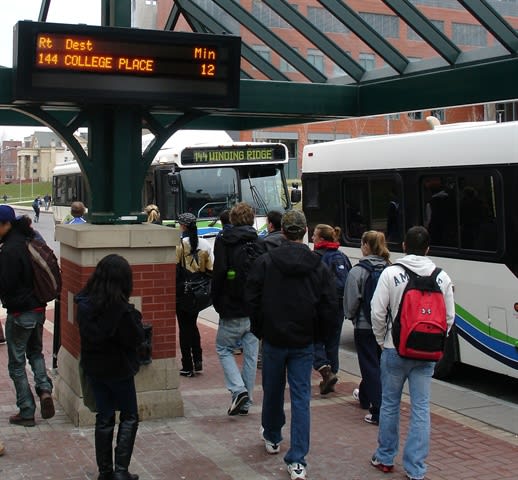
Syracuse University Students board a Centro bus at College Place, the main bus stop on campus. The stop is equipped with Bus Time GPS signage. Photo Courtesy: Centro
[IMAGE]CENTRO-2.jpg[/IMAGE]In a public-private partnership with Syracuse University, the Central New York Regional Transportation Authority (Centro) debuted a GPS tracking system that will provide predictive bus arrival times for customers.
The system, "Bus Time," has been installed along Syracuse's Connective Corridor, which links the Syracuse University campus with many of the city's cultural venues. More than a dozen Bus Time LED signs have been installed at bus stops along the corridor, with each providing visual and audible information on the arrival time of the next scheduled bus.
Customers can also access the information via text message / email, or by accessing Centro's website on their smart phone or personal computer.
"It really is part of our collaborative working relationship with Syracuse University, explained Steven Koegel, director, marketing & communications for Centro. "Chancellor Nancy Cantor has spearheaded a concept called the Connective Corridor, which is an effort to integrate Syracuse University students in the fabric of the city of Syracuse by increasing student awareness and accessibility to downtown Syracuse and its cultural venues. The first step in this process was establishing a bus route connecting the campus and downtown."
The university inquired about GPS bus technology and secured federal grants to pay for Bus Time. The project was then awarded to Clever Devices through a competitive bid process and has been working with Centro and Syracuse University to implement the system, added Koegel.
The cost of the new system is approximately $2.8 million and is being funded through $2.25 million in SAFETEA-LU grant monies from Sen. Charles E. Schumer (D-NY), along with 10 percent matches provided by both Syracuse University and the New York State Department of Transportation.
The ITS (intelligent transportation system) technology in Syracuse is unique because it is converging network technologies and VoIP (voice over Internet protocol) on each bus while connecting these technologies via a cellular signal to a centralized command center, according to Centro.
Customers are now able to wait at an equipped bus stop and receive information on exactly when their bus will arrive at that stop. Each sign will visually count down the arrival of the next scheduled bus and can provide audio announcements of the same information for sight-impaired users.
The Bus Time system also includes LED signs on 20 buses that operate along the corridor. Each provide automated stop announcements and other important bus route information for riders. The project is an 18-month pilot program. Once complete, Centro will evaluate whether to pursue Bus Time technology for other aspects of its bus services.
"We are hopeful the system proves to be accurate and reliable for our customers and for our drivers and dispatchers. It not only helps the rider by providing predictive information, but it also helps our dispatchers and bus operators maintain a timely product," said Koegel. "If all works well, we would look to install the system on more bus routes in coming years."
Clever Devices produced and installed the Bus Time system and has provided similar technology for transit systems in Chicago, New York City, Chattanooga and Richmond.
More Bus

New York MTA Plans Largest Bus Fleet Upgrade in More Than a Decade
The agency is seeking manufacturers for 650 new CNG buses to replace aging vehicles, improve reliability, and advance its broader fleet modernization strategy.
Read More →
Building a Flexible Path to Transit Electrification
John Hroncich discusses BAE Systems’ modular and scalable approach, lessons learned from decades of real-world operations, and how agencies can identify electrification strategies that fit their fleets.
Read More →
Bus Tech Talk: Keeping Transit Technicians Ahead of the Technology Curve
LA Metro’s Obed Mejia discusses technician training, evolving maintenance technology, fleet replacement, and strategies for getting the most out of today’s transit fleets.
Read More →
Biz Briefs: RIPTA Unveils New Frontrunners, Clevland RTA Adds New Siemens, and More
In METRO's latest installment, we take a look at recent news from Siemens, Prevost, Dodge, and more partnerships making headlines across the transportation sector.
Read More →
People Movement: Holly Arnold Joins Transdev and More
In this edition, we also cover recent appointments and announcements at Pace, CamTran, MCI, and more, showcasing the individuals helping to shape the future of transportation.
Read More →
The High Cost of Transit Buses: Industry Leaders Look to Procurement Reform
Transit leaders and policymakers examine how standardized bus designs, streamlined procurement, and predictable funding could help agencies stretch budgets and deliver better service.
Read More →
The Business Voice Behind Public Transportation
As chair of APTA’s Business Members Board of Governors, Ray Melleady explains how more than 850 business members are partnering with transit agencies to advance funding, innovation, and industry-wide collaboration.
Read More →
From Surviving to Thriving: Building Stronger Transportation Organizations
Bus Business Consultants founder Brian Dickson shares lessons on leadership, organizational health, and creating options for long-term success in a changing transportation industry.
Read More →
Finding the ‘Happy Medium’: Optimizing Maintenance Without Sacrificing Reliability
The key to maintenance optimization isn’t doing less work—it’s doing the right work at the right time on the right assets.
Read More →
LA Metro, City of West Hollywood, and Partners Advance Smarter Bus Lane Enforcement
The award-winning partnership combines AI-powered detection with human oversight to improve bus reliability, accessibility, and enforcement efficiency.
Read More →