



Zipcar expands car sharing service to UCLA, USC
Pilot program was made possible by a public-private partnership by Zipcar, Mayor Villaraigosa and the Los Angeles City Council and is intended as a first step toward a potentially larger expansion of car sharing in the Los Angeles area.

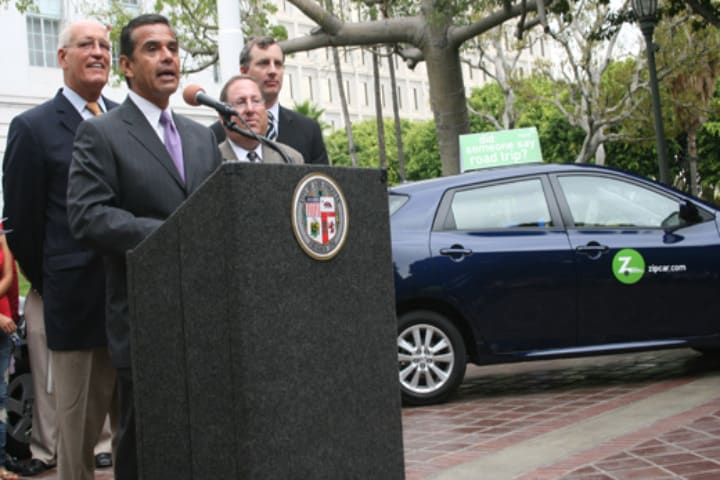
"Providing alternatives to car ownership will help improve the environment and the city's traffic congestion," said Los Angeles Mayor Antonio Villaraigosa during a press conference.
[IMAGE]L-A-Mayor-full.jpg[/IMAGE]In mid-September, Zipcar expanded its car sharing program on the campuses of the University of California Los Angeles (UCLA) and University of Southern California (USC).
Zipcar added 12 new vehicles in reserved parking spots on city streets in the neighborhoods adjacent to UCLA and USC. "Providing alternatives to car ownership will help improve the environment and the city's traffic congestion," said Los Angeles Mayor Antonio Villaraigosa.
The pilot program was made possible by a public-private partnership by Zipcar, Mayor Villaraigosa and the Los Angeles City Council and is intended as a first step toward a potentially larger expansion of car sharing in the Los Angeles area.
“Our partnership with Zipcar will give more people a real alternative to owning a car without having to sacrifice the flexibility of having one when they need one,” said Eric Garcetti, City Council President. “This program will cut down on our carbon emissions, reduce our traffic congestion, and help the people of Los Angeles save money.”
Convenient access to Zipcars on city streets is proven to provide benefits to local residents, taxpayers, and the environment, according to a statement released by the Mayor's office. For residents, car sharing helps reduce parking demand and congestion, as each Zipcar takes between 15 and 20 personally owned vehicles off the road.
In addition, members report driving 40 percent fewer miles and increasing public transit use by nearly 20 percent, helping to reduce traffic congestion and emissions. Finally, the average Zipcar member reports saving more than $600 per month on transportation costs.
Zipcar vehicles are available by the hour or by the day to members, who can reserve a car via phone, online or a mobile device. A simple hourly/daily fee as low as $8/hour and $66/day weekdays, and $9/hour and $72/day weekends, includes parking in the reserved spot, gas, insurance, 180 free miles and 24/7 roadside assistance.
"I am very excited that our partnership with Zipcar will give more UCLA students options for local travel while helping to reduce the traffic impact around UCLA,” said City Councilman Paul Koretz, whose district includes UCLA.
In addition to being able to access vehicles in Los Angeles, members have access to Zipcar’s network of vehicles throughout the state, along the West Coast, across the country and around the world.
More Bus

People Movement: Dan Dipert Coaches Adds Third-Generation Leader, Keolis Names New Valley Metro VP/GM, and More
In this edition, we also cover recent appointments and announcements at the Wabtec, SilverRide, HNTB, and more, showcasing the individuals helping to shape the future of transportation.
Read More →
New York MTA Plans Largest Bus Fleet Upgrade in More Than a Decade
The agency is seeking manufacturers for 650 new CNG buses to replace aging vehicles, improve reliability, and advance its broader fleet modernization strategy.
Read More →
Building a Flexible Path to Transit Electrification
John Hroncich discusses BAE Systems’ modular and scalable approach, lessons learned from decades of real-world operations, and how agencies can identify electrification strategies that fit their fleets.
Read More →
Bus Tech Talk: Keeping Transit Technicians Ahead of the Technology Curve
LA Metro’s Obed Mejia discusses technician training, evolving maintenance technology, fleet replacement, and strategies for getting the most out of today’s transit fleets.
Read More →
Biz Briefs: RIPTA Unveils New Frontrunners, Clevland RTA Adds New Siemens, and More
In METRO's latest installment, we take a look at recent news from Siemens, Prevost, Dodge, and more partnerships making headlines across the transportation sector.
Read More →
People Movement: Holly Arnold Joins Transdev and More
In this edition, we also cover recent appointments and announcements at Pace, CamTran, MCI, and more, showcasing the individuals helping to shape the future of transportation.
Read More →
The High Cost of Transit Buses: Industry Leaders Look to Procurement Reform
Transit leaders and policymakers examine how standardized bus designs, streamlined procurement, and predictable funding could help agencies stretch budgets and deliver better service.
Read More →
The Business Voice Behind Public Transportation
As chair of APTA’s Business Members Board of Governors, Ray Melleady explains how more than 850 business members are partnering with transit agencies to advance funding, innovation, and industry-wide collaboration.
Read More →
From Surviving to Thriving: Building Stronger Transportation Organizations
Bus Business Consultants founder Brian Dickson shares lessons on leadership, organizational health, and creating options for long-term success in a changing transportation industry.
Read More →
Finding the ‘Happy Medium’: Optimizing Maintenance Without Sacrificing Reliability
The key to maintenance optimization isn’t doing less work—it’s doing the right work at the right time on the right assets.
Read More →