




RELATED: World's largest subway goes cashless, adopts QR code
Microbes in Hong Kong subway system mix together by evening rush
"Studies of microbial composition of train compartments may guide future public health strategies and public transit designs."
August 7, 2018
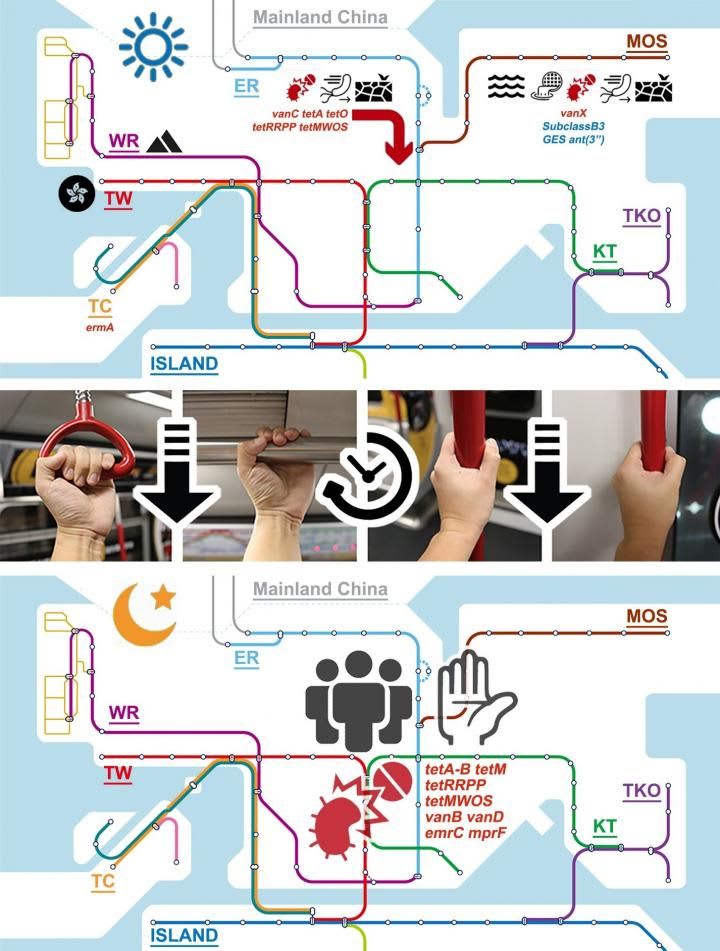
This diagram shows how the interconnectivity of subway lines both within Hong Kong and across to mainland China permit specific mixing patterns of bacteria between morning and evening. Credit: Gianni Panagiotou
3 min to read
This diagram shows how the interconnectivity of subway lines both within Hong Kong and across to mainland China permit specific mixing patterns of bacteria between morning and evening.
Gianni Panagiotou
Every day, the hundred-mile-long Hong Kong subway system serves nearly five million people commuting from as far away as mainland China. In the journal Cell Reports, researchers show how microbes from these diverse travelers mix throughout the day. While each subway line hosts a characteristic set of bacteria during morning rush hour, by evening, these unique bacteria join into one uniform microbiome populating the entire system.
"In the morning, each line has unique microbial features reflecting the regions it passes, but with more and more people using the subway during the day, the microbial communities of all the lines become more similar, dominated by human skin commensal bacteria," says Gianni Panagiotou, a systems biologist at the Hans Knoell Institute in Germany and the University of Hong Kong. "The Metro is constantly cleaning every surface that we touch, but the train compartments have little personal space — passengers are squashed there, and we are talking about one of the busiest and densest cities in the world."
In partnership with architect Chris Webster, Panagiotou and his team wanted to uncover how the geographical features of the different subway lines and their connectivity to urban streets and other public spaces affected the overall microbial composition of the subway. Then, they wanted to see if the microbiome itself would inherit the tidal effects of the traffic flow enough to vary over traveling time.
To simulate the average commuter experience, the researchers sent volunteers through the subways for half an hour during both the morning and evening rush hours, sampling the skin on their hands after each. Because the skin is a major biointerface critical for immune function, the researchers were curious not about which bacteria lived on the train compartment surfaces themselves, as had been examined in earlier studies in Boston and NYC subways, but about which were transferred to commuters' hands.
The majority of microbes transferred were relatively harmless skin commensals, or bacteria normally living on the skin of other travelers. But, some pathogens were discovered as well. In fact, according to Panagiotou, the best illustration of the mixing pattern came from antibiotic resistance genes. "In the morning, ARGs were only captured in a few lines but, by the evening, could be traced in all of them," he says.
"The idea for this project is not to scare people, because what we observed was that higher traffic Metro lines do not carry higher health risks, neither in terms of pathogens or in terms of antibiotic resistance genes," says Panagiotou. "Instead, we want to better understand how urban planning can impact the types of bacteria we encounter so that studies like ours investigating the microbial composition of train compartments may guide future public health strategies and public transit designs."
More Rail

FTA Ends Direct Oversight of MBTA Safety Actions
The federal agency closed its remaining special directive to the Massachusetts Department of Public Utilities following a safety review that began in 2022.
Read More →
Amtrak, CN Reach Agreements to Strengthen Passenger Rail Service, Safety
The agreement resolves a more than decade-long proceeding before the Surface Transportation Board concerning the terms and conditions for Amtrak services, such as the City of New Orleans, Illini/Saluki, and Wolverine.
Read More →
New York MTA Advances Final Contract for Second Avenue Subway Expansion
Contract Four is the largest in the Second Avenue Subway Phase 2 project and includes construction of station infrastructure, tracks, and signals for the subway expansion, MTA officials said. Work on Contract Four will begin in 2027.
Read More →
San Diego MTS Breaks Monthly Trolley Ridership Record
Agency officials said July’s ridership indicates MTS’s continued recovery from the pandemic.
Read More →
Report Examines NJ TRANSIT Reliability, Funding Challenges
The Garden State Initiative analysis examines the roles of Amtrak infrastructure, fleet management, and agency operations while recommending a more performance-based approach to improving reliability.
Read More →
Stadler, CapMetro Sign Long-Term Rail Fleet Support Agreement
Beginning in 2027, Stadler will provide on-site technical expertise, spare parts support, training, and obsolescence management to help extend the reliability and longevity of CapMetro’s GTW fleet.
Read More →
Biz Briefs: Alstom Lands Canadian Contract, LYT to Supply California TSP, and More
In METRO's latest installment, we take a look at recent news from Complete Coach Works, Beep, FlixBus, and more partnerships making headlines across the transportation sector.
Read More →
CATS Gold Line Marks 5 Years of Service, 2.8M Passenger Trips
With a six-mile expansion planned, the Charlotte streetcar is positioned to connect more neighborhoods and major transit hubs across the region.
Read More →
Why Simulating Pedestrian Movement Has Become Essential for Modern Rail Stations
Pedestrian microsimulation is helping rail planners identify bottlenecks, test station designs, and prepare complex transit hubs for growing passenger volumes.
Read More →
Amtrak Begins Major Construction at New York’s Sunnyside Yard
The new maintenance facility will support Amtrak’s Airo trainsets while improving maintenance efficiency and turnaround times in New York.
Read More →