




RELATED: High-Speed Rail is at a Crossroads
California's Governor calls for scaling down of high-speed rail project
The state’s high-speed rail authority will focus now on building only the Central Valley segment of the planned San Francisco to Los Angeles train.
February 12, 2019
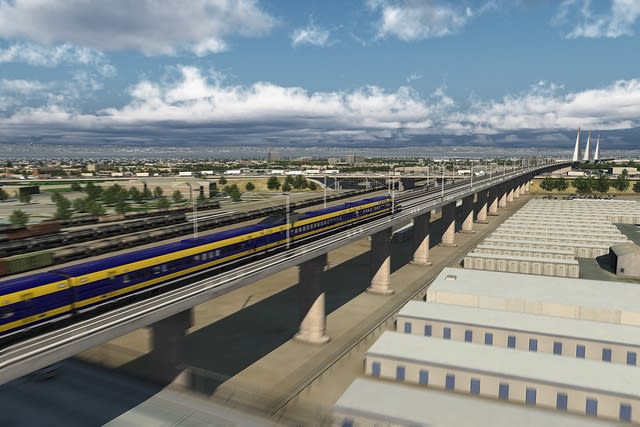
A rendering of the Bakersfield portion of the California High-Speed Rail project via the California High-Speed Rail Authority
3 min to read
A rendering of the Bakersfield portion of the California High-Speed Rail project via the California High-Speed Rail Authority
During his first State of the State address, Gov. Gavin Newsom discussed plans to scale back two major California infrastructure projects, including the state’s beleaguered high-speed rail project.
The state’s high-speed rail authority will focus now on building only the Central Valley segment of the planned San Francisco to Los Angeles train.
“Right now, there simply isn’t a path to get from Sacramento to San Diego, let alone from San Francisco to LA,” Newsom said during his address. “However, we do have the capacity to complete a high-speed rail link between Merced and Bakersfield.”
He also bristled at the notion that the high-speed rail system was a “train to nowhere.”
“I know that some critics will say this is a ‘train to nowhere.’ But that’s wrong and offensive,” said Newsom. “The people of the Central Valley endure the worst air pollution in America as well as some of the longest commutes. And they have suffered too many years of neglect from policymakers here in Sacramento. They deserve better.”
The Governor added that high-speed rail is more than a train project, but an economic transformation that could unlock “the enormous potential of the Valley,” before adding that this doesn’t necessarily mark the end of the project’s larger goal.
“Look, we will continue our regional projects north and south,” he said. “We’ll finish Phase 1 environmental work. We’ll connect the revitalized Central Valley to other parts of the state, and continue to push for more federal funding and private dollars. But let’s just get something done.”
Newsom added that for those who want to abandon the project entirely would mean that the state will have wasted billions of dollars with nothing but broken promises and lawsuits to show for it, and wasn’t “interested in sending $3.5 billion in federal funding that was allocated to this project back to Donald Trump.”
In closing, the Governor said there will be new transparency measures implemented, including holding contractors and consultants accountable to explain how taxpayer dollars are spent — including change orders, cost overruns, and even travel expenses — which will be available online.
“You’re also going to see some governance changes, starting with my pick for the next chair of the High-Speed Rail Authority, Lenny Mendonca, my economic development director,” Newsom said. “Because at the end of the day, transportation and economic development must go hand in hand.”
Following the announcement, APTA President/CEO Paul P. Skoutelas released the following statement:
"The American Public Transportation Association appreciates and applauds California Governor Gavin Newsom's commitment to the long-term goal of bringing high-speed rail to California and to continued improvements of local and regional public transportation systems.
"The Governor said that the state will focus first on completing the 119-mile Central Valley phase in the near term, while completing environmental assessments and seeking funding for the entire project.
"The investments made to date have created thousands of jobs and will produce dramatic improvements in mobility through clean, efficient public transportation.
"APTA is committed to working with Governors and local leaders to support their efforts in advancing vital investment projects that require strong federal, state and local partnerships.
"Improving and expanding our nation's transportation system is critical, and APTA urges Congress and the Trump Administration to make infrastructure investment a priority this year, which will benefit millions of Americans across the country."
[This story was updated on Feb.14]
More Rail

Stadler, CapMetro Sign Long-Term Rail Fleet Support Agreement
Beginning in 2027, Stadler will provide on-site technical expertise, spare parts support, training, and obsolescence management to help extend the reliability and longevity of CapMetro’s GTW fleet.
Read More →
Biz Briefs: Alstom Lands Canadian Contract, LYT to Supply California TSP, and More
In METRO's latest installment, we take a look at recent news from Complete Coach Works, Beep, FlixBus, and more partnerships making headlines across the transportation sector.
Read More →
CATS Gold Line Marks 5 Years of Service, 2.8M Passenger Trips
With a six-mile expansion planned, the Charlotte streetcar is positioned to connect more neighborhoods and major transit hubs across the region.
Read More →
Why Simulating Pedestrian Movement Has Become Essential for Modern Rail Stations
Pedestrian microsimulation is helping rail planners identify bottlenecks, test station designs, and prepare complex transit hubs for growing passenger volumes.
Read More →
Amtrak Begins Major Construction at New York’s Sunnyside Yard
The new maintenance facility will support Amtrak’s Airo trainsets while improving maintenance efficiency and turnaround times in New York.
Read More →
Chicago Leaders Unveil Plans for O’Hare Airport Express Train
The privately developed project would offer a 15-minute trip between downtown and O’Hare’s Terminal 2, with trains operating every 15 minutes on a dedicated track. The service would use battery-electric trains and three existing freight rail rights-of-way.
Read More →
OCTA Maps Out 30-Year Strategy to Protect Coastal Rail Corridor
The draft feasibility report identifies strategies to protect the coastal rail line for decades as the agency continues near-term stabilization and sand placement efforts.
Read More →
The Business Voice Behind Public Transportation
As chair of APTA’s Business Members Board of Governors, Ray Melleady explains how more than 850 business members are partnering with transit agencies to advance funding, innovation, and industry-wide collaboration.
Read More →
FRA Announces $5.3B in Rail Investments, Including $2B for Amtrak
Funding will support grade-crossing improvements, infrastructure upgrades, and new Amtrak equipment in 23 states.
Read More →
Finding the ‘Happy Medium’: Optimizing Maintenance Without Sacrificing Reliability
The key to maintenance optimization isn’t doing less work—it’s doing the right work at the right time on the right assets.
Read More →