



9 startups tapped to bring cutting-edge tech to MTA, other area agencies
More than 130 companies applied to be part of this year’s program, which focuses on three topics that were jointly chosen by the participating agencies.

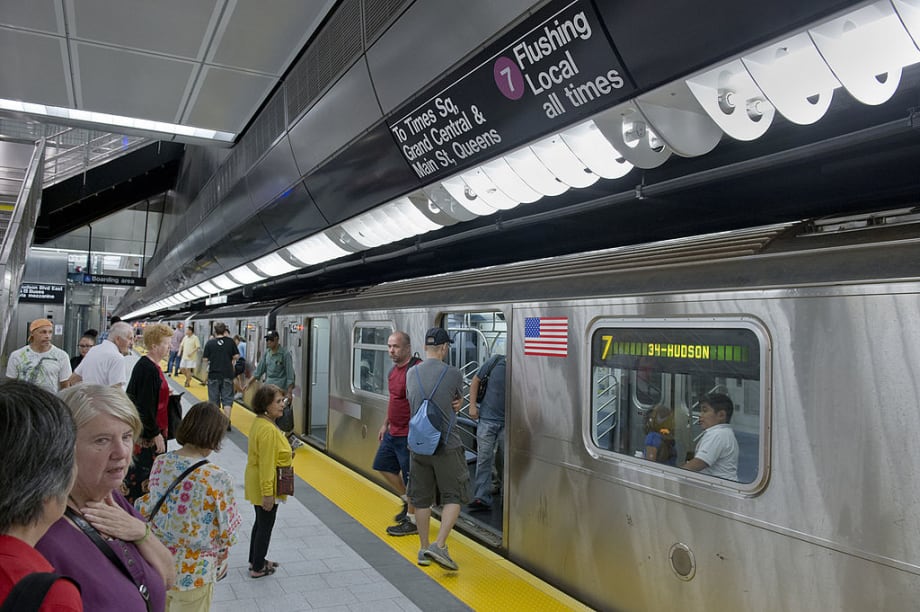
During the rigorous eight-week program, each company will collaborate closely with participating agencies and work to demonstrate their product has the potential to solve one of the identified challenges.
Patrick Cashin
During the rigorous eight-week program, each company will collaborate closely with participating agencies and work to demonstrate their product has the potential to solve one of the identified challenges. Patrick Cashin
The Partnership for New York City’s Transit Tech Lab, the Metropolitan Transportation Authority, and four other transportation agencies announced nine start-up companies have been selected to pilot cutting-edge technologies that could improve accessibility, revenue generation, and traffic congestion for millions of daily travelers in the New York metropolitan area. The agencies joining the MTA in this initiative are the Port Authority of New York and New Jersey, New York City Department of Transportation, NJ TRANSIT, and Amtrak.
The Transit Tech Lab is part of the public-private Transit Innovation Partnership and enables the MTA and other public transportation agencies to leverage innovative technology solutions to improve metropolitan area transit, with the aim to make New York the global leader in public transportation.
More than 130 companies applied to be part of this year’s program, which focuses on three topics that were jointly chosen by the participating agencies:
Accessibility: How can we make New York’s public transit systems more accessible?
Entrepreneurial Revenue Generation: How can public transit generate more revenue outside the farebox?
Curb Coordination: How can transit agencies reduce traffic by increasing coordination at the curb?
During the rigorous eight-week program, each company will collaborate closely with participating agencies and work to demonstrate their product has the potential to solve one of the identified challenges. Companies that successfully achieve this “proof of concept” accelerator phase will move on to a formal pilot project that deploys their technology for testing in one or more participating transit systems. Last year, six companies were selected for the accelerator program and four proceeded to pilots upon completion.
“At the MTA, we believe that start-ups are key to unlocking innovative ideas to address our most pressing transportation challenges,” said Mark Dowd, MTA chief innovation officer.
Company
Partner Organization(s)
Acoustic Protocol: Converts audio public address announcements into personalized, targeted messages to improve accessibility for deaf and hard of hearing customers.
New York City Transit and Metro-North Railroad
NaviLens: Uses a computer vision algorithm that interprets geospatial information and provides navigation guidance in any space without use of GPS, Bluetooth, Wi-Fi, or cell coverage.
New York City Transit, Metro-North Railroad, Amtrak, NJ TRANSIT, and the Port Authority of New York and New Jersey
Okeenea: Smartphone app that provides transit system navigation for customers who are blind/low vision or deaf/hard of hearing.
New York City Transit and Amtrak
Knaq: Provides predictive elevator and escalator maintenance tools enabling any service elevator to be digitized and its status instantly updated online.
New York City Transit, Metro-North Railroad, Amtrak, NJ TRANSIT, and the Port Authority of New York and New Jersey
Allvision IO: Inventories curb infrastructure and monitors street parking behavior of both commercial and noncommercial vehicles.
New York City Department of Transportation
CARMERA: Provides up-to-the-minute construction data and descriptions, such as obstructions in parking spots or traffic lanes.
New York City Transit
CurbFlow: Marketplace for curbside access that sources dedicated curb supply from municipalities to create pickup and drop-off management and maps.
Port Authority of New York and New Jersey
Numina: Measures curb-level behaviors using a proprietary, camera-based sensor that mounts to any fixed infrastructure, Numina processes all imagery securely onboard the sensor, anonymously measures activity and provides behavioral insights to improve traffic operations.
New York City Transit, NJ TRANSIT and the Port Authority of New York and New Jersey
Miles: Provides anonymized multimodal analytics to cities and offers mileage-based rewards to users encouraging public transit use.
New York City Transit, NJ TRANSIT and the Port Authority of New York and New Jersey
More Technology

ENC Lands MATA Contract and More in Biz Briefs
In this edition of Biz Briefs, we spotlight the latest developments shaping the future of mobility.
Read More →
Strada360’s Steve Lassey on Turning Transit Data Into Better Decisions
From breaking down data silos to preparing for AI, Strada360 CEO Steve Lassey discusses how transit agencies can use technology to improve operations, customer information, and long-term decision-making.
Read More →
Almaviva Looks to Open Architecture to Advance Transit Technology
Eric Reese discusses how interoperability, open architecture, and modular design can help transit agencies control costs, reduce vendor lock-in, and upgrade technology without starting over.
Read More →

Driving Smarter Paratransit
John Hanlon shares how AlphaRoute is leveraging AI-powered technology to help paratransit providers optimize operations, support frontline staff, and enhance the rider experience.
Read More →
From Hardware to Digital Partner: Luminator Charts Its Next Chapter
CEO Magnus Friberg discusses Luminator’s shift toward becoming a digital partner, the growing importance of software and interoperability, and how AI can help agencies improve operations and passenger experience.
Read More →
Beyond the Checklist: A Structured Approach to Transit Maintenance
Reliability-Centered Maintenance helps transit agencies move beyond routine checklists to focus limited resources on the assets and failures that have the greatest impact on safety, reliability, and service.
Read More →
NJ TRANSIT Advances Bus Technology Upgrades Across Statewide Fleet
More than 1,500 buses now feature upgraded technology designed to improve arrival predictions and provide free Wi-Fi, with deployment expected to reach nearly 2,000 buses by the end of 2026.
Read More →
Building a Flexible Path to Transit Electrification
John Hroncich discusses BAE Systems’ modular and scalable approach, lessons learned from decades of real-world operations, and how agencies can identify electrification strategies that fit their fleets.
Read More →
Biz Briefs: Alstom Lands Canadian Contract, LYT to Supply California TSP, and More
In METRO's latest installment, we take a look at recent news from Complete Coach Works, Beep, FlixBus, and more partnerships making headlines across the transportation sector.
Read More →
From Legacy Silos to Conversational Intelligence
What if transit leaders could ask any operational question and get a trusted answer in seconds? Conversational AI is transforming how agencies use their data.
Read More →