



Related: Electrification Enhances Bay Area Commuter Rail, Sets High-Speed Stage
High-Speed Rail: At a Crossroads
Major corridor programs — such as California High-Speed Rail and the Northeast Corridor — are actively advancing visionary futures for public transportation. Yet, future federal funding for HSR remains clouded in the complexities of the federal appropriations process.
by David J. Carol
September 27, 2017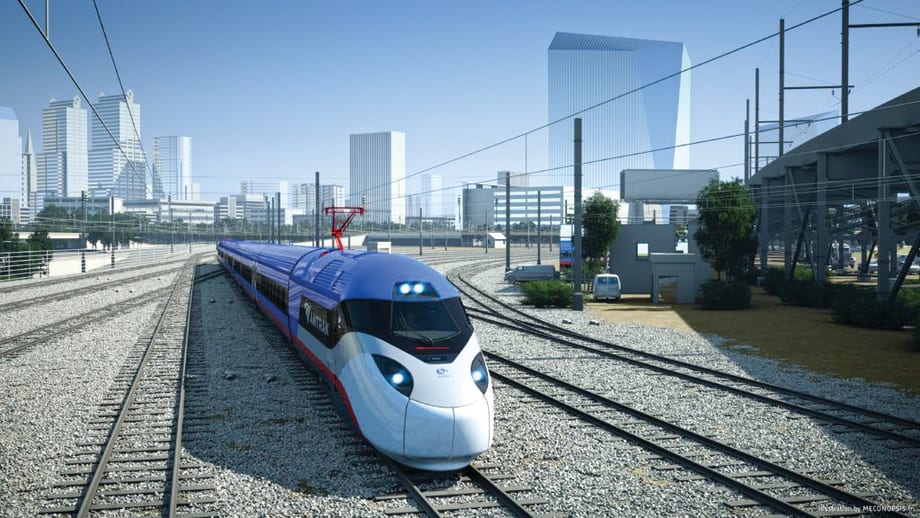
In July 2017, the FRA released the Record of Decision for NEC FUTURE, its planning platform for defining the expansion of the Northeast Corridor over the next 25 to 50 years. Rendering via Amtrak
8 min to read
It is the best of times and . . . perhaps the most unclear of times for high-speed rail (HSR) in the U.S. Major corridor programs — such as California High-Speed Rail and the Northeast Corridor — are actively advancing visionary futures for public transportation. Privately funded projects — All Aboard Florida’s Brightline project and Texas Central’s Houston-Dallas HSR program — have achieved major and exciting milestones. Other programs — from the Chicago-St. Louis HSR program to the Southeast High Speed Rail Corridor to the Hartford Line program in New England— continue to progress.
Yet, future federal funding for HSR remains clouded in the complexities of the federal appropriations process. While states such as California have, and will continue to step in with significant, and often creative, funding initiatives, such as the use of cap-and-trade taxes on greenhouse gas emissions to partially fund the California High-Speed Rail Program, it is the long-term availability of federal funding that ultimately will define the scale and pace of HSR implementation in this country.
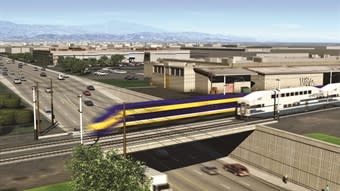
The California High-Speed Rail project, which will eventually connect San Diego, Los Angeles, San Francisco, and Sacramento, will be implemented in phases. Rendering via CHSRA
For the first time ever, as a direct outcome of the $10 billion investment in HSR made in 2009 and 2010, states across the country have developed and now completed the environmental and planning processes for a myriad of new HSR systems and for expansion of existing ones. The Federal Railroad Administration (FRA) has overseen dozens of environmental and engineering projects that make the nation truly “shovel ready” for passenger rail investment. This includes the California High-Speed Train Project; the Eugene-Portland-Seattle-Vancouver Cascades program; various Midwest corridors connecting to Chicago; the Atlanta, Charlotte, Raleigh, Richmond and Washington Southeast HSR Corridor; the Northeast Corridor; the Boston and Montreal Northern New England Intercity Rail Initiative; the Tucson-Phoenix corridor; Tulsa-Oklahoma City HSR; the Minneapolis-Rochester ZIP Rail project; among other rail corridor initiatives.
With federal funding, these programs could accelerate design and construction, ushering in a new era of transportation in this country. Yet, legislative efforts to define a long-term investment program and to provide a long-term funding vehicle for investment remain stalled in Washington, D.C. Funding for FY 2018, and congressional priorities for that funding, will not be resolved until some time this fall. Until a sustained funding program is implemented, many plans will remain on the shelf. Nonetheless, real progress is being made in a number of major corridors.
For the first time ever, as a direct outcome of the $10 billion investment in HSR made in 2009 and 2010, states across the country have developed and now completed the environmental and planning processes for a myriad of new HSR systems and for expansion of existing ones.
California The California High-Speed Rail Program, the largest single rail transportation project in U.S. history, is making significant construction progress as it seeks to implement the first 119-mile segment of world-class HSR infrastructure in the U.S. The project, which will eventually connect San Diego, Los Angeles, San Francisco, and Sacramento, will be implemented in phases, with many related upgrades to the state’s extensive commuter rail system. Work currently is focused in the Central Valley, with the first phase of service linking San Jose to Bakersfield expected around 2025. Some 13 active construction projects are underway, ranging from construction of new rail infrastructure to new bridges and viaducts to convey vehicular traffic over the railroad. Some major recent milestones include:
Completion of the Tuolumne Street Bridge in downtown Fresno, a large structure that carries vehicular traffic over the Union Pacific and future HSR tracks. Beginning in 2015, the project involved placement of 42 massive steel-and-concrete girders, each some 149 feet long and weighing more than 83 tons. The bridge reopened to traffic on Aug. 3, 2017.
New spans on the 3,700-foot Cedar Viaduct in Fresno, which will carry high-speed trains over State Route 99, North Avenue, Cedar Avenue, and Golden State Boulevard. Crews are installing reinforcing steel bars in preparation for the next concrete pours. The massive structure is expected to be completed in 2018.
Near completion of the Fresno River Viaduct, a 1,600-foot structure that will carry high-speed trains over the Fresno River and State Route 145 outside of the town of Madera. The viaduct was the first project to start construction.
Northeast Corridor The FRA has achieved two major milestones related to enabling the Washington-New York-Boston corridor to accommodate growing demand for intercity and commuter rail services. In July 2017, the FRA released the Record of Decision for NEC FUTURE, its planning platform for defining the expansion of the Northeast Corridor (NEC) over the next 25 to 50 years. The alternative adopted by the FRA would accommodate as many as five times as many intercity trains on the NEC as operate today, significantly reduce travel time, enable commuter railroads to meet projected growth, and upgrade the NEC to a state of good repair. The program foresees addition of some 200 miles of new track and alignments, replacement of most of the aging bridges across the 465-mile corridor, and elimination of numerous chokepoints that result in delays and restrict operations. The expansion would support a near doubling of ridership across the NEC, as well as transforming the NEC into an integrated network for commuter, regional, and intercity rail services. In all, some $135 billion in investments would be required over a 25- to 50-year period, creating a reliable, fast, and safe rail corridor that for many would be the predominant means of transportation across the region.
In addition to NEC FUTURE, the FRA released the draft Environmental Impact Statement for the Gateway Tunnel Project, the critical effort to build two new tunnels under the Hudson River from New Jersey to Penn Station in Manhattan, and to rehabilitate the existing 115-year-old Hudson River tunnels, heavily damaged in Superstorm Sandy. The current tunnels under the Hudson River, along with aging infrastructure and capacity constraints at Penn Station, represent the single worst bottleneck on the NEC. Expanding service to and from Penn Station is the cornerstone for expanding NEC service and ensuring a vibrant and competitive regional economy. Amtrak, New Jersey Transit, the Port Authority of New York and New Jersey, and the FRA are leading the effort to address this critical deficiency. Future work will focus on expansion of Penn Station to add platforms and tracks and to incorporate new train operations at the Farley Post Office adjacent to Penn Station. Meanwhile, Amtrak has ordered new high-speed trainsets to initially supplement and then replace the existing Acela fleet.
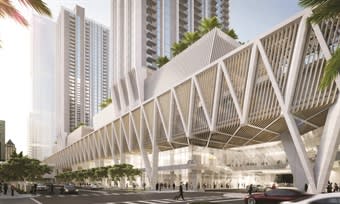
Brightline will serve some of Florida’s most populated cities and tourist destinations with frequent and fast rail service. Rendering via All Aboard Florida/Brightline
Brightline
Brightline is the privately-funded passenger rail initiative to create a new train corridor connecting Miami, Fort Lauderdale, West Palm Beach, and Orlando. Owned by All Aboard Florida, a subsidiary of Florida East Coast Industries, the rail service will be built in two phases — from Miami to West Palm Beach on upgraded existing right-of-way and then to Orlando on new alignment capable of 110 mph operations. Travel time will be approximately three hours end-to-end. Work is currently focused on upgrades between Miami and West Palm Beach, with three major stations and track upgrades under construction, and on trainset acquisition and commissioning. While not the 90-minute HSR service many want for the Miami-Orlando market, Brightline will serve some of Florida’s most populated cities and tourist destinations with frequent and fast rail service. Moreover, it will be the first privately funded U.S. rail corridor program in decades, presenting a new model for rail corridor implementation at a time when public funding for new rail infrastructure is so challenging. Brightline anticipates start-up of its first phase later this year.
Texas Central HSR
Texas Central is another privately developed passenger rail initiative that could dramatically expand travel options between the state’s two economic powerhouses — Dallas/Fort Worth and Houston. The $12 billion initiative, which will utilize N700 Shinkansen train technology developed and operated by Central Japan Railways, will support 90-minute service between the two cities, with an additional mid-line stop near the state’s largest university, Texas A&M. The project is attracting a myriad of institutional investors and Texas Central Railroad recently awarded a contract for construction of the civil infrastructure. The final environmental impact statement is anticipated later this year.
The success of the Texas Central initiative — a HSR corridor serving two large business markets supported by Japanese rail interests and requiring no federal and state funding — may well define the future of HSR in the U.S. Its success will provide a powerful model for implementation of new passenger initiatives in corridors where premium fares from the business travel market can support capital and operating costs without significant public funding.
In July 2017, the FRA released the Record of Decision for NEC FUTURE, its planning platform for defining the expansion of the Northeast Corridor over the next 25 to 50 years. Rendering via Amtrak
In addition to these major initiatives, work continues on other important HSR projects. Between St. Louis and Chicago, completion of track and crossing improvements this year will reduce travel times by as much as an hour. In Connecticut, Hartford Line service connecting New Haven, Hartford, and Springfield, Mass. will begin service in 2018, with some 16 new daily round-trip trains connecting central New England to the NEC. Amtrak’s Downeaster service from Boston has been extended to Brunswick, Maine, including completion of a new maintenance facility in Brunswick. Major improvements are under way between Richmond, Va. and Washington, D.C. to improve travel times and expand the capacity of the rail corridor to support additional frequencies, while the North Carolina Department of Transportation is completing several grade separation and capacity expansion projects to support additional Piedmont and Southeast HSR corridor service. In the Pacific Northwest, the State of Washington recently announced a new initiative, supported by Microsoft and other major companies, to implement HSR for the Portland-Seattle-Vancouver corridor.
The success of these initiatives, and the willingness of state governments to finance improved passenger rail service, underscores the public support for passenger rail and the strong economic and environmental benefits it can provide. Elsewhere in the world —notably France, the UK, Singapore, and China — national governments continue to use HSR investment to achieve broad economic, environmental and social policy objectives. Whether, and to what extent, the U.S. government follows suit is an open question.
David J. Carol serves as deputy project director on the Tel Aviv Red Line light rail project for WSP.
Subscribe to Our Newsletter
More Rail

New York MTA Advances Final Contract for Second Avenue Subway Expansion
Contract Four is the largest in the Second Avenue Subway Phase 2 project and includes construction of station infrastructure, tracks, and signals for the subway expansion, MTA officials said. Work on Contract Four will begin in 2027.
Read More →
San Diego MTS Breaks Monthly Trolley Ridership Record
Agency officials said July’s ridership indicates MTS’s continued recovery from the pandemic.
Read More →
Report Examines NJ TRANSIT Reliability, Funding Challenges
The Garden State Initiative analysis examines the roles of Amtrak infrastructure, fleet management, and agency operations while recommending a more performance-based approach to improving reliability.
Read More →
Stadler, CapMetro Sign Long-Term Rail Fleet Support Agreement
Beginning in 2027, Stadler will provide on-site technical expertise, spare parts support, training, and obsolescence management to help extend the reliability and longevity of CapMetro’s GTW fleet.
Read More →
Biz Briefs: Alstom Lands Canadian Contract, LYT to Supply California TSP, and More
In METRO's latest installment, we take a look at recent news from Complete Coach Works, Beep, FlixBus, and more partnerships making headlines across the transportation sector.
Read More →
CATS Gold Line Marks 5 Years of Service, 2.8M Passenger Trips
With a six-mile expansion planned, the Charlotte streetcar is positioned to connect more neighborhoods and major transit hubs across the region.
Read More →
Why Simulating Pedestrian Movement Has Become Essential for Modern Rail Stations
Pedestrian microsimulation is helping rail planners identify bottlenecks, test station designs, and prepare complex transit hubs for growing passenger volumes.
Read More →
Amtrak Begins Major Construction at New York’s Sunnyside Yard
The new maintenance facility will support Amtrak’s Airo trainsets while improving maintenance efficiency and turnaround times in New York.
Read More →
Chicago Leaders Unveil Plans for O’Hare Airport Express Train
The privately developed project would offer a 15-minute trip between downtown and O’Hare’s Terminal 2, with trains operating every 15 minutes on a dedicated track. The service would use battery-electric trains and three existing freight rail rights-of-way.
Read More →
OCTA Maps Out 30-Year Strategy to Protect Coastal Rail Corridor
The draft feasibility report identifies strategies to protect the coastal rail line for decades as the agency continues near-term stabilization and sand placement efforts.
Read More →