



Related: Wayne Joseph named executive VP, New Flyer Bus Business
New Flyer Chief Talks Corporate Culture, Sustainable Propulsion Efforts
President/CEO Paul Soubry discusses revamping NABI’s Anniston, Ala. plant, the company’s focus on using multiple propulsion systems and the future of green technologies, including hydrogen fuel cells.
by Alex Roman, Managing Editor
October 5, 2015
8 min to read

Paul Soubry joined New Flyer as president/CEO in 2009. Prior to New Flyer, he worked for 24 years with StandardAero joining as a marketing assistant in 1984, before leaving the company as its president/CEO.
METRO recently spoke with Soubry about the company’s advancements, including updating NABI’s Anniston, Ala. plant, making the most of Brazil-based Marcopolo S.A.’s $115 million investment in 2013, and the company’s focus on sustainable propulsion systems, including electric buses and fuel-cell technology.
A couple of years ago we spoke about the transformation of New Flyer’s culture. how that is progressing?
We have worked very hard to make every New Flyer facility look and feel the same. Operate with the same policies and systems. Same level of safety. Treat and develop people the same.
We are thrilled with the progress and buy-in from our teams. We are now on a regular cycle of employee satisfaction and engagement surveys and the last two have had a response rate over 85%. This tells me our people are giving us their honest feedback — both good and bad. My goal is to have our people want to come to New Flyer everyday to satisfy our customers, and not because they have to.
I am also very pleased with our teams embracing a common understanding of our Core Values and our ‘Built to Rely On,’ culture — meaning our product, services, parts, company structure and people can all be relied on.
We have been around for 85 years and want to be around for another 85. We are proud of our history and excited about our future. We are focused on continually getting better and improving our competitiveness.
Also during that time, Marcopolo S.A. had just recently made a 20% investment in New Flyer, how has that investment been used?
Marcopolo made their investment in New Flyer in January 2013, taking a 19.99% ownership share of the company. They have been a fantastic strategic investor, and we have worked on a number of projects with them — sharing ideas back and forth. Given that they annually build over 30,000 bus and coach bodies around the world, we have been able to bounce ideas off them and discuss innovation and technologies with them.
As part of their investment in New Flyer, we secured first right of refusal for North America for any of the Marcopolo products. To date, we have done market research and talked at a high level about possible product strategies for growth and diversification.
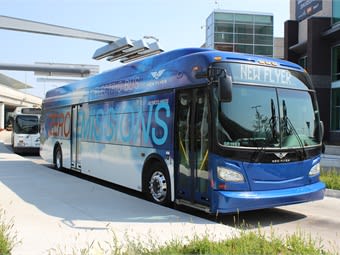
New Flyer has a continuous stream of projects on its Technology Roadmap, which address advancements in diesel, CNG, hybrids, catenary-electric, battery-electric, and fuel-cell-electric drive systems.
Just this past quarter, Paulo Nunes was appointed to the New Flyer Board of Directors pursuant to the Investment Agreement between New Flyer and Marcopolo. Mr. Nunes has deep experience in the manufacturing, distribution and automotive-related sectors, having served in leadership positions for almost 40 years. He is now an independent business consultant and currently serves on the board of directors of Cesbe S.A., a Brazilian construction company, and Marcopolo S.A.
What other types of sustainable projects is New Flyer working on?
Emissions regulations and the drive toward non-carbon based energy has placed a broad and extensive amount of focus on all forms of low- and zero-emission bus propulsion systems. New Flyer has a continuous stream of projects on our Technology Roadmap, which address advancements in diesel, compressed natural gas (CNG), hybrids, catenary-electric, battery-electric, and fuel-cell-electric drive systems.
Each of these propulsion systems has relevancy to specific customers, depending on local market conditions and preferences. From a macro level, this requires a thoughtful approach to our product platform management strategy, but at a micro level our development engineers are highly focused on the smallest of details to optimize the packaging and performance of each of these systems.
Achieving a balanced and forward-thinking pipeline of propulsion systems at New Flyer requires a clear understanding of upcoming regulatory and policy changes, selecting good partners and understanding the specific needs of each of our customers. We pride ourselves as being world class bus system integrators, and we rely on our suppliers’ research and development to complement our internal strengths and capabilities.
We feel operators want to try new propulsion approaches, but also want it on a proven transit vehicle with millions of miles of in-service experience — this is what makes New Flyer’s approach unique with our Xcelsior platform.
Today, we are obviously more focused on zero-emissions technology compared to where we were 10 years ago. However, New Flyer’s journey with CNG, battery-electric and fuel-cell propulsion has been non-stop over the past 20 years. During this period, New Flyer (and NABI) have delivered over 6,000 buses with electric motors, and an additional 6,000 buses with CNG systems to customers throughout North America.
The focused attention on the commercial deployment of battery-electric buses, including the New Flyer Xcelsior XE40, is the outcome of the quantum leap in battery technology over the last five years. The demand has been fueled by the Environmental Protection Agency, the Department of Energy and the Federal Transit Administration (FTA), using grant funding to accelerate pilot deployments. We may see a similar trend with hydrogen, where fuel-cell technology has advanced greatly and pilot deployments sponsored by these same agencies will create demand over time.
One of the challenges today, from an operator perspective, is each battery-electric bus OEM has their own proprietary method of charging the energy storage batteries on the bus, including both on-route fast charging and plug-in charging. New Flyer has taken the lead with the Society of Automotive Engineers and the Electric Power Research Institute and others to develop standards that allow interoperability of the equipment and vehicles. With the likelihood these standards won’t be completed before 2018, we will continue with pilot deployments with transit agencies throughout that period. Afterwards, we expect to see more ambitious fleet deployments with larger metropolitan transit agencies.
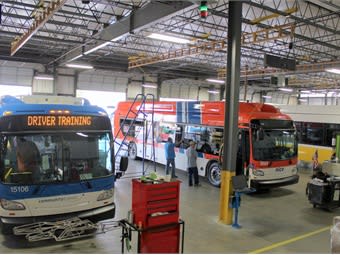
Part of New Flyer’s focus over the last several years is to make each one of its facilities, including its Anniston, Ala. plant, look and feel the same.
One of the technologies that we are working on is with fuel cells — not as a propulsion type but as a range extender. With a fuel cell on board, there’s no need for electrical plug-in or on-route electrical power. The bus has the ability to yield greater operating ranges compared to pure battery-electric buses, and hydrogen fuel tanks on the bus can be refilled in less time than recharging batteries from off-board chargers. We have extensive knowledge and experience of storing hydrogen on the bus, but the infrastructure for hydrogen stations is not currently in place to support refueling in most areas of the country. Perhaps we will see this change.
With much going on since the NABI acquisition, discuss how the changeover has gone as well as your investment into the Anniston plant?
When we acquired NABI in June 2013, we did not yet have a clear plan. We debated operating two separate brands and also did extensive research with customers and analysis on synchronization to one brand.
In June 2014, a year later, we made the decision to proceed with ‘Project United’ to invest $20 million in both capital and operating expenses to migrate the NABI facilities to be capable of building the Xcelsior, using New Flyer operating systems. Employee buy-in in Anniston and a very strong project team have delivered excellent results — better than we expected, quite honestly.
By the end of 2015, the remaining NABI LFW/BRT buses will have been delivered, and we will be 100 percent Xcelsior at all New Flyer manufacturing facilities. The good news is we lost very few people, we’re on a common platform for engineering, supply, manufacturing and customer support, which is allowing us to truly focus.
Our next big effort is what we call ‘Project Convergence,’ or the synchronization of NABI Parts and New Flyer Parts. Again, the goal is a common platform and one team all focused on enhancing our support for customers with spare parts. The right inventory, at the right place and for the right price.
At this point, what do you feel is your biggest challenge at New Flyer?
One external and one internal. Clearly the uncertainty of long-term funding model for FTA programs is a serious concern for our industry, and our customers’ ability to plan fleet renewals.

In June 2014, New Flyer made the decision to proceed with ‘Project United’ to invest $20 million in both capital and operating expenses to migrate the NABI facilities to be capable of building the Xcelsior, using New Flyer operating systems.
Internally, while we have come a long way we must continue to stay universally focused on satisfying our customers and enhancing our competitiveness. We have to be relentless on pursuing innovation for our customers but doing it faster, cheaper and better.
After 85 years in business, our company is built for longevity. Customers rely on New Flyer to adapt to technology changes and support them throughout the life of the bus. We also foresee the trend for customers to take advantages of systems such as New Flyer Connect, our on-board telematics systems and support service, to monitor the bus in real-time, for optimal management, operational efficiency, safety and energy management.
The team at New Flyer wants to continue to lead the industry, not just in size, but having buses that are the workhorse of the fleet, leading through innovation and delivering great customer service.
What is your perspective of the transit industry and the market right now? Are you seeing a growth in bus sales?
For New Flyer, the number of units we will deliver in 2015 will be approximately flat from last year.
We are seeing fleets in the U.S. age and an increase in the number of buses that are older than 12 years or 500,000 miles. The uncertainty of long-term U.S. funding model makes customer fleet planning and renewal a real challenge.
The bottom line is we need to continue to be flexible and adapt to our customer’s needs. They no longer want to wait a year to get new buses in their fleets, and we need to have systems that allow us to work to their schedules, not ours.
Subscribe to Our Newsletter
More Management

METRO Opens Submissions for 2026 Motorcoach Awards
Nominations are now being accepted for METRO Magazine’s Operator of the Year and Innovative Operator of the Year awards.
Read More →
New York MTA Advances Final Contract for Second Avenue Subway Expansion
Contract Four is the largest in the Second Avenue Subway Phase 2 project and includes construction of station infrastructure, tracks, and signals for the subway expansion, MTA officials said. Work on Contract Four will begin in 2027.
Read More →
Transit Agencies Highlight Safety Gains at National Summit
Leaders from 15 major transit systems shared crime-reduction results and safety initiatives while discussing the role of continued federal support.
Read More →

NITA Names New Leadership, Expands Reduced-Fare Program at First Board Meeting
The new regional transit authority appointed its first board chair and interim executive director while extending reduced fares across CTA, Metra, and Pace for eligible riders.
Read More →
Beyond the Checklist: A Structured Approach to Transit Maintenance
Reliability-Centered Maintenance helps transit agencies move beyond routine checklists to focus limited resources on the assets and failures that have the greatest impact on safety, reliability, and service.
Read More →
APTA 2026 Nominating Committee Selects Leadership Slate, Names Chair and Vice Chair Nominees
Leadership changes will help shape the association’s priorities and its representation of the transportation industry during the 2026–2027 term.
Read More →
DART Launches Major Security, Fare Enforcement Initiative
The 90-day demonstration will deploy coordinated security teams at five light rail stations while testing controlled access and gathering data to guide future investments.
Read More →
Sponsored•September 9, 2026
Advancing Fare Collection Through Technology and Innovation
Learn about delivering 1300 gates at 91 stations while managing fare evasion. Explore the large scale deployment, solution customization and real-world results that affect the region. Prepare for deployment in your region now.
Read More →
Game Day in Motion: Moving Millions During the 2026 World Cup
Between packed transit stations and team motorcoaches, see how agencies and operators across North America tackled the transportation demands of the 2026 FIFA World Cup.
Read More →
Surface Transportation Extension Averts Shutdown, Leaves Transit Funding Gap
The stopgap keeps federal transportation programs moving, but missing advance funding could complicate the transit and rail projects agencies are planning next.
Read More →