



King County Metro, MV Transportation Win Innovative Solutions Award for Accessibility
King County Metro (KCM) and MV Transportation developed and implemented a new multi-tenant GIS recording and reconciliation system to collect, process, and distribute pathway data: CommonPaths.

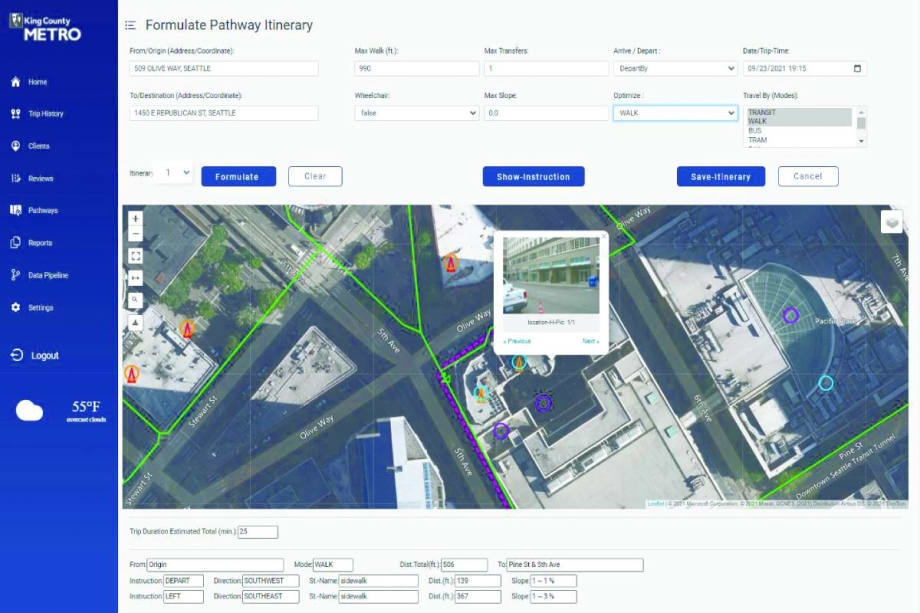
CommonPaths can collect and serve high-fidelity detailed pedestrian pathway information in a standardized and computable format.
Photo: King County Metro
Now in its seventh year, the Innovative Solutions Awards honors bus operations and their supplier partners who have implemented initiatives that helped them save money, run more efficiently, streamline operations, increase safety, improve customer satisfaction, increase ridership, and more.
METRO’s staff would like to thank everyone who applied, and congratulations again goes to all our winners.
Planners have historically struggled with gathering and defining high-quality data about sidewalk conditions and the usability of a pathway network for pedestrians, including for those users with disabilities.
To overcome these barriers, King County Metro (KCM) and MV Transportation developed and implemented a new multi-tenant GIS recording and reconciliation system to collect, process, and distribute pathway data: CommonPaths. CommonPaths can collect and serve high-fidelity detailed pedestrian pathway information in a standardized and computable format. It can accurately describe and translate pedestrian pathway data and serve the data in a usable and actionable format for consumption by various users of differing ability. This platform was built in partnership with the University of Washington’s Taskar Center for Accessible Computing Technology and its OpenSidewalks project. The OpenSidewalks project seeks to ensure data consistency and longevity with OpenStreetMap, open standards, and open technology.
CommonPaths enriches pathway data by integrating data from the crowdsourced and community data-governed OpenStreetMap, calculating the slope gradient from USGS Digital Elevation Model, and reviewing it using a field assessment mobile app. Data collected and distributed via the CommonPaths application can serve as the basis for automated accessibility condition analysis across an entire region, pedestrian network connectivity analysis for a variety of user mobility conditions, and provide granular and automated pedestrian pathway navigation instructions similar to what vehicle experience today through in-vehicle GPS units, according to KCM and MV officials.
Development began in late 2019 on the solution architecture and workflow that would include identifying possible pedestrian routes and transit system routes for candidate riders, a tablet device for capturing and accessing detailed pedestrian pathway route characteristics in the OpenSidewalks data standard, and a personal travel training approach with each candidate. The first release of CommonPaths was completed in early 2021, serving KCM and the Seattle and Puget Sound region. With its mobile and scalable architecture, MV has subsequently expanded the scope and functionality for additional cities and is promoting to transit agencies nationally as “MV Pathways.”
CommonPaths overcomes the “siloing” of pedestrian data by leveraging OpenStreetMap and realizing collaboration between the public and public agencies. It enables jurisdictions and agencies to integrate proprietary or sensitive data into a single framework that seamlessly assimilates input from the public, as they report a change in conditions or new conditions emerge. This ensures that all participants in the system and the public benefit from the others’ efforts, thereby eliminating redundant data collection by overlapping jurisdictions and providing immediate value for the public through regular updates to the core dataset: OpenStreetMaps. At its core, this system is allowing the flow from community collected and validated data to the pathway program and field-validated pathway program data back to the public for validation.
“Traditional transit contracts involve a set number of road hours or operators and/or vehicles with the contractor responsible for operations, maintenance, and key performance measures, such as OTP and customer service,” explain MV Transportation officials. “While MV’s partnership with King County involves many of these same attributes, we also share responsibility for helping Metro achieve their overall vision and objectives for serving the Seattle area — which in relation to CommonPaths was a vision to continue to enhance mobility options for the community.”
CommonPaths’ novel approach to pedestrian pathway data collection has revolutionized the way KCM collects data and assesses pathways in the built environment, which will lead to more accurate routing instructions for pedestrians and enable new tools and analysis techniques for measuring transit system accessibility, while reducing overall cost, complexity, and uncertainty for the agency.
“King County Metro’s vision for improving mobility has provided our teams with a North Star to rally around and successfully collaborate in an unconventional way to create CommonPaths,” KCM officials explain. “We are pleased not only with the value delivered by the solution — but more importantly that it has enhanced the lives of the individuals in the program, enabling people the flexibility to reach jobs or activities on their own.”
More Technology

New York MTA Launches Historic $1.9B Signal, Track Modernization Project
Funded in part by congestion pricing revenue, the project will replace nearly century-old signals along the A and C lines in Brooklyn and Queens.
Read More →
Biz Briefs: New Electric Offering from Alexander Dennis/Volvo, Transdev in Boston, and More
In METRO's latest installment, we also take a look at recent news from STV, WSP, Prevost, and more partnerships making headlines across the transportation sector.
Read More →
Roman Cornell on ABC Companies’ Evolution and the Future of Passenger Transportation
The company’s CEO discusses carrying forward a third-generation family legacy, ABC’s continued evolution in passenger transportation, support for increasingly complex fleets, and how technology and continued investment could help operators improve uptime.
Read More →
ETA CEO John Maglio on Transit Technology, Innovation, and Building Agency Trust
ETA founder and CEO John Maglio explores the evolution of transit technology, the importance of reliable systems, and how stronger partnerships can help agencies improve operations and the passenger experience.
Read More →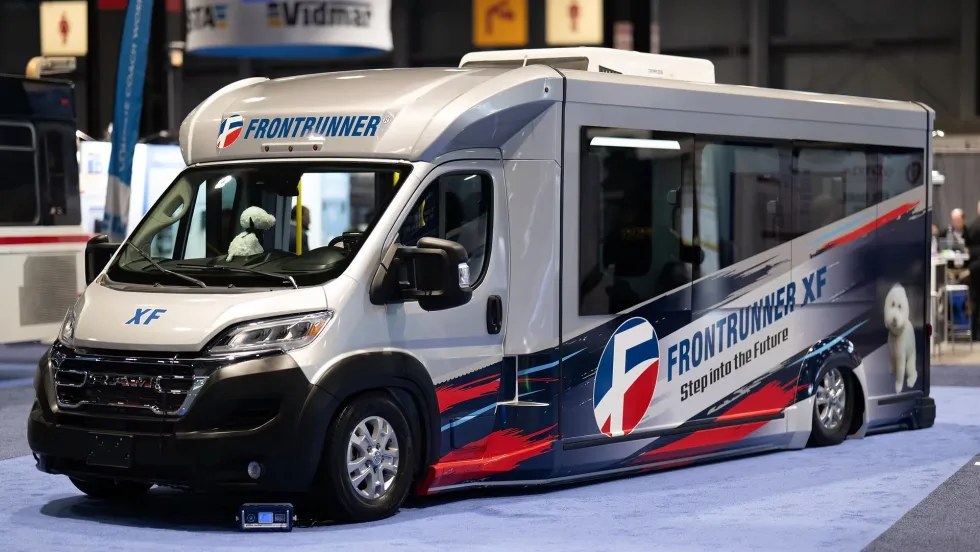
Frontrunner Bus Group Introduces XF Low-Floor Bus with Enhanced Accessibility
The new mid-sized bus features a full flat-floor design, eight-inch curbside step-in height, and zero-entry rear ramp to improve passenger access and operational flexibility.
Read More →
Building a Flexible Path to Transit Electrification with BAE's John Hroncich
John Hroncich discusses BAE Systems’ modular and scalable approach, lessons learned from decades of real-world operations, and how agencies can identify electrification strategies that fit their fleets.
Read More →
Scenes from APTA TRANSform & EXPO 2026
Transit leaders, manufacturers, and industry professionals gathered in Chicago to explore new technologies, share ideas, and discuss the future of public transportation.
Read More →
Biz Briefs: New Flyer Secures Additional 100-Bus Order from WMATA and More
In METRO's latest installment, we also take a look at recent news from Masabi, MCI, Samsara, and more partnerships making headlines across the transportation sector.
Read More →
MTA Fare Gate Pilot Reduces Fare Evasion by 35%
Following a 20-station pilot, the agency plans to install new fare gates at 20 additional subway stations as part of a $1.1 billion modernization initiative.
Read More →
California Law Extends AC Transit’s Bus Lane Camera Enforcement
The new law allows AC Transit to continue using forward-facing bus cameras to enforce parking violations in bus-only lanes and at bus stops.
Read More →