



Biz Briefs: Electric Shuttles in Hawaii, STV and LA Metro's Clean Bus Program, and More
From strategic partnerships to acquisitions and service expansions, the industry continues to evolve at a rapid pace.

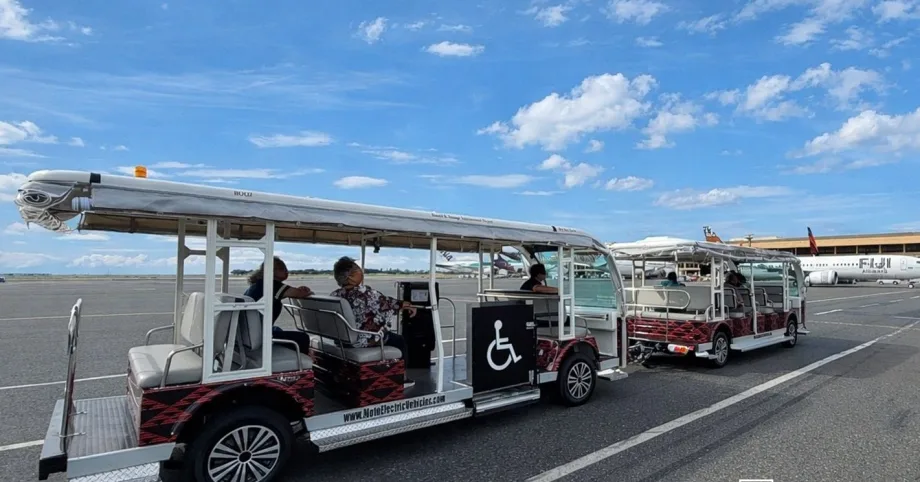
The Wiki Wiki Shuttle at HNL is the airport's free intra-airport shuttle that connects terminals and concourses.
Sustainability Partners
- STV is collaborating with Metro to enhance the performance of America's largest clean-air bus fleet in Los Angeles County.
- The project seeks to reduce bus breakdowns, extend vehicle lifespans, and prepare for next-generation clean transit technologies.
- Efforts will include refining maintenance practices, analyzing performance data, and ensuring smooth network operations to minimize service disruptions.
*Summarized by AI
From strategic partnerships to acquisitions and service expansions, the industry continues to evolve at a rapid pace.
In this edition of Biz Briefs, we highlight the latest developments shaping the future of mobility — from manufacturers and technology providers to transit agencies and motorcoach service operators. Stay informed with these quick takes on the projects and companies driving progress across the transportation landscape.
In METRO's latest installment, we take a look at the latest news from suppliers including Trapeze, Greyhound, Sustainability Partners, and more.
STV Solutions to Support America’s Largest Clean-Air Bus Fleet
STV announced that it is part of a team that has been awarded a contract by the Los Angeles County Metropolitan Transportation Authority (Metro) to help improve the performance of its bus fleet–the largest clean-air bus fleet in the nation, with more than 2,000 buses delivering over 800,000 rides a day.
The project aims to reduce breakdowns, extend vehicle lifespans, and prepare the agency for its transition to next-generation clean transit technologies.
STV and its partners will support Metro in bolstering the network’s reliability, including Metro’s legacy compressed natural gas (CNG) vehicles and its growing fleet of electric buses. The team will use its technical expertise to help Metro fine-tune maintenance practices, analyze performance data, and make process improvements that keep buses running smoothly and reduce the risk of service disruptions or delays. Working in partnership with Metro staff, STV will help strengthen fleet performance today while supporting the agency’s long-term modernization goals.
Trapeze Group Rebrands European Business
Trapeze announces it has rebranded its European businesses, launching four dedicated public transport technology brands.
The move restructures Trapeze’s activities in Intermodal Transport Control Systems, fixed-route planning and scheduling, bus driver allocation, and public transport data management into distinct entities operating under the names ebblo, Grampian Solutions, Naviquate, and Nexfeld.
The companies officially operate within Modaxo, the global collective of people transportation technology businesses owned by Constellation Software.
Honolulu Airport Wiki Wiki Shuttle Adds 3 Electric Transit Trams
Sustainability Partners, a public benefit company that helps public entities fund, deploy, and maintain sustainable infrastructure through as-a-service delivery models, has delivered three Moto Electric transit trams with trailers (MotoEV Electro Transit Buddy) for the Wiki Wiki Shuttle service at Daniel K. Inouye International Airport (HNL), in collaboration with the State of Hawai'i fleet electrification contract.
The Wiki Wiki Shuttle at HNL is the airport's free intra-airport shuttle that connects terminals and concourses. The new electric trams, which will transport domestic travelers, support the airport's on-site passenger movement and advance the State's transition to lower-emission ground transportation.
The project was delivered through Sustainability Partners' Electric Vehicles as a Service (EVaaS) offering. This as-a-service approach helps public entities adopt electric vehicles by addressing common barriers, including vehicle procurement, customization, and charging infrastructure coordination. Through EVaaS, Sustainability Partners supports agencies with programmatic delivery and long-term maintenance to scale fleet electrification, according to the company.
In METRO's latest installment, we take a look at the latest news from suppliers including Trapeze, Greyhound, Sustainability Partners, and more.
METRO
Hitachi Rail Invests in New Canadian Headquarters
Hitachi Rail announced that it is investing approximately $22 million in a new state-of-the art Canadian headquarters in Toronto.
The new HQ hosts Hitachi Rail’s Global Communications-Based Train Control (CBTC) Competence Centre, which provides the engineering and technical expertise around the world. This new announcement builds on an approximate $73 million commitment to develop SelTrac G9, the next generation of cutting-edge rail signaling technology from this new office.
The new headquarters spans 125,000 sq. ft. across 5.5 floors and will be the base for 1,100 Hitachi Rail employees and 100 paid interns. The office is located in Consilium Place in Toronto’s Scarborough district and is due to open officially in summer 2026.
Greyhound Looking to Make Celebrating America’s 250th Easier.
As the US prepares to mark its 250th anniversary, Greyhound is making it easier for more people — especially those in rural areas and without access to a car — to take part in this once-in-a-generation celebration.
With affordable fares and a coast-to-coast network serving thousands of destinations, Greyhound offers a reliable, simple way for travelers to explore America, including 250 events, historic sites, and hometown festivities, said the company in a press release.
To help travelers discover, plan, and book trips for the Semiquincentennial anniversary, Greyhound has added The America 250 Travel Hub to its website, which includes:
- Themed itineraries for history lovers, road trip explorers, and small-town travelers.
- Tips for traveling without a car, including multi-stop trip ideas.
- Spotlights on parades, exhibitions, and community celebrations.
- New content will be added throughout 2026 as programming expands.
Quick Answers
The primary goal of STV's involvement is to improve the performance of Metro's clean-air bus fleet, reduce breakdowns, extend vehicle lifespans, and prepare for the transition to next-generation clean transit technologies.
*Summarized by AI
More Technology

From Hardware to Digital Partner: Luminator Charts Its Next Chapter
CEO Magnus Friberg discusses Luminator’s shift toward becoming a digital partner, the growing importance of software and interoperability, and how AI can help agencies improve operations and passenger experience.
Read More →
Beyond the Checklist: A Structured Approach to Transit Maintenance
Reliability-Centered Maintenance helps transit agencies move beyond routine checklists to focus limited resources on the assets and failures that have the greatest impact on safety, reliability, and service.
Read More →
NJ TRANSIT Advances Bus Technology Upgrades Across Statewide Fleet
More than 1,500 buses now feature upgraded technology designed to improve arrival predictions and provide free Wi-Fi, with deployment expected to reach nearly 2,000 buses by the end of 2026.
Read More →

Building a Flexible Path to Transit Electrification
John Hroncich discusses BAE Systems’ modular and scalable approach, lessons learned from decades of real-world operations, and how agencies can identify electrification strategies that fit their fleets.
Read More →
Biz Briefs: Alstom Lands Canadian Contract, LYT to Supply California TSP, and More
In METRO's latest installment, we take a look at recent news from Complete Coach Works, Beep, FlixBus, and more partnerships making headlines across the transportation sector.
Read More →
From Legacy Silos to Conversational Intelligence
What if transit leaders could ask any operational question and get a trusted answer in seconds? Conversational AI is transforming how agencies use their data.
Read More →
USDOT Announces Rail Vehicle Replacement Grants, Chattanooga AV Shuttle Funding
More than $191 million in federal funding will help three transit agencies replace aging rail vehicles and support a new autonomous shuttle service in Chattanooga.
Read More →
Bus Tech Talk: Keeping Transit Technicians Ahead of the Technology Curve
LA Metro’s Obed Mejia discusses technician training, evolving maintenance technology, fleet replacement, and strategies for getting the most out of today’s transit fleets.
Read More →
Biz Briefs: RIPTA Unveils New Frontrunners, Clevland RTA Adds New Siemens, and More
In METRO's latest installment, we take a look at recent news from Siemens, Prevost, Dodge, and more partnerships making headlines across the transportation sector.
Read More →
Why Simulating Pedestrian Movement Has Become Essential for Modern Rail Stations
Pedestrian microsimulation is helping rail planners identify bottlenecks, test station designs, and prepare complex transit hubs for growing passenger volumes.
Read More →